What a B.Sc. Degree in Economics Can Do for Your Career That a BA Simply Can't
Blog / April 09, 2026
Most students pick Economics and move on. The subject is interesting, the career options seem broad, done. What almost nobody stops to check is whether they are enrolling in a BA or a B.Sc. That one letter makes a genuinely large difference, and not knowing it has cost people a lot.
This is not about prestige or rankings. A BA in Economics and a B.Sc. degree in Economics are structurally different programs. One leans on theory, history, and ideas. The other is built around maths, data, and technical modelling. Both are legitimate. But if you want to sit in a Ph.D. interview, work a quant role, or run economic models at a central bank, one of them will prepare you, and the other mostly will not.
The earlier you understand this, the better your decision gets.
So What Is Actually Different?
In short, a BA teaches you how economists reason, while a B.Sc. trains you to do what economists do with data. This is the core difference between BA in Economics and B.Sc. in Economics, and it shapes everything that follows.
That gap is wider than it sounds. Here is what it looks like in practice:
Feature | B.Sc. Economics | BA Economics |
Primary Focus | Scientific modelling and quantitative analysis. | Qualitative social science and theory. |
Maths Depth | Heavy- calculus, linear algebra, differential equations, optimisation. | Basic- intro stats and simple calculus. |
Methods | Econometrics, STATA, EViews, R. | Theoretical and institutional analysis. |
Where It Takes You | Quant finance, data science, policy research. | Journalism, PR, general management. |
The maths requirement is really the thing. Multivariable calculus, linear algebra, and real analysis. Not because someone decided economists should suffer, but because the work at the technical end of the field genuinely requires it. If you cannot read an econometric model, you cannot produce one. And if you cannot produce one, a large part of the job market simply will not look at you.
That is not gatekeeping for its own sake. It is just how the filtering works in practice.
What You Actually Study in a B.Sc. Degree in Economics
The core curriculum covers five areas. They build on each other, so the sequence matters.
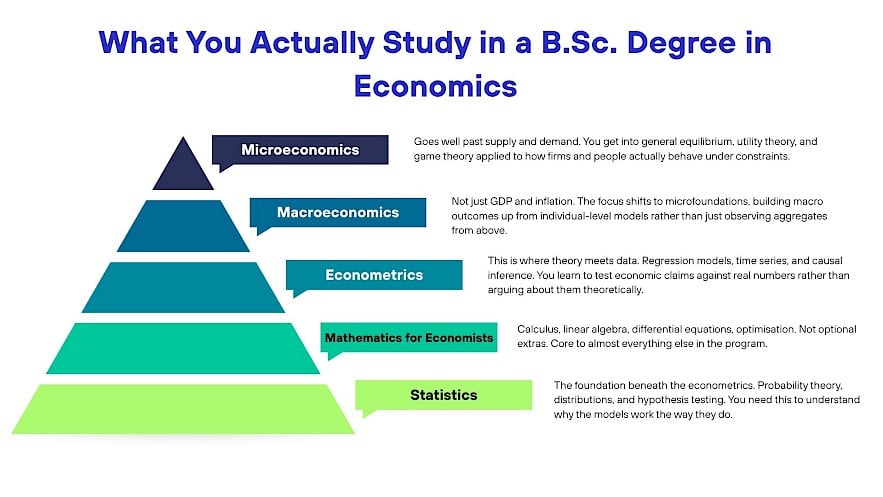
Beyond the core, most programs let you specialize in applied health economics, labour economics, and international trade. These electives matter, but they sit on top of the quantitative foundation. Without it, the applied work stays shallow.
The software training is also worth mentioning specifically. STATA, EViews, R. Learning these in a structured setting with real datasets is not the same as watching a tutorial. By the time a B.Sc. student graduates, they have produced an actual analysis. That is what moves you from being someone who understands economics to someone who can work with it professionally.
Where This Degree Takes You
Three sectors come up repeatedly when B.Sc. graduates are placed well. They are worth understanding individually rather than just listing them.
- Central Banking & Policy- These are the premier employers for B.Sc. graduates. Central banks demand technical economists capable of macro-modeling and risk assessment to navigate a volatile global economy.
- Corporate Data Analytics & Finance—Private firms pay a significant premium for quantitative literacy, specifically for roles involving market modeling and financial economics.
- International Development & NGOs—Statistical methods are the current gold standard for impact evaluation, making B.Sc. graduates essential for measuring the success of global projects.
Shiv Nadar University (Institution of Eminence) - Setting a New Standard in Economics Education
Many B.Sc. degrees in Economics sound quantitative on paper but often remain largely theoretical in practice. This is where Shiv Nadar University’s B.Sc. (Research) in Economics differs. The program is designed around mathematical modelling, econometrics, as well as research-led learning, aligning closely with what a true B.Sc. degree in Economics is expected to deliver.
A few things set it apart-
- Research-active faculty- Faculty in the Department of Economics engage in development economics, macroeconomics, applied microeconomics, and econometrics, connecting teaching with real-world research applications.
- Quantitative-first curriculum- The program integrates microeconomics, macroeconomics, and econometrics with mathematics and statistics, emphasizing skills in calculus, probability, optimization, and data analysis.
- Built-in research experience- The B.Sc. (Research) program culminates in an undergraduate thesis guided by expert faculty, providing students with hands-on research experience and econometric tool application.
- Flexible career pathways- Besides the standard track, students can pursue a B.Sc. (Research) in Economics and Finance, combining economics with finance and offering industry internships for corporate roles.
- Interdisciplinary learning environment- The program allows for courses in mathematics, data science, and management to enhance analytical and computational skills beyond traditional economics.
If you are looking for a B.Sc. degree in Economics that emphasises data, modelling, and research, Shiv Nadar University's course offers a clearer pathway into analytics, finance, policy, and postgraduate study. Apply now!
Conclusion
Pick the BA if you want a broad overview of economic ideas and you are heading toward journalism, policy communication, general management, or a non-technical graduate program.
Choose the B.Sc. Degree in Economics if you want to work with data, run models, enter a Ph.D. program, or compete for analytical roles in finance or policy institutions. The two degrees are not equal for those second purposes. They were never designed to be. Understanding that before you apply is genuinely useful, while afterward is considerably less so.
Your choice of degree directly affects your finances and future options. First, identify which options are important to you. Then, choose the degree that will help you achieve those goals.
FAQs
- What is the scope of B.Sc. Economics?
A B.Sc. Degree in Economics opens paths in quant finance, data analytics, policy research, and academia by equipping you with mathematical modelling and econometric skills.
- Is economics very math heavy?
B.Sc. Economics is math-intensive, requiring calculus, linear algebra, and statistics because real economic modelling and data analysis depend heavily on quantitative methods.
- Is B.Sc. in Economics easy?
B.Sc. Economics is not easy. Its rigorous mathematical and statistical foundation makes it challenging, especially for students without strong quantitative aptitude.
- Where can I work with a B.Sc. in Economics?
Graduates work in central banks, financial firms, consulting, data analytics, and international organisations where economic modelling and data-driven decision-making are essential.
- Is B.Sc. Economics in demand?
Yes, B.Sc. Economics graduates are in demand due to their quantitative skills, especially in finance, analytics, and policy roles that require data interpretation and modelling.