From Gallery Walls to Global Stages: What a Master's in Fine Arts Really Opens Up
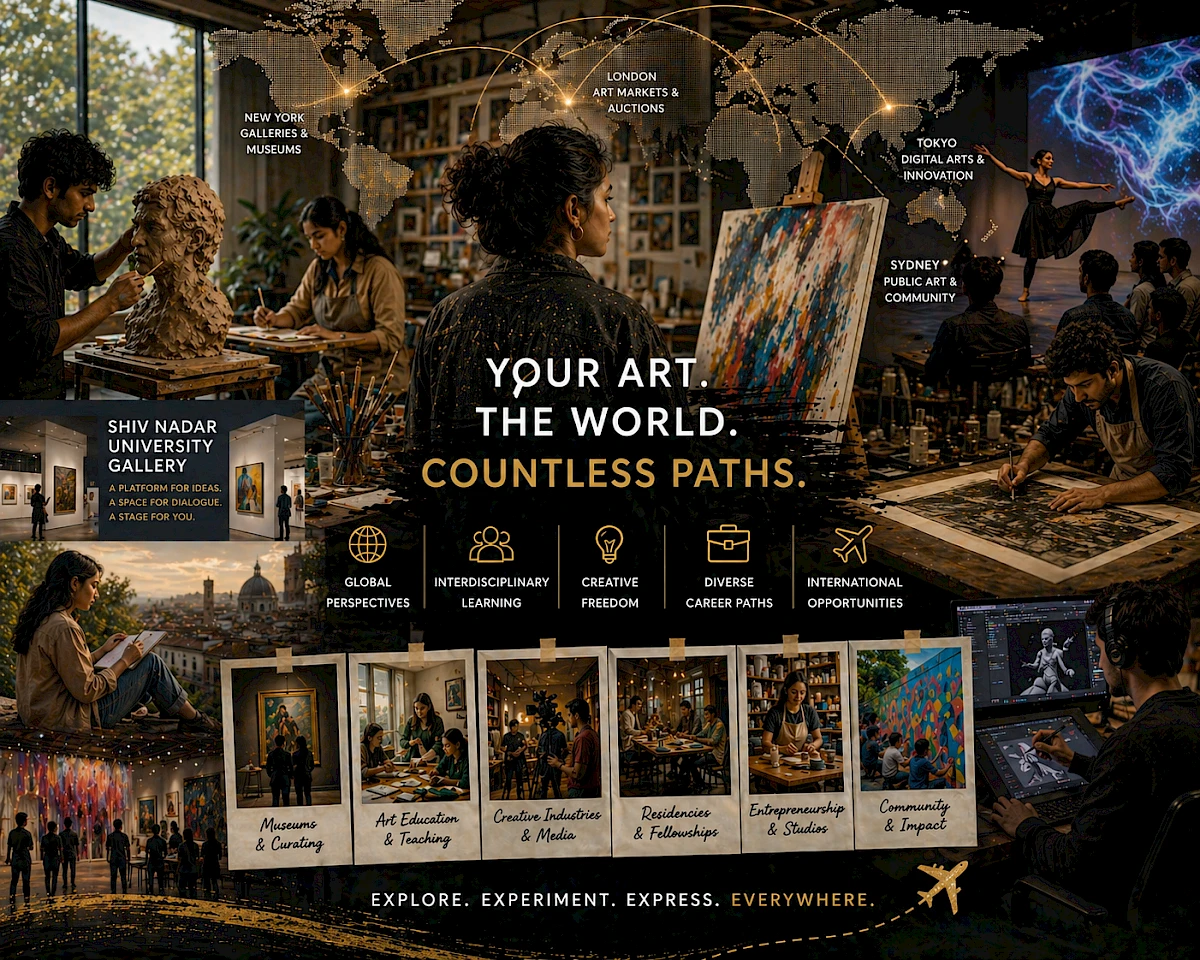
Blog / April 17, 2026
For many aspiring creatives, the decision to pursue a Master’s in Fine Arts (MFA) is often haunted by a persistent cultural ghost- the myth of the "starving artist." The common fear is that a graduate degree in the arts is an expensive detour leading to a professional dead end, characterized by financial instability and underemployment. This narrative suggests that while other master’s degrees are investments in human capital, the MFA is merely a luxury of personal expression.
However, data from major arts institutions suggests a vastly different reality. For instance, comprehensive employment surveys of arts alumni from institutions like MassArt show that 81% of graduates are employed in fields directly or somewhat related to their major. Far from being a professional "black hole," the arts sector is a robust component of the global creative economy. In this world, skills in visualization, material engagement, and critical thinking are not just hobbies; they are high-demand professional assets.
The shift from seeing oneself as a "struggling creative" to a "creative professional" is the first and most vital step toward a global career. Today’s MFA programs are designed to facilitate this mindset shift, moving away from the isolated studio model and toward a professionalized framework that views art as a rigorous form of research. To understand why this degree is a strategic career move, we must look at what a contemporary MFA actually entails beyond the canvas.
Beyond the Studio- What a Master's in Fine Arts Really Is
A contemporary MFA is not simply "more art school." It is a "terminal degree", which positions the graduate as both an expert practitioner and a qualified researcher. Unlike the undergraduate experience, which focuses heavily on technical skill-building, the MFA blends practice with theory, emphasizing "making as thinking."
Analytical frameworks from leading programs define the MFA as an intersection of art practice and scholarly inquiry. This approach moves beyond the creation of artistic objects and focuses on the generation of "generative discourses." In simpler terms, this means creating a sophisticated conversation around the work that inspires new ideas in others. Art becomes more than a silent object; it becomes a catalyst for dialogue and new ways of thinking.
By treating the artistic process itself as a form of research, students learn to conduct rigorous examinations of the human condition through material engagement. This "process as art" model prepares students for a world where critical thinking and adaptability are the primary currencies. In a global economy where industries are constantly disrupted, the ability to engage with "unsettled" work and navigate uncertainty is an invaluable asset.
Breaking the "Starving Artist" Myth- Career Paths Beyond Galleries
The economic viability of an arts degree is often obscured by the high-profile nature of gallery sales, which represent only a fraction of the creative economy. When we look at data-driven outcomes, a much more stable and diverse picture emerges.
Theme | Traditional Perception | Data-driven Reality |
Employment | High rates of chronic unemployment among arts graduates | 70-75% of arts/design graduates find employment in related fields within 1-2 years (NASSCOM Creative Economy & NID alumni surveys) |
Work Structure | Reliance on unstable freelance or gig work only | 55-60% work with studios, agencies, or firms; 40-45% are self-employed or freelance |
Earning Potential | Stagnant, low-income, with little growth | Median CTC by experience level:
|
Career Scope | Narrow focus on selling paintings or gallery shows | Diverse roles across UX/UI design, ed-tech content, game art, film & OTT production, advertising, fashion, cultural institutions, and academia |
The Master of Fine Arts in Painting- Depth, Materiality, and Evolution
While the creative economy is vast, the specialized Master of Fine Arts in Painting remains a cornerstone of the discipline. However, at the graduate level, painting is rarely just about pigment on canvas. It is a deep dive into materiality and the evolution of a personal visual language.
Consider the example of artist Kate Bonner. During her MFA studies, her practice underwent a total transformation, evolving from traditional drawings into complex "photographic-sculptural objects." This is exactly what gallerists and curators look for.
As dealer Haynes Riley notes, the value of the MFA lies in seeing work that is "unsettled." Gallerists are not looking for artists who have simply polished existing skills; they value those who use graduate school to transform their practice and look toward the "not quite known" future of their work. This willingness to move from the known to the unknown signals an intellectual depth that forms the basis of a sustainable, long-term career.
The Strategic Edge- Why an MFA is Not Just "BFA Part Two"
The transition from a Bachelor of Fine Arts (BFA) to an MFA represents a shift from "skill-building" to "career-architecting." While the BFA provides the tools, the MFA acts as a professionalization engine. In a longitudinal study of graduate students at a large research-intensive institution, researchers identified a "Hidden Curriculum"- the professional literacies that aren't found in a basic syllabus-
- Terminal Degree Status- Essential for the academy, this provides the eligibility for tenure and the credibility to lead institutional research.
- Professional Identity- The graduate environment builds confidence, allowing students to move from being "students of art" to becoming professional researchers and instructors.
- Cross-Disciplinary Literacy- MFA students learn to talk to professionals outside of their specific silo. This ability to communicate across disciplines—from the sciences to the humanities—is essential for securing high-level collaborations and funding.
Navigating the Art World- Networking and the "Hidden" Benefits
One of the most significant benefits of an MFA program is the pre-built social network it provides. As the study authors in the To Improve the Academy journal noted-
"One of the greatest benefits of the program is the sense of community during arguably the most challenging phase of one’s PhD [or MFA] life."
This community is the engine of professional opportunity. Gallerists and curators frequently use MFA programs as scouting grounds. This happens through several key platforms-
- Open Studios- These events provide gallerists with the chance to see a large "bulk" of work in person, offering a direct line of access that is difficult to achieve independently.
- Peer Recommendations- As Chicago gallerist Efrain Lopez notes, "Talented artists surround themselves with other talented artists." Word-of-mouth within a respected MFA cohort is a primary way dealers discover new talent.
- Residencies and Art-Adjacent Roles- Many students gain exposure through roles as assistants or art handlers within the gallery system. In these environments, "two degrees of separation" often becomes "zero degrees" very quickly.
Master of Fine Arts at Shiv Nadar University (Institution of Eminence) - A Program Built for the Artist of Tomorrow
Shiv Nadar University offers a world-class Master of Fine Arts program that exemplifies this modern, strategic approach. Situated within a multidisciplinary research environment, the program is designed for the artist who wishes to impact the global creative economy. Some key highlights of the program include-
- Interdisciplinary Approach- Based in the School of Humanities and Social Sciences, the Department of Art, Media, and Performance offers students interdepartmental access. This facilitates dialogues between art, technology, and philosophy, ensuring graduates can operate in multifaceted professional environments.
- The Curriculum- This two-year, studio-based model focuses on "making/doing as thinking." Students engage with current topics like "Ecology and Digital Media" and culminate their studies with a Solo Project/Exhibition and a written dissertation.
- Faculty Mentorship- Students receive one-on-one guidance from active practitioners and scholars, such as Dr. Aadya Kaktikar (Dance), Professor Atul Bhalla, and Dr. Iram Ghufran (Documentary Practice). These mentors guide research in specialized areas like "Art in Public Domain- Intervention and Action."
- Facilities & Support- To bridge the gap between graduation and professional life, Shiv Nadar University offers a Visual Art Fellowship. This prestigious fellowship provides graduating students with a year of on-campus residency and studio access, serving as a vital launchpad to "push their frontiers" and refine their craft.
Shiv Nadar University’s pedagogy emphasizes that art is a tool for "emancipatory change." By teaching artists to challenge social constructs, the program prepares them to be leaders who can (re)configure perspectives in the wider world.
Conclusion- The Future of Your Practice
An MFA is more than a degree; it is a total transformation of the self into a professional researcher and practitioner. It moves the artist beyond the "starving" myth and into a reality where their work is a vital contribution to the global creative economy. By providing the time, space, and community to conduct rigorous critical examinations, the MFA prepares you to navigate a career that is as intellectually deep as it is financially viable.
In an era of rapid change, art has the unique power to (dis)locate existing narratives and (un)assemble preconceived notions. As you consider your future, the question is no longer "What can you do with an art degree?" but rather, "What narratives do you intend to reshape?" The contemporary MFA is designed to give you the tools not just to see the world, but to provide the creative leadership needed to change it.
FAQs
- What can you do with a Master's in Fine Arts?
An MFA opens diverse careers across galleries, design, film, education, and digital industries, positioning artists as creative professionals contributing to the global creative economy.
- Can I get a job with an MFA?
Yes, MFA graduates find roles in studios, agencies, academia, and creative industries, with many also pursuing freelance or interdisciplinary careers within the expanding creative economy.
- What is the salary of an MFA graduate in India?
MFA graduates in India earn ₹3-5 LPA initially, growing to ₹7-12 LPA mid-career, with senior professionals reaching ₹15-25 LPA across creative industries.
- What is the MFA qualification?
An MFA is a terminal degree combining studio practice with research, qualifying graduates as professional artists, educators, and interdisciplinary thinkers within the global art and creative industries.
- Is there a Master's degree in Fine Arts?
Yes, a Master’s in Fine Arts is a postgraduate degree focused on advanced artistic practice, critical research, and professional development within contemporary creative and cultural industries.