What Exactly Happens Inside a B.Des. Course That Makes Graduates Think So Differently?
Blog / April 21, 2026
The persistent aesthetic myth surrounding design masks a rigorous cognitive architecture. While the uninitiated often mistake a B.Des. course for a vocational training ground in "making things look good," the modern curriculum functions as a fundamental engine for systems thinking and high-stakes problem-solving. It is a transition from cosmetic application to strategic intervention.
In an era defined by volatility, design has evolved from raw creativity into "refined intent." B.Des. graduates are not merely artists; they are trained orchestrators of social, ethical, and technological complexity. This evolution ensures that the designer’s role is no longer to simply observe the world, but to lead the charge in simplifying its most pressing challenges.
The following analysis explores how the B.Des. curriculum transforms a student’s cognitive toolkit over four intensive years.
The 4-Year Journey- From Fundamentals to Futures
Building "design resilience" requires a phased pedagogical approach. This roadmap ensures that students build a deep understanding of the human condition before they ever touch software or coding. In the first year, focusing on Social Sciences like Psychology and Sociology is critical; one must understand the fabric of human behavior and culture before attempting an ethical intervention within it.
Year-by-Year Curriculum Breakdown
Year | Strategic Focus | Core Components |
Year 1 | Foundations & Social Context | Applied fundamentals of Society, Culture, Psychology, and Sustainability; Foundational Design. |
Year 2 | Technology Integration | Applied Electronics, Software, Coding; Collective Group Design Projects; First Summer Internship. |
Year 3 | Integrated Research & Management | Design Research, Future Tech (AI/VR); Decision point for B.Des. vs. 5-year Integrated B.Des.–M.Des. path. |
Year 4 | Choice-Based Specialization | Streamed Electives; Semester-long Industry Project; Second mandatory 8-week Summer Internship. |
This journey is punctuated by two required summer internships (minimum of eight weeks each), which bridge the gap between academic theory and the grit of professional practice.
The Three Specialization Streams- Precision in Practice
In a volatile job market, the value of "choice-based streaming" cannot be overstated. It allows students to move beyond generalist knowledge to develop a specific design vocabulary tied to high-growth career sectors. Each stream is an intensive deep dive into methods, tools, and project experiences that define professional excellence.
B.Des. Specialization Pathways
Stream | Focus Area | Key Courses/Topics |
Experience Design (UI-UX) | Digital products, Intangible Interfaces, and Service Design. | AR/VR, IoT, Usability Testing, Information Design, Interaction Design. |
Product-System Design | Physical-digital ecosystems and the environment. | Smart Product Design, Mobility, Tangible Interfaces, System Thinking. |
Visual Communication Design | Brand storytelling, narrative, and meaning. | Typography, Animation, Packaging Design, Campaign, and Motion Graphics. |
These specializations ensure that graduates enter the workforce not just as designers, but as specialists who understand the nuances of their chosen domain.
The B.Des. Edge- Why Design Graduates Think Differently
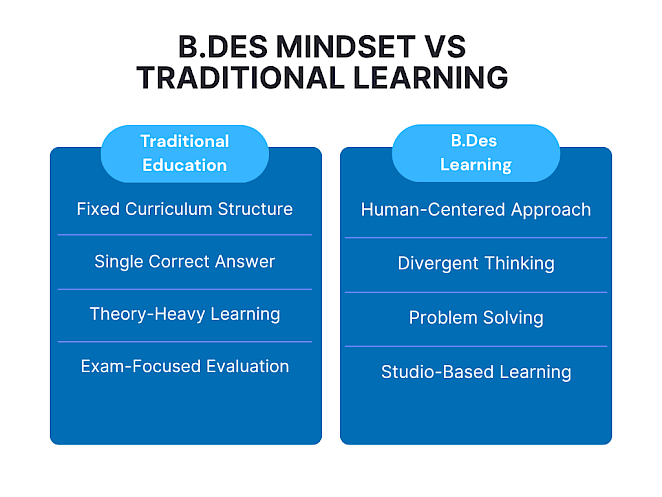
The most profound outcome of a B.Des. course is the cognitive choreography between convergent and divergent thinking. While traditional education often over-prizes convergent thinking, finding the single "correct" answer, designers are trained to lead with divergent thinking. They expand the search for ideas, treating barriers as opportunities and asking "Why not?" This is not a replacement for logic, but an ongoing cycle where divergent exploration is followed by convergent analysis to narrow down the most viable solutions.
The key differentiators of this mindset include-
- Human-Centered Design (HCD) Philosophy- A B.Des. teaches students to co-create solutions by considering the needs of people as societies, not just individuals. This ensures that empathy, the ability to see the world through other eyes, is the starting point for every project.
- Studio-Based Pedagogy- Learning occurs in the studio via a "mentor-apprentice" model. The essence of instruction is the Critique, a ritual performance where work is subjected to "Expert Judgment" or "Shared Inquiry." This process is not mere grading; it is a collaborative struggle that builds "thick skin," teaching students to advocate for their intent while separating their identity from their work.
- Multidisciplinary Ecosystem- Through CCC and UWE, design students are linked with the sciences and management. This prevents the "creative silo," ensuring their work is grounded in real-world feasibility, desirability, and viability.
- Future-Oriented Competencies- The curriculum integrates AI, Machine Learning, and AR/VR, preparing graduates for the "supercomplexity" of the next decade.
Career Prospects- Is B.Des. a High-Value Investment?
When evaluating “Is B.Des. a good course?”, the economic indicators clearly show that the Indian design sector is currently growing at a robust annual rate. This growth is driven by the increasing integration of design thinking into every level of industry and public service.
A B.Des. graduate is uniquely qualified for high-demand roles. Based on recent data, fresher salary ranges are as follows-
Role | Domain | Est. Fresher Salary (LPA) |
UX Designer / Service Designer | Digital Products & Service Design | ₹4-6 LPA |
Design Strategist / Brand Strategist | Brand Strategy & Business Design | ₹4-7 LPA |
Product-System Designer | Physical-Digital Product & Systems | ₹3-6 LPA |
Design Researcher | Academic, Policy & Innovation Research | ₹3-5 LPA |
While B.Des. course fees are a significant investment, the 23-25% industry growth rate signals a strong return for skilled graduates.
B.Des. Program at Shiv Nadar University (Institution of Eminence) - A Program Built for a 21st-Century Designer
The B.Des. program at Shiv Nadar University serves as the gold standard for this trans-disciplinary model. Housed within the School of Humanities and Social Sciences (SHSS), the program is built on the bedrock of liberal education. This ensures that before students master the "how" of design, they have mastered the "why" through a deep engagement with sociology and history.
- Liberal Arts Foundation- The program is built on the bedrock of liberal education. Students master the “why” of design through deep engagement with sociology and history before they ever touch a tool.
- Industry-Grade Technology- The Dassault Systèmes 3DEXPERIENCE platform is embedded into projects, particularly in the Product-System Design stream, allowing students to bridge digital concepts and physical reality with industrial precision.
- Low Faculty-Student Ratio- The intimate “apprentice-mentor” model is preserved, a model that has historically given Indian design education its global edge.
- Research-Active Faculty- Faculty are active researchers in fields such as Assistive Technology and low-cost innovation for unorganized industries, bringing real-world inquiry into the studio.
Conclusion
The transformation from "creative curiosity" to "design leadership" is the hallmark of a B.Des. education. It is far more than an undergraduate degree; it is a cognitive toolkit designed for a world where complexity is the new norm. By merging empathy with technology and research with practice, B.Des. graduates are positioned to responsibly simplify complexity.
Ultimately, a designer’s responsibility is to plan for a future that is ethical, sustainable, and human-focused. Whether they are improving a public service or reimagining a digital interface, their work ensures that innovation is never exclusionary.
As we look toward the next decade of development, one question remains- In a nation as diverse and complex as India, can we afford to solve our most significant social and technological challenges without the divergent thinking and systems-level intent of a trained designer?
FAQs
What is the use of B.Des. course?
A B.Des. course trains graduates to solve complex social, technological, and business challenges through systems thinking, empathy, and human-centered design.
Is BDes. in demand?
Yes. The Indian design sector is growing at 23-25% annually, creating strong demand for UX designers, brand strategists, and product-system designers.
What is BDes' salary?
A B.Des. fresher can expect ₹3-7 LPA depending on specialization, with UX and brand strategy roles commanding the higher end.
What is the future of BDes?
As AI, AR/VR, and complex systems reshape industries, B.Des. graduates, trained in divergent thinking and ethics, will lead critical innovation.
Is BDes difficult?
It is rigorous, not merely creative. Students navigate studio critiques, social sciences, technology, and real industry projects across four demanding years.