B.Tech. Mechanical Engineering in the Age of EVs and AI - What's Actually Changing?
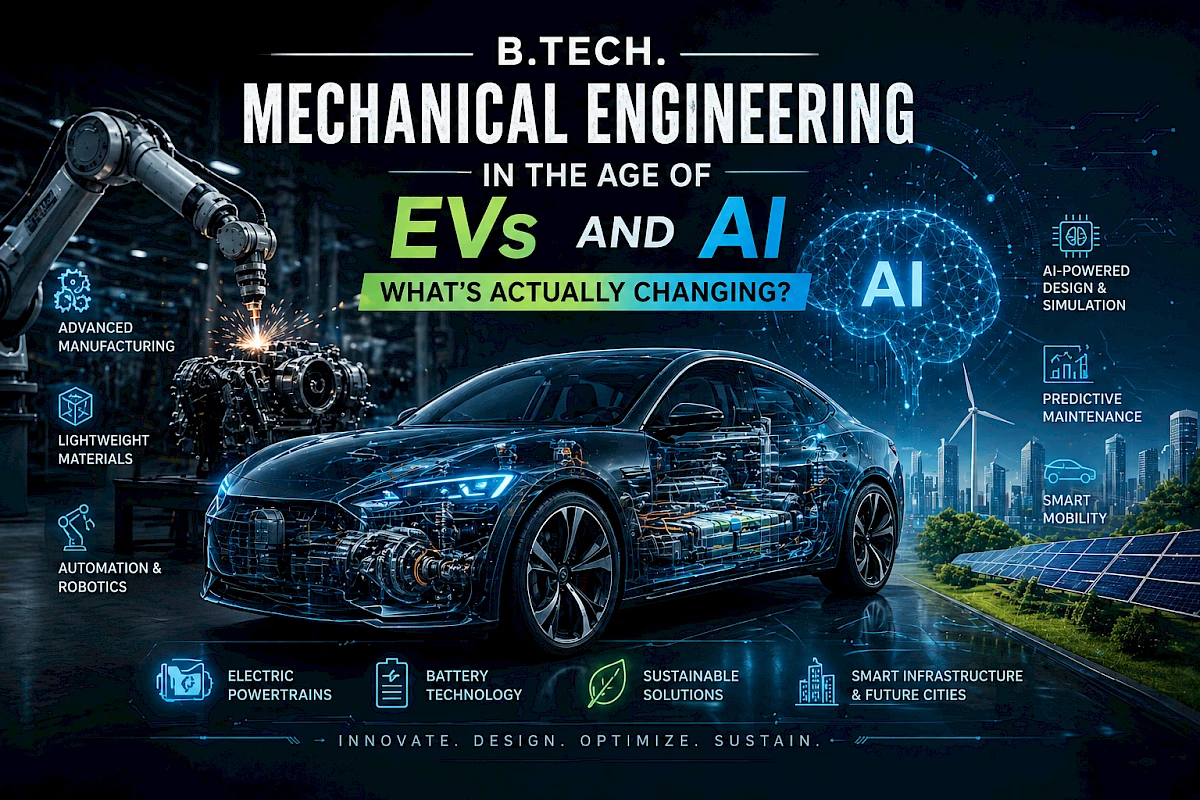
Blog / April 15, 2026
The conventional view of a mechanical engineer over the years has been envisaged as someone who deals with big machinery, develops internal combustion engines, as well as handling blueprints that have grease on them due to the mechanical engineering process. We have now passed beyond the 2020s halfway point, so the general outlook of B.Tech. Mechanical Engineering is truly radically different, starting with the Industrial Revolution.
The fast evolution into the field of mechanical engineering with the adoption of Artificial Intelligence is quite evident as the world becomes more sustainable. It is currently shifting its state beyond being purely mechanical to electro-mechanical and digital. It is therefore crucial to know these changes in the future in case you intend to take up this course.
The Paradigm Shift: From Fossil Fuels to Electrification
The most apparent shift in the industry is the shift toward Electric Vehicles (EVs). The International Energy Agency (IEA) notes that in 2024, electric car sales exceeded 17 million, and the market will increase by another 35% annually.
In a conventional B.Tech. Mechanical Engineering syllabus, much time was spent on Thermodynamics and IC Engine design. Although these fundamentals still hold, the emphasis is on:
- Battery Thermal Management Systems (BTMS)- This is used to ensure that lithium-ion batteries do not operate at unsafe temperatures.
- Lightweighting- This involves the use of high-technology composites to counterbalance the high mass of battery packs to enhance range.
- Drivetrain Optimization- Replacing the complicated gearboxes with highly efficient electric motors.
AI and Industry 4.0: The Digital Twin Revolution
Mechanical engineering is no longer just about building physical objects; it’s about creating "Digital Twins." AI and Machine Learning (ML) are now integrated into the B.Tech. Mechanical Engineering curriculum to predict structural failures before they happen.
Statistical data from Custom Market Insights suggests that the global smart manufacturing market is expected to grow at a CAGR of 14.9% from 2023 to 2030. This growth is fueled by:
- Generative Design- Using AI algorithms to create high-performance parts that use minimal material, designs often too complex for a human to conceive.
- Predictive Maintenance- Using sensors and IoT to determine when a machine part will fail, saving industries billions in downtime.
- Robotics and Cobots- Collaborative robots that work alongside humans, requiring engineers to master kinematics alongside sensor integration.
How the B.Tech. Mechanical Engineering Syllabus is Evolving
To keep up with these changes in the industry, the present B.Tech. Mechanical Engineering syllabus has gone beyond Fluid Mechanics and Solid Mechanics. Most top universities are now integrating interdisciplinary modules:
- Mechatronics and Robotics- A blend of mechanical, electrical, and computer engineering.
- Additive Manufacturing (3D Printing)- Leaving subtractive (milling/lathe) manufacturing and creating complex geometries in layers.
- Data Science for Engineers- Learn to compute mechanical stress data and fluid flow simulations with Python or R.
- Renewable Energy Systems- Focusing on aerodynamics of wind turbines and solar thermal.
The Job Market: New Roles, New Salaries
The idea that mechanical engineering is a dead-end profession is something of the past. As a matter of fact, the convergence of AI, IoT, and Electrification has triggered a recruiting spurt in skilled positions that were not present ten years ago. With the move of industries towards software-defined machines, rather than mechanical hardware, the compensation system and the career paths have changed dramatically.
High-Demand "New Age" Roles
The B.Tech. graduate in Mechanical Engineering is no longer an employee who has to work on the shop floor. Industry 4.0 has made a vacuum to fill in the gap between the physical systems and the digital intelligence, which can be filled by professionals. The prominent roles in the market today are:
- Battery Design & Thermal Engineer- As the EV market in India is expected to expand with a CAGR of 49% in the coming years (2022-2030), companies such as Tata Motors, Ola Electric, and Mahindra are searching for engineers who can maximize battery life and safety.
- Simulation & Digital Twin Analyst- With tools such as ANSYS and MATLAB, engineers can create virtual simulations of physical objects to anticipate wear and tear, which helps save R&D expenses by up to 30%.
- Robotics & Automation Specialist- With the manufacturing units aiming to achieve Lights Out production, experts capable of programming and maintaining collaborative robots are in greater demand than ever before.
- Sustainability & ESG Consultant- Mechanical engineers to audit carbon footprints and redesign manufacturing processes to become net-zero are now being hired as sustainability & ESG Consultants.
Salary Trends and Statistics
The economic incentive to specialism is obvious. Whereas in India, a mainstream entry-level mechanical position may pay a typical entry-level package, individuals with certifications or project experience in EVs and AI are joining the job market at a higher level.
Role Category | Average Entry-Level Salary (INR) | Salary Premium |
Traditional Mechanical | ₹3.5 L - ₹5.0 L | Base |
EV / Battery Tech | ₹6.5 L - ₹9.0 L | +30-40% |
AI / Robotics Integration | ₹7.0 L - ₹10.0 L | +45-50% |
CAE / Simulation Analyst | ₹5.5 L - ₹8.0 L | +20-25% |
The "Hybrid" Skill Premium
T-shaped skills are now being paid off in the job market. This implies both deep functional familiarity with the principles of mechanism (the vertical bar) and wide familiarity with the field of coding, electronics, and data analytics (the horizontal bar).
As per the latest employment statistics, mechanical engineers with Python skills to analyze data or ROS (Robot Operating System) receive two times more chances to be hired by the global technology-consulting companies compared to those possessing a conventional set of skills.
Engineer the Machines That Move the World with B.Tech. Mechanical Engineering at Shiv Nadar University (Institution of Eminence)
The School of Engineering at Shiv Nadar University provides a progressive ecosystem to those students who wish to cope with this new age. The B.Tech. in Mechanical Engineering program here is designed to fill the gap between classical engineering and future technology.
Key Highlights of the Program:
- Interdisciplinary Curriculum- Shiv Nadar University focuses on a Research-led model in which students have the opportunity to pursue a minor in Data Science, Artificial Intelligence, or Business Management on top of their major.
- State-of-the-Art Labs- The university has state-of-the-art facilities, such as the Robotics and Automation Lab, CAD/CAM Center, and Materials Science and Testing Speciality labs.
- Research Focus- Undergraduate students have the opportunity to become members of the OUR (Opportunities for Undergraduate Research) program, where students can work on real-world problems such as sustainable energy and advanced robotics at an early stage in their academic careers.
- Industry Connections- Students can have exposure to industry with a concentration on experiential learning, meaning that they go through internships and projects that follow the Industry 4.0 standards, so that by graduation, they are industry-prepared.
- Multidisciplinary Approach- The B.Tech. Mechanical Engineering syllabus is special in the sense that it incorporates the concept of the Major-Minor system, where a mechanical student can acquire formal knowledge in Computer Science, which is one of the crucial skills in the era of AI.
Conclusion: Is it Still a Good Career Choice?
The response is a resounding yes. The mother branch of engineering is mechanical engineering, and it is not disappearing; it is being upgraded. The next generation is that of the "Mechanical Plus" engineer, who not only knows the laws of physics but also can write code and design a carbon-neutral world.
When selecting a course of study, such as that of Shiv Nadar University that emphasizes research and interdisciplinary education, students can be sure that they are not learning the engineering of the past, but they are constructing the technology of the future.
FAQs
Q. Is B.Tech. Mechanical Engineering good?
A. Yes, B.Tech. Mechanical Engineering remains a strong career choice, especially with emerging opportunities in EVs, AI, robotics, and sustainable technologies.
Q. What are the subjects in B.Tech. Mechanical Engineering?
A. Core subjects include thermodynamics, fluid mechanics, solid mechanics, machine design, manufacturing processes, along with newer areas like mechatronics, robotics, and data science.
Q. What are the different types of Mechanical Engineering degrees?
A. Mechanical Engineering degrees include undergraduate (B.Tech./B.E.), postgraduate (M.Tech./M.E.), and specialized programs focusing on areas like automotive, robotics, thermal, and manufacturing engineering.
Q. Will AI replace Mechanical Engineers?
A. No, AI will not replace mechanical engineers but will enhance their roles by automating tasks and enabling smarter design, analysis, and decision-making.