Printing the Future, Monitoring the Cracks
Editorial / June 22, 2026
Construction is not an industry that changes quickly. It has been pouring concrete into moulds and stacking bricks in mortar for the better part of two centuries, refining the same essential moves rather than abandoning them. So the speed at which 3D printing has arrived in the sector is worth pausing over.
The global market for printed construction was valued at roughly $25.5 billion in 2026 and is projected to climb past $1 trillion within a decade, with Asia Pacific already accounting for nearly half of all activity. Printed homes have gone up in Pune. Printed bridges have opened to pedestrians in IIT-Hyderabad. Printed schools, pavilions, and emergency shelters are beginning to appear in planners' brochures.
That speed is precisely what makes the next question so urgent. When a building is printed, how does one know if it's safe even after a few years?
A review in 'Smart Materials and Structures' by Dr Sumedha Moharana, Associate Professor of Civil Engineering, and her past doctoral researcher, Dr Lukesh Parida, argues that the construction industry has not yet answered this question with the seriousness it deserves.
Conventional concrete fails in well-rehearsed ways. Engineers know how it cracks under load, how it spalls in fire, how reinforcing steel rusts and swells over decades of monsoon and frost. Engineers are trained to read those signals. However, a 3D-printed structure rewrites the rulebook.
The reason is geometric. Printed concrete is laid in horizontal beads, with each layer hardening before the next is applied. Each interface between layers is a potential weak point. If the previous layer has dried too far, or the mix is slightly off, or the printer pauses for too long, the bond between layers will be incomplete. A wall that looks pristine from the outside can harbour hairline voids, cold joints, and uneven curing zones running through it, like the grain in a piece of wood. The most dangerous of these failures, layer delamination, can hollow out a structure's load capacity long before any visible distress reaches the surface.
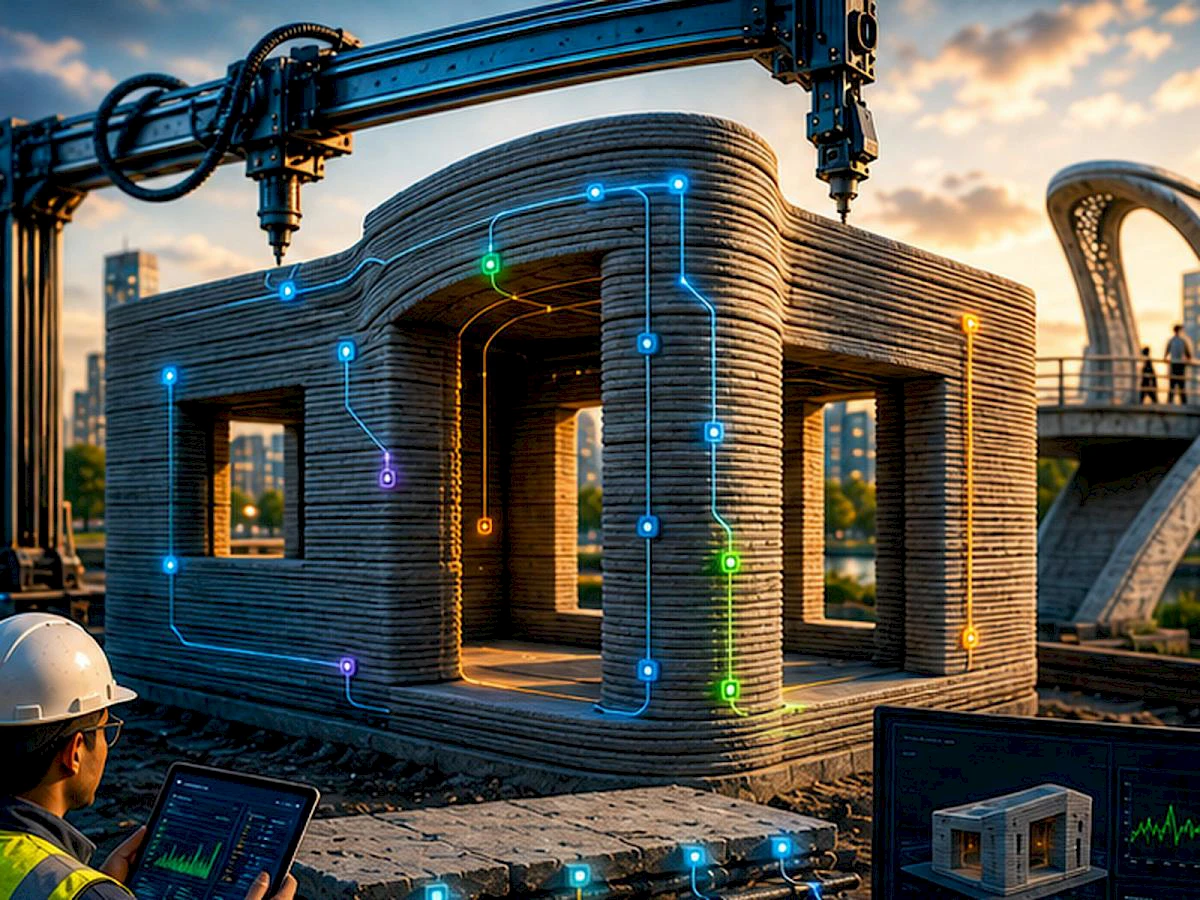
This is where structural health monitoring (SHM) comes into play. Rather than waiting for an inspector to arrive every five years, SHM embeds sensors in the building during construction and continuously monitors them. The structure, in effect, learns to report on its own condition.
Dr Moharana's review surveys the sensing toolkit in detail. Accelerometers track how a wall vibrates under wind, traffic, or seismic loads, and can also flag printer-head irregularities while a structure is still under construction. Strain gauges are the workhorse. They measure how the material flexes under load, and the data feeds back into the design loop for the next building. Fibre-optic cables, often laid straight into the print path as it goes down, pick up strain, temperature, and the slow chemical shifts that creep through curing concrete. They don't care about electromagnetic interference, which is handy given how much rebar tends to be in the way.
Ultrasonics work by listening. Send a pulse through the slab and read what comes back; one can map voids, delaminations, and hairline cracks well before any of them surface. Lead Zirconate Titanate (PZT) patches or small piezoelectric tiles, either glued on or embedded into the structure, turn mechanical stress into a faint electrical signal, and a drift in that signal usually shows up before any visible damage does.
The cleaner option is to skip instrumentation entirely and let the concrete do the work. Mix carbon fibres or carbon powder into the print mix, and the material becomes conductive. Stress changes its resistance; damage shows up as a wobble in the readings. For printed structures, where bolting sensors on after the fact is awkward, expensive, and often impossible, self-sensing concrete is the obvious answer.
None of this is plug-and-play, though. A printed wall is layered and anisotropic, behaving differently along the print direction than across it, which makes sensor placement and calibration harder than in a cast slab. A continuously monitored building also produces far more data than any human inspector could realistically read, so a machine-learning layer of some kind has become unavoidable rather than optional. Costs are uneven: distributed fibre-optic networks remain pricey to install, while PZT patches are cheap but unforgiving to interpret. And the codes governing printed construction are largely copied across from cast concrete, even though the two materials fail in quite different ways.
Dr Moharana's point cuts through all of this: monitoring cannot be tacked on at the end. A printed building without embedded sensors is, in effect, mute about its own condition. The structures that age best over the next decade will be the ones built to talk back.
More Blogs

The Hawthornden Literary Retreat bestowed on Dr Sambudha Sen to complete the manuscript of a novel
Professor Sambudha Sen, Head of the Department of English at Shiv Nadar Institution of Eminence, Delhi-NCR, was awarded a residency at the...
The Power of the Moving Body
Movement is an innate bodily action that humans have been exhibiting for the longest time. Long before language was invented, the body was the...

How Does A Multi-Disciplinary Approach To Education Enhance Learning And Prepare Students For A Multi-Faceted World?
In today’s world, where businesses are changing almost every day, it is the responsibility of educational institutes to provide holistic...