M.Sc. Then Ph.D. or Integrated M.Sc.-Ph.D. in Chemistry: Which Path is Right After a B.Sc.?
Blog / June 19, 2026
Here's the honest version of something nobody in an admissions brochure will tell you-
The path you choose right now, at the end of your B.Sc., will set the tempo of the next six or seven years of your life.
And that's not an exaggeration.
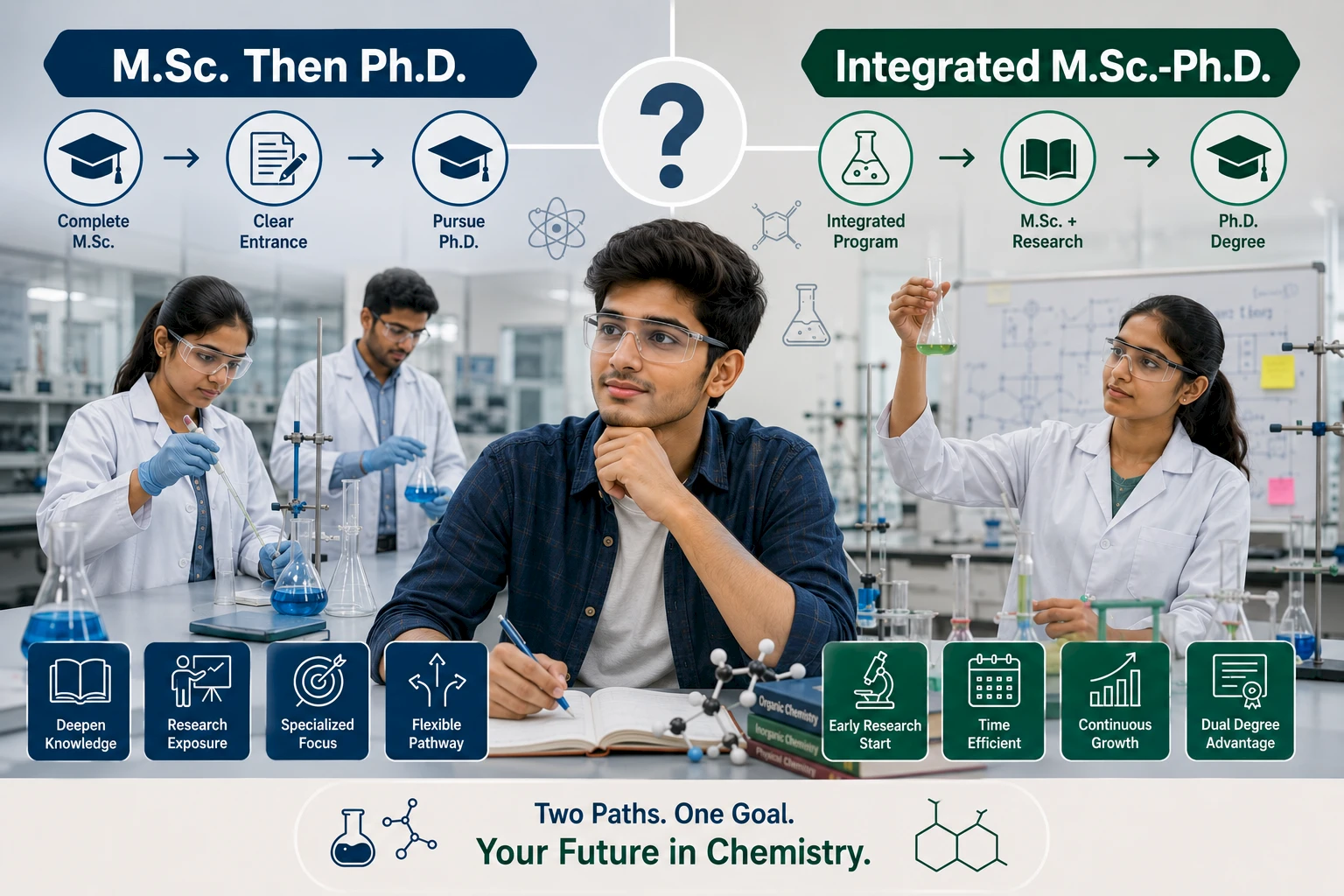
A standalone M.Sc. is two years of coursework, then another round of entrance exams (CSIR-NET, GATE, or institutional tests) before you can even apply for a Ph.D. seat. An integrated M.Sc.-Ph.D. is a single, continuous program that takes you from postgraduate coursework all the way through your doctoral dissertation, without re-applying, re-testing, or switching institutions midway. Most well-structured programs run about six years compared to seven-plus on the traditional route, on a good timeline.
The part most comparisons miss is research continuity. On the integrated path, you're building a relationship with an advisor and a specific scientific problem from year one. By the time a traditional M.Sc. student is just entering their Ph.D., an integrated student may already have preliminary results, a conference presentation, or a publication draft on record. The question is whether this trade-off makes sense for where you are right now.
A Direct Comparison: Traditional Path vs. Integrated
|
Criteria |
Traditional M.Sc. + Ph.D. |
Integrated M.Sc.-Ph.D. |
|
Total Duration |
7 years (2 + 5) |
6 years |
|
Admission Exams |
Separate for M.Sc. and Ph.D. |
One process: test + interview |
|
Research Access |
After M.Sc. completion |
From Semester 1 |
|
Exit Option |
None built in |
M.Sc. (Research) available |
|
Stipend Eligibility |
After Ph.D. admission only |
Doctoral phase onwards |
|
Credit Transparency |
Varies by institution |
Defined upfront |
Which Path is Right for You?
This is the section most blogs skip, and it might be the most useful part of this one. Not every B.Sc. Chemistry graduate should default to the integrated route.
The integrated M.Sc.-Ph.D. is likely right for you if-
- A specific area of chemistry already excites you. Medicinal Chemistry, Computational Quantum Chemistry, Green Chemistry, Chemical Biology, or something at a disciplinary interface.
- You've done lab work or a dissertation project and genuinely enjoyed the process of research, not just studying chemistry.
- You want to avoid the post-M.Sc. gap year. Here, you might have to spend months preparing for Ph.D. entrance exams while your research momentum stalls.
- Your goal is academia, pharma, or biotech R&D, advanced materials, or an international post-doc.
A standalone M.Sc. might make more sense if-
- You genuinely aren't sure yet whether you want to go all the way to a Ph.D. and want to test the waters first.
- You want flexibility to choose a different supervisor or institution at the doctoral stage.
- You have a specific reason for mobility mid-way. International plans, family circumstances, or a particular lab you want to join elsewhere.
One nuance worth noting: the best integrated programs include an M.Sc. (Research) exit option. If your goals shift after year two, you can leave with a recognized master's degree rather than walking away empty-handed. That structural flexibility makes the decision considerably less binary than it first appears.
Eligibility for an Integrated M.Sc.-Ph.D. in Chemistry
Entry requirements vary by institution, but the baseline is fairly consistent across well-regarded programs in India-
- A 3-year B.Sc. in Chemistry with a minimum 60% marks or an equivalent CGPA.
- A valid score in CSIR-NET (JRF), GATE, or an institution-specific test, depending on the program.
- A research aptitude interview, which most selective programs use to assess your fit with the department's active research areas.
- Some programs require Chemistry as the principal subject, while others may accept candidates from related disciplines such as Biochemistry or Pharmaceutical Sciences.
Check the specific eligibility criteria for every program you apply to. The broad requirements above are a reliable starting point, but individual institutions may have additional conditions around subject combinations or prior research experience.
Fast-Track Your Research Career with an Integrated M.Sc.-Ph.D. in Chemistry at Shiv Nadar University (Institution of Eminence)
Shiv Nadar University has a fully residential research campus built from the ground up. It holds Institution of Eminence status, one of a handful of private universities in India with that designation, which gives it a different funding profile, academic autonomy, and international standing than most private institutions can claim. The Chemistry department sits inside that ecosystem, and the Integrated M.Sc.-Ph.D. in Chemistry is where that ecosystem becomes directly useful to you.
Here is what separates this program from others at the same level-
- Purpose-built research infrastructure that keeps your doctoral work moving rather than stalled behind shared-facility queues.
- Research methodology is a formal, compulsory part of the curriculum from early on, not something you are expected to pick up informally along the way.
- Faculty with international academic backgrounds and genuinely close student-to-advisor ratios, the kind that actually shape where you land after your Ph.D.
- A single campus shared with Engineering, Natural Sciences, Humanities, and Management - a real advantage when your research sits at a disciplinary boundary.
If you are choosing an integrated program, the institution behind your degree matters as much as the degree structure itself. At Shiv Nadar University, both hold up under scrutiny.
The Bottom Line
The integrated M.Sc.-Ph.D. in Chemistry isn't the right call for every B.Sc. graduate. But if you've read this far and you recognize yourself in this profile and feel committed to research, not in repeating the admissions cycle after M.Sc., and are ready to build a serious scientific career without unnecessary detours, then the choice becomes considerably clearer.
The traditional path isn't wrong. But it does ask you to prove yourself twice, wait longer, and manage transition uncertainty that the integrated route simply eliminates. For Monsoon 2026, that opportunity is in front of you right now, at an Institution of Eminence with the infrastructure, faculty, and curriculum depth to back up what the program page says.
Explore the full program, including curriculum, faculty, research areas, and how to apply at the official program page.
Frequently Asked Questions
Q: Is the integrated M.Sc.-Ph.D. actually better than a standalone M.Sc.?
A: For students certain about a research career, yes. It saves one to two years, eliminates multiple post-M.Sc. entrance exams, and gives earlier access to doctoral stipends and resources.
Q: What is the eligibility for Shiv Nadar University's Integrated M.Sc.-Ph.D. for Monsoon 2026?
A: A minimum of 60% in a 3-year B.Sc. in Chemistry. Admission is through SNUSAT/APT and a faculty interview. The Monsoon 2026 cycle is currently active.
Q: Can I exit with just an M.Sc. if my goals change?
A: Yes. The integrated track at Shiv Nadar University includes an explicit M.Sc. (Research) exit option after the first two years. It's a real structural safety net, not a theoretical one.
Q: What research areas does the Chemistry program at Shiv Nadar University cover?
A: More than 20 specialized areas, including Asymmetric Catalysis, Chemical Biology, Cheminformatics, Computational Quantum Chemistry, Green Chemistry, Materials Chemistry, and many more.