Bloom That Could Charge Tomorrow
Editorial / July 13, 2026
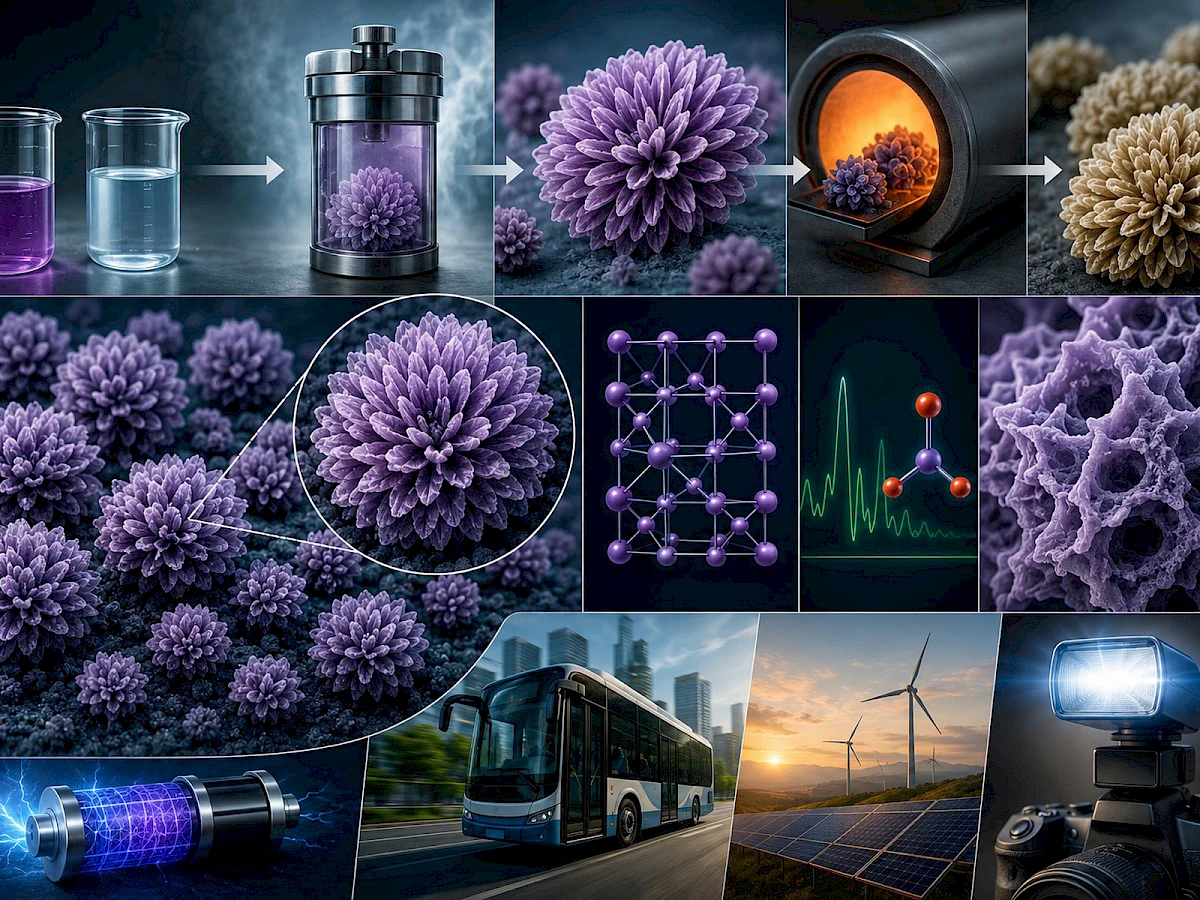
The first time Dr Ranjit Kumar slid the sample under an electron microscope, what came up on the screen looked less like a battery material and more like a garden. Hundreds of tiny clusters, each one arranged in layered petals, sat scattered across the field of view. They were chrysanthemums in miniature, or sea anemones, depending on what the eye preferred to call them. They were also the products of a one-pot chemical reaction designed to produce manganese phosphate, a workhorse compound in increasing demand for the next generation of energy storage devices.
Making materials like this is rarely a glamorous business. The recipe books that produce most manganese phosphates have looked roughly the same for decades. Three or four reagents that do not get along. Multiple heating stages, a fume hood working overtime to vent nitrogen dioxide. It's a process of combining, waiting, heating, washing, and repeating. The reward at the end is a powder. The price along the way is time, energy, and a non-trivial amount of toxic gas.
The study by Dr Kumar at the Centre for Advanced Materials and his collaborator, Dr Prakash Bobde, suggests that the reward can be reached via a much shorter route. The Senior Scientist with the Department of Chemical Engineering, School of Engineering, found a one-pot hydrothermal synthesis that produces two industrially useful manganese phosphates, MnPO4·H2O and Mn2P2O7, from only two starting materials: potassium permanganate and phosphorous acid. No nitric acid. No external template. No multi-step routine. The reaction is carried out at 150°C in water, and the second compound is obtained by heating the first compound to 700°C in air.
The trick is the phosphorous acid. In most syntheses, a reagent does one job. Here, phosphorous acid does three. It reduces the permanganate ions that give the reaction its violet colour. It supplies the phosphate groups that the new crystals need to grow. And it quietly guides the geometry of those crystals as they assemble, acting as a structure-directing agent without anyone adding one. Three jobs, one molecule. The recipe shrinks accordingly.
Under the microscope, the consequences become visible. Where conventional methods tend to produce blocky or irregular crystals, this route grows hierarchical clusters with their characteristic petaled form. After calcination, the pyrophosphate Mn2P2O7 retains its porous, open structure but with a much larger active surface area. The flowers are not decorative. In an electrode, every petal is a potential surface area. Every gap between petals is a channel for ions to move through during charge and discharge. Geometry, in electrochemistry, is destiny.
The supporting evidence lined up. X-ray diffraction confirmed that both compounds had crystallised into pure monoclinic phases, with no secondary products that often muddle simpler syntheses. Infrared spectroscopy picked up the phosphate vibrations exactly where they should be. Surface area measurements showed that the pyrophosphate had a significantly larger accessible area than its precursor, precisely what an electrode wants.
The performance numbers followed. Tested as a supercapacitor electrode, Mn2P2O7 delivered a specific capacitance of 169 F/g, well above the hydrated precursor and competitive with materials produced through far more elaborate routes. It retained close to 40% of that capacitance even at the high current densities required by fast-charging applications. Over 250 charge-discharge cycles, it lost none of its storage capacity effectively. For a compound made in a single pot from two reagents, that is a useful result.
Why does it matter beyond the laboratory? Because the bottleneck in modern energy storage is not really an invention. It is a scale. The world has no shortage of exotic electrode materials that perform beautifully in a glass cell and impossibly outside it. The materials that survive the trip from journal to grid tend to be the ones that can be made cheaply, repeatably, and without an inventory of hazardous reagents. Manganese is abundant. Phosphate chemistry is mature. The simpler the recipe, the more likely a process engineer will agree to scale it.
Supercapacitors, the technology this material targets, sit in an awkward middle of the energy storage spectrum. They cannot hold as much charge as lithium-ion batteries, but they can deliver and absorb it far faster. That makes them useful exactly where batteries struggle: the regenerative braking circuit of an electric bus, the buffer that smooths a wind turbine's output during a gust, the camera flash that needs to recover in half a second. As more of the grid runs on renewables that produce power in fits rather than streams, the demand for fast, durable buffers will grow. A pseudocapacitive material that holds its capacity over hundreds of cycles, made from cheap precursors in a single reaction, sits squarely in that future market.
More Blogs

The Hawthornden Literary Retreat bestowed on Dr Sambudha Sen to complete the manuscript of a novel
Professor Sambudha Sen, Head of the Department of English at Shiv Nadar Institution of Eminence, Delhi-NCR, was awarded a residency at the...

The Power of the Moving Body
Movement is an innate bodily action that humans have been exhibiting for the longest time. Long before language was invented, the body was the...

How Does A Multi-Disciplinary Approach To Education Enhance Learning And Prepare Students For A Multi-Faceted World?
In today’s world, where businesses are changing almost every day, it is the responsibility of educational institutes to provide holistic...