How to Apply for a Ph.D. in Management in India: Step-by-Step Guide for 2026
Blog / June 29, 2026
If you have spent the last decade or more in a senior role, watching patterns repeat across industries, asking questions no quarterly review will ever answer, a Ph.D. in Management might be the thing you have been circling. Not because it adds a title, but because it gives your professional insight a research framework: a structure to investigate, challenge, and contribute to the body of knowledge your career has been drawing from.
This guide walks you through exactly how to apply for a Ph.D. in Management in India in 2026 — who it is right for, what it pays, what it costs, how the process works, and which program in Delhi NCR deserves your serious attention.
What is a Ph.D. in Management — And How is It Different from an MBA?
The difference is fundamental. An MBA sharpens your ability to operate within business systems. A Ph.D. teaches you to question, study, and redesign those systems. One produces a skilled practitioner; the other produces an original researcher who generates new knowledge.
In India, doctoral programs in management come in two formats-
- Full-time Ph.D. - Campus-based and suited for candidates who can commit entirely to research, stepping away from professional roles.
- Executive Ph.D. - Designed for working professionals, combining online engagement with structured campus residencies. If you are mid-career, this is almost certainly the format worth exploring.
The Executive format is gaining ground because it allows professionals to pursue doctoral-level inquiry without abandoning the careers that are themselves the source of the research questions.
What Can You Do With a Ph.D. in Management? (And What Does It Pay?)
This is one of the most commonly searched questions and one that most program pages quietly sidestep. So here is an honest answer.
A Ph.D. in Management opens doors to academia (faculty positions at IIMs, ISB, or leading private business schools), senior research consulting, policy think tanks, and executive advisory roles where thought leadership carries as much weight as operational experience. In India, faculty roles at top institutions offer salaries in the range of ₹15-30 LPA at the assistant professor level, with senior faculty earning significantly more. Research consulting and policy roles vary, but tend to sit well above industry averages for equivalent experience.
If you are already earning well in the industry, a Ph.D. is less a salary jump and more a deliberate career pivot — from execution to inquiry, from applying knowledge to producing it. The candidates who benefit most are those who have a specific research problem they cannot stop thinking about, and the discipline to pursue it for four years.
Eligibility for a Ph.D. in Management in India
Before anything else, check whether you qualify. For most Executive Ph.D. programs in India, the standard criteria are-
- A Master’s degree with 55%+ marks (or equivalent CGPA) from a recognized university, OR a four-year bachelor’s degree with research (minimum CGPA 7.5/10)
- Approximately ten years of professional experience in business, management, policy analysis, industrial research, or academia
- UGC-NET qualification exempts you from the written entrance test; candidates without it must sit an institution-administered test
If you have the degree and the experience but not the UGC-NET, do not stop here. Most institutions run their own entrance tests, and a well-prepared application with strong research aptitude can absolutely clear the bar.
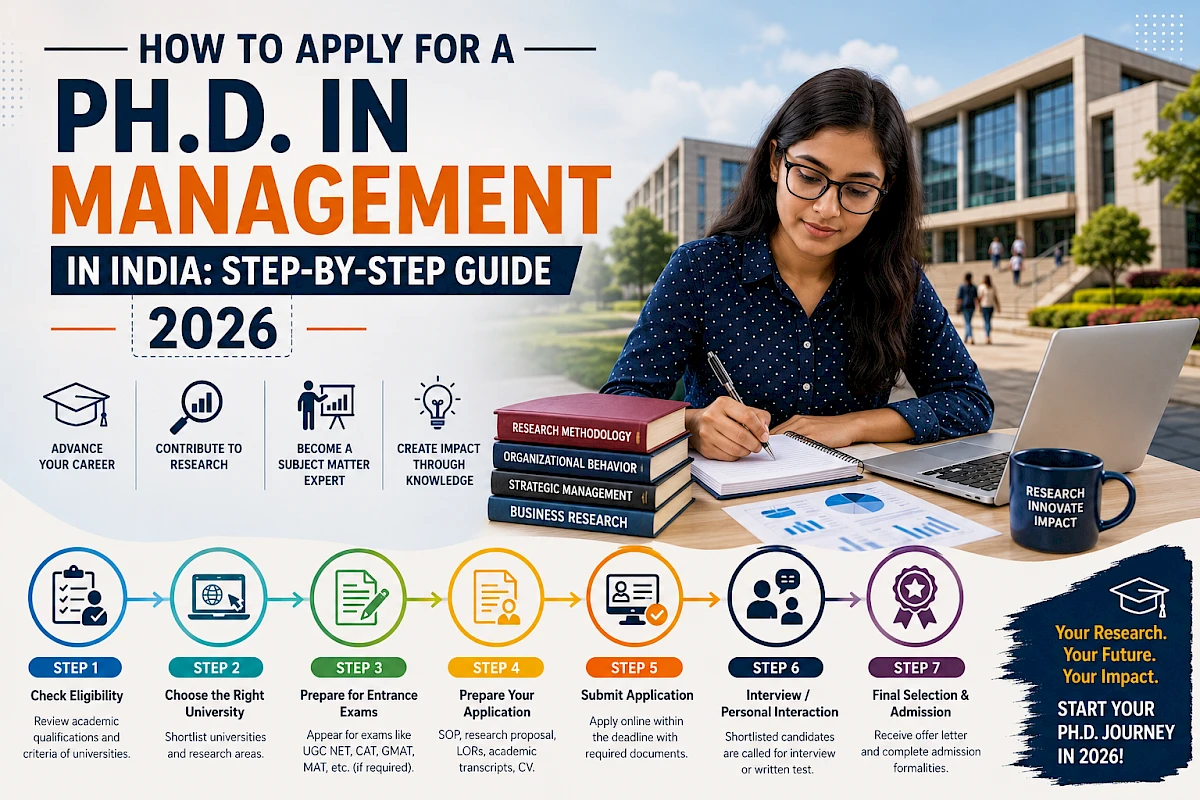
How to Apply for a Ph.D. in Management: Step-by-Step
Step 1: Identify Your Research Problem Before You Apply
This is where most candidates underestimate the process. A Ph.D. application is not an MBA application — you are not selling your career story. You are proposing an intellectual agenda. Before opening any portal, be able to clearly answer:
- What specific question do I want to research?
- Why does it matter?
- Why am I positioned to study it?
Write it down. That clarity feeds directly into your Statement of Purpose and carries through to the interview.
Step 2: Prepare Your Documents
Standard documents required include-
- Statement of Purpose (SOP) outlining your research intent and background
- Academic transcripts from all qualifying degrees
- Professional experience certificates or letters
- UGC-NET scorecard, if applicable
- Two to three letters of recommendation from academic or senior professional references
- A government-issued photo ID
Step 3: Submit the Online Application
Most institutions in India now process doctoral applications entirely online. For Shiv Nadar University, the application fee is ₹1,200, payable online. Submit well before the deadline — portals tend to slow down significantly in the final days.
Step 4: Appear for the Written Entrance Test (If Required)
UGC-NET qualified candidates are exempt. All others sit a written test assessing research aptitude, analytical reasoning, and foundational management knowledge. UGC-NET management syllabi are a practical preparation reference even for institution-specific tests.
Step 5: Attend the Admission Interview
Shortlisted candidates meet an academic panel. This round tests the clarity and feasibility of your proposed research, your intellectual preparedness, and your ability to sustain doctoral work alongside professional commitments. Come prepared to discuss your research problem in detail, the reading you have done in the area, and why you are choosing this specific program.
Step 6: Await the Offer and Confirm
Results are communicated within a defined window after interviews. If admitted, confirm acceptance by the stated deadline to secure your seat in the cohort.
Ph.D. in Management Subjects: What Will You Actually Research?
Doctoral research in management spans several mature sub-disciplines. Depending on your research interests, you might work in-
- Marketing Management- consumer behavior, brand strategy, digital marketing, pricing dynamics
- Human Resource Management- organizational behavior, talent strategy, workplace systems
- Finance- corporate finance, behavioral finance, financial markets, risk management
- Economics and Public Policy- policy analysis, development economics, regulatory frameworks
- Decision Sciences, Operations Management, and Information Systems- supply chain, data-driven decision making, systems design
Choose your research area before you apply. Admission panels are testing for a specific research question — not a broad subject interest.
Elevate Your Business Acumen with a Ph.D. for Working Professionals at Shiv Nadar University (Institution of Eminence)
If you are based in Delhi, Gurgaon, or anywhere in the NCR and looking for a rigorous Executive Ph.D. that does not require stepping away from your career, Shiv Nadar University (Institution of Eminence), located in Greater Noida, is the most relevant option.
The School of Management and Entrepreneurship (SME) at Shiv Nadar University runs a Ph.D. in Management (Executive), designed specifically for professionals with a decade or more of domain experience who want to convert that experience into rigorous, publishable research. Here is what the program delivers-
- Blended learning format- online engagement combined with 180 structured campus residency days across workshops, thesis reviews, and seminars, designed to minimize career disruption
- 4-year structure with clear milestones- Year 1 covers research foundations (philosophy of science, methodology, academic writing, case writing); Years 2-4 are dedicated to dissertation research with periodic review meetings built into the calendar
- Multidisciplinary research environment- access to faculty and research communities across Shiv Nadar University’s schools of engineering, natural sciences, and humanities, enabling cross-disciplinary work grounded in a management core
- Faculty with international pedigree- doctorates from world-ranked universities, with publications in top international peer-reviewed journals
The program is built for the kind of professional who has genuine domain expertise and wants to convert it into scholarship. That is not marketing language — it is reflected in the residency design, the breadth of research area, and the dissertation process.
Should You Apply?
A Ph.D. in Management requires four years of sustained intellectual commitment. It is the right move if you have a real research question (something your career has surfaced that industry alone cannot answer) and the discipline to pursue it rigorously.
If that describes you, the 2026 Monsoon cycle at Shiv Nadar University closes on June 30. There is enough time to prepare a strong application if you start now. Clarify your research problem, build a focused SOP, and go into the interview knowing exactly what you want to study and why. The process itself is straightforward. What it rewards is the thinking you do before you apply.
FAQs
Q.1. What is the eligibility for a Ph.D. in Management in India?
You need either a Master’s degree (55%+) or a four-year bachelor’s degree with research (CGPA 7.5+), along with approximately ten years of professional experience.
Q.2. How long does a Ph.D. in Management take?
Most Executive Ph.D. programs in management are designed to be completed in four years: one year of coursework followed by three years of dissertation research.
Q.3. Can I pursue a Ph.D. in Management while working?
Yes, the Executive Ph.D. format is specifically designed for this. Programs like the one at Shiv Nadar University use a blended model with campus residencies and online engagement, structured to minimize disruption to your professional schedule.