Building a Public Policy Career in India: Types of Roles and How to Get Started
Blog / July 01, 2026
Public policy is no longer a career path limited to government administration. Today, organizations across the public, private, and non-profit sectors are looking for professionals who can solve complex challenges, design evidence-based policies, and improve the lives of millions. From AI governance and climate action to healthcare, education, and digital transformation, public policy professionals play a critical role in shaping India's future.
As public policy education evolves, students are no longer confined to a single career path. According to the Center for Public Policy Research (CPPR), public policy programs prepare graduates for careers in government, non-profit organizations, international institutions, and the private sector, while equipping them with interdisciplinary knowledge spanning economics, law, sociology, political science, public health, and governance. This makes a public policy career in India an attractive choice for students from diverse academic backgrounds.
Understanding the types of roles in public policy, the skills employers value, salary prospects, and career opportunities can help you choose the right path and build a rewarding career in this rapidly evolving field.
The Growing Demand for Public Policy Professionals
Rapid changes are taking place in India in fields like renewables, digital government, health, education, financial technology, transport as well as climate change. Each and every change demands professionals who can connect the dots between research and decision-making.
The demand for policy professionals is accelerating alongside India's digital and economic growth. According to the India Brand Equity Foundation (IBEF), India's digital economy is expected to contribute almost 20% of the country's GDP by 2029–30, creating an increasing need for experts who can shape regulations, data governance, digital infrastructure, and technology policy.
Different Types of Roles in Public Policy
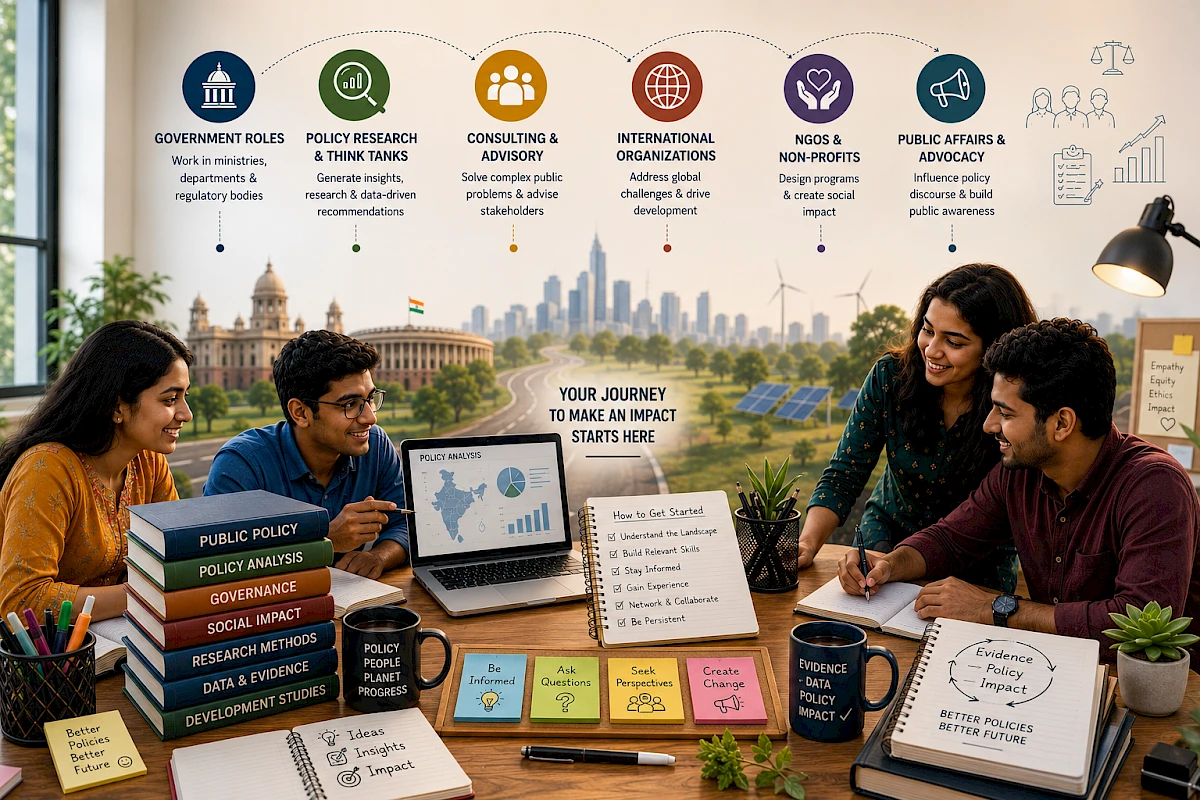
There are a number of career opportunities available, whether you enjoy research, strategy, communication or implementation.
Role | Key Responsibilities |
Policy Analyst | Research policies, analyze data, prepare recommendations |
Public Policy Consultant | Advise governments and organizations on policy decisions |
Government Relations Manager | Build relationships with government departments and regulators |
Legislative Research Associate | Support lawmakers with research and policy briefs |
Public Affairs Specialist | Manage communication between organizations and policymakers |
Program Manager | Execute and monitor public policy initiatives |
Policy Research Associate | Conduct evidence-based research and impact assessments |
Regulatory Affairs Specialist | Ensure organizations comply with government regulations |
Advocacy Manager | Design campaigns to influence public policy |
Monitoring & Evaluation Officer | Measure program effectiveness and policy outcomes |
These are among the most common types of roles in public policy, with opportunities available across both public and private sectors.
Top 10 Emerging Areas Creating High-Demand Public Policy Jobs
The policy landscape is evolving rapidly, creating exciting career opportunities across several specialised domains. Some of the fastest-growing areas include-
- Artificial Intelligence (AI) Governance: Governments and technology companies need policy professionals to develop regulations that promote responsible AI use, address ethical concerns, and protect public interests while encouraging innovation.
- Climate Change and Sustainability Policy: As India focuses on achieving its climate goals, policymakers play a key role in designing strategies for carbon reduction, environmental conservation, and sustainable development.
- Public Health Policy: Public health experts help shape policies related to disease prevention, healthcare access, vaccination programs, and strengthening the country's healthcare systems.
- Digital Governance: With the rapid expansion of e-governance initiatives, professionals are needed to improve digital public services, enhance transparency, and make government services more accessible.
- Cybersecurity Policy: The increasing number of cyber threats has created demand for specialists who can develop policies to safeguard digital infrastructure, critical systems, and citizen data.
- Education Reform: Policy professionals contribute to improving education systems by developing strategies that enhance learning outcomes, promote inclusivity, and align education with future workforce needs.
- Urban Development: As cities continue to grow, policymakers work on issues such as affordable housing, transportation, waste management, and smart city planning to improve urban living.
- Renewable Energy Policy: India's transition towards clean energy requires policies that encourage investment in solar, wind, and other renewable energy sources while ensuring long-term energy security.
- Data Privacy and Technology Regulation: Organizations need experts who can develop frameworks that balance innovation with data protection, privacy rights, and responsible use of emerging technologies.
- ESG and Corporate Sustainability: Businesses increasingly rely on policy professionals to ensure compliance with environmental, social, and governance standards while supporting responsible and sustainable business practices.
Public Policy Career in India: Salary Insights
A public policy career in India offers competitive salaries that increase with experience, sector, and area of expertise. While entry-level professionals typically begin in research, consulting, or management roles, experienced policy experts working in consulting firms, multinational companies, international organizations, and leadership positions can earn significantly higher compensation.
Job Role | Average Annual Salary (Approx.) |
Policy Analyst | |
Public Policy Consultant | |
Government Relations Manager | |
Public Affairs Specialist | |
Program Manager | |
Regulatory Affairs Specialist | |
Advocacy Manager | |
Monitoring & Evaluation Officer |
Skills That Employers Look for in Public Policy Professionals
Success in public policy isn't just about academic knowledge. Employers look for professionals who can analyze complex problems, communicate well, and find practical solutions. Some of the most sought-after skills include-
- Policy analysis
- Research methodology
- Data analysis
- Report writing
- Public speaking
- Stakeholder engagement
- Critical thinking
- Legal and regulatory understanding
- Project management
- Leadership and collaboration
- Problem-solving
- Economic analysis
Developing both technical and interpersonal skills can significantly improve career prospects.
Top Sectors Hiring Public Policy Professionals
Public policy graduates can explore opportunities across a number of sectors, including-
- Government ministries and departments
- Public sector undertakings
- Think tanks
- International development organizations
- NGOs
- Corporate public affairs teams
- Consulting firms
- Research institutions
- Multilateral organizations
- Healthcare and education organizations
- Sustainability and ESG consulting firms
The increasing collaboration between governments and private organizations has expanded career opportunities beyond traditional public administration roles.
The Future Scope of Public Policy Careers
The future looks highly promising for professionals entering this field. India's policy ecosystem now includes more than 1,335 organizations spanning across government, think tanks, consulting firms, NGOs, corporate public affairs, and international development agencies, highlighting the expanding demand for skilled public policy professionals.
Government initiatives focused on Digital India, smart cities, renewable energy, healthcare reforms, startup ecosystems, AI regulation, and sustainable development are expected to further strengthen career opportunities in the coming years.
Professionals with interdisciplinary knowledge and strong analytical abilities can progress into senior leadership positions, including Policy Advisor, Director of Public Affairs, Governance Consultant, Program Director, and Chief Policy Officer.
How to Get Started in Public Policy
Entering the field requires a combination of education, practical experience, and continuous learning. Some effective ways to begin include-
- Pursue an undergraduate degree in relevant disciplines such as economics, law, political science, engineering, business, or public administration.
- Build strong research and analytical skills.
- Stay informed about current affairs and policy developments.
- Participate in internships with think tanks, NGOs, consulting firms, or government bodies.
- Learn data analysis and policy evaluation techniques.
- Develop excellent writing and communication skills.
- Pursue specialised postgraduate programs or certifications in public policy or governance.
- Build a professional network through seminars, workshops, and policy forums.
Why Choose Shiv Nadar University for a Public Policy Career in India?
Building a successful public policy career in India requires more than theoretical knowledge. It demands interdisciplinary learning, strong analytical skills, research exposure, and an understanding of governance, economics, international affairs, and society. With that in mind, Shiv Nadar University offers a vibrant academic ecosystem that helps students develop these capabilities through research-driven programs and experiential learning.
Students interested in public policy can choose from a number of programs that prepare them for careers in government, research, public administration, consulting, international organizations, and think tanks. Some of the courses include-
- B.A. (Research) in International Relations: Develops an understanding of global politics, diplomacy, governance, and international affairs
- B.Sc. (Research) in Economics: Builds expertise in economic analysis, public finance, development economics, and quantitative research
- M.Sc. in Economics: Offers advanced training in economic theory, data analysis, and evidence-based policymaking within a research-oriented environment
- Ph.D. in Economics: Focuses on areas such as development economics, public economics, political economy, labour economics, and environmental economics
- Ph.D. in International Relations and Governance Studies: Enables scholars to undertake advanced research in governance, public institutions, global affairs, and policymaking
Conclusion
A career in public policy offers the opportunity to shape decisions that influence millions of lives. As India addresses complex challenges in areas such as digital governance, climate action, healthcare, education, and economic development, the demand for skilled policy professionals continues to grow.
Whether you aspire to work with governments, think tanks, consulting firms, NGOs, or global organizations, building strong analytical, research, and communication skills can open doors to diverse and meaningful career opportunities. By choosing the right academic pathway and gaining practical experience, you can contribute to creating evidence-based policies that drive lasting social and economic impact.
FAQs
Q1. Is public policy a good career in India?
Ans. Yes. A public policy career in India offers diverse opportunities across government, consulting firms, NGOs, think tanks, and corporate organizations, with growing demand driven by governance reforms and sustainability initiatives.
Q2. Which degree is best for a public policy career in India?
Ans. Degrees in economics, political science, law, public administration, international relations, engineering, or business provide a strong foundation. A postgraduate program in public policy can further enhance career prospects.
Q3. Can engineers or business graduates work in public policy?
Ans. Yes. Professionals from engineering, business, law, economics, and social sciences increasingly pursue public policy careers, bringing diverse perspectives to policymaking, governance, and strategic decision-making.
Q4. How to become a public policy analyst in India?
Ans. To become a public policy analyst in India, complete a bachelor's degree in fields like economics, political science, sociology, law, or public administration. Pursue a master's in public policy or a related discipline, develop research and data analysis skills, gain internship experience, and build expertise in policy evaluation and governance.