Ph.D. vs Master's Degree: A Side-by-Side Comparison for Indian Students
Blog / July 03, 2026
If you have just finished your bachelor's degree, or you are midway through one, the question of what comes next probably feels bigger than it should. A master's degree and a Ph.D. both sound like the obvious route into higher study, but they lead to very different places. One sharpens what you already know for the job market. The other asks you to spend years building something that did not exist before.
Getting this choice right early saves you from switching tracks after two years. This guide helps you understand exactly how the two differ, what they actually pay, and where Indian students are heading before you commit.
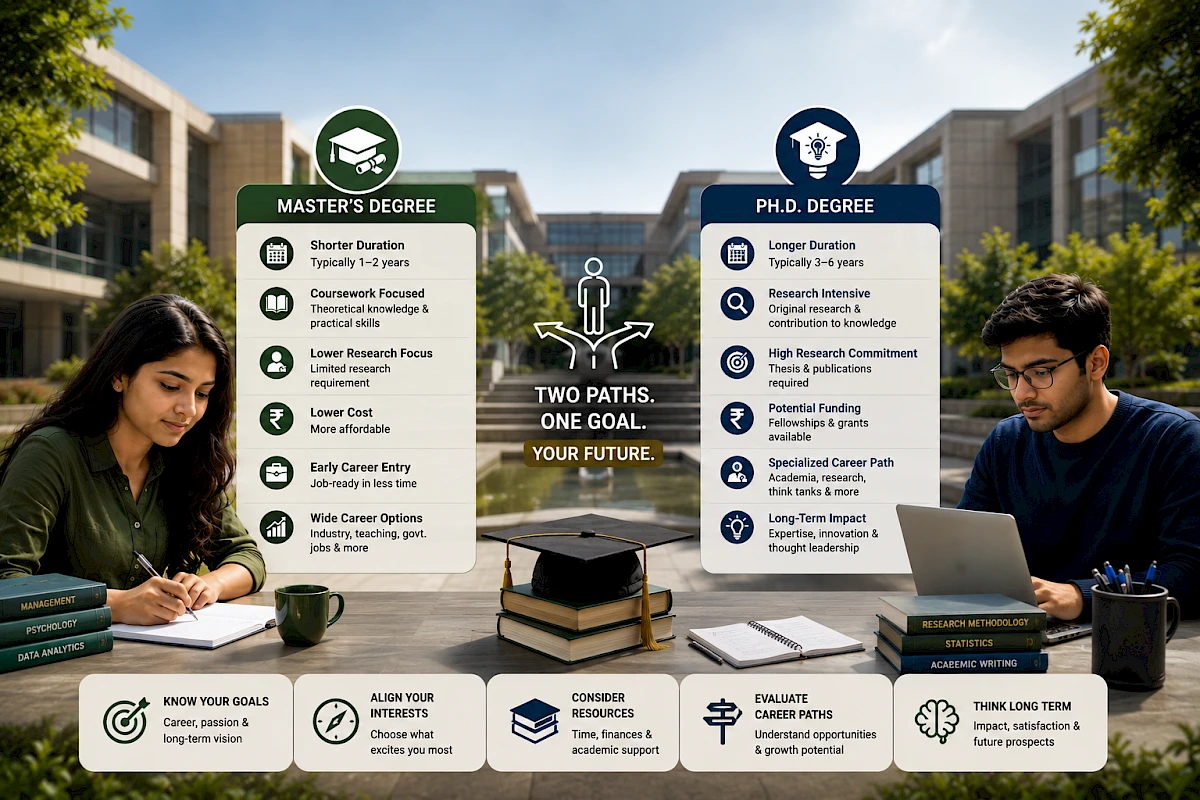
Ph.D. vs Master's: Side-by-Side Comparison
Here is how the two compare when placed side by side.
Feature | Master's Degree | Ph.D. |
Duration | 2 years | 5 years |
Primary focus | Deepening existing knowledge for the job market | Original research contributing new knowledge to the field |
Structure | Coursework, seminars, and a short thesis or capstone project | Initial coursework, then independent research and a dissertation |
Eligibility | A relevant bachelor's degree | A relevant master's degree, though direct entry after a 4-year bachelor's is possible at some institutes |
Admissions | Merit & certificates of CSIR, UGC-NET, GATE, etc. (if applicable) | Standardized exams such as CSIR, UGC, GATE, etc, plus interviews |
Funding | Stipend for teaching and research assistantships | Often funded through teaching and research assistantships |
Career path | Specialized corporate, government, or professional roles | Professorships, post-doctoral research, or senior R&D roles |
The Real Numbers: How Many Indians Are Choosing a Ph.D.
Doctoral study in India has picked up sharply in the most recent data. According to the Ministry of Education's All India Survey on Higher Education (AISHE) 2023-24, total Ph.D. enrolment across the country reached 3.44 lakh students, up from 1.17 lakh in 2014-15 and a sharp jump from 2.33 lakh just the year before, in 2022-23. Female Ph.D. enrolment climbed to 1.71 lakh in 2023-24, more than tripling from 47,717 in 2014-15 and now accounting for roughly half of all doctoral scholars in the country.
Even with this surge, Ph.D. enrolment still makes up under 1% of India's total higher education enrolment of 4.5 crore students, which confirms the same point as before: doctoral study is growing fast, but it remains a genuinely selective path.
Indicator | 2014-15 | 2022-23 | 2023-24 | Change (2014-15 to 2023-24) |
Total Ph.D. enrolment in India | 1.17 lakh | 2.33 lakh | 3.44 lakh | Up 193% |
Women enrolled in Ph.D. programs | 47,717 | — | 1.71 lakh | Up roughly 259% |
Source:All India Survey on Higher Education (AISHE) 2023-24, Ministry of Education, Government of India, released July 8, 2026.
What a Master's Degree Actually Involves
A master's degree in India typically runs for one to two years and works like an extension of your undergraduate study, covering more advanced concepts. You will sit through structured coursework, attend seminars, and usually close the program with a short thesis or a capstone project rather than years of independent research.
Programs like an “M.A., M.Sc., or M.Tech” exist to make you job-ready faster. They deepen the theoretical and practical knowledge you already have so you can walk into specialized corporate, government, or professional roles right after graduating.
- Outcome- A specialized, job-ready skill set rather than original research.
- Best for- Students who want to move into the workforce within two years with a stronger, more specialized qualification.
What a Ph.D. Actually Involves
A Ph.D., or Doctor of Philosophy, is a different commitment altogether. Where a master's degree teaches you what is already known, a Ph.D. asks you to add something new to it. Most Ph.D. programs in India run for three to six years, starting with six to eight months of mandatory coursework before you move into independent research, writing, and eventually the dissertation defense. This is not a faster or harder version of a master's degree. It is a research career in miniature, built around a single question you spend years answering.
- Outcome- Original research that contributes new knowledge to your field.
- Best for- Students aiming for careers in research, academia, or advanced R&D roles that require original research expertise.
So, Which One Is Actually Higher?
A Ph.D. ranks above a master's degree. It is the highest academic qualification you can earn, and it sits at the top of the academic ladder for a reason- It demands original research and years of sustained, independent work that a master's simply does not ask of you. But higher does not automatically mean better for you personally.
A master's degree can outperform a Ph.D. on return over time if your goal is a corporate or industry role, since it gets you into the workforce faster with a specialized, job-ready skill set. A Ph.D. makes sense when your goal is research, teaching, or a senior R&D position that specifically requires it. Treat the hierarchy as a fact about the degree, not a verdict on which path suits your career.
Funding: A Real Point of Difference, With Real Numbers
The cost of a postgraduate degree isn't just about tuition fees. Many research-intensive universities now offer substantial financial support that can make both master's and Ph.D. programs far more affordable. Depending on the program and your academic performance, this support may include stipends, tuition waivers, research grants, assistantships, and subsidized accommodation.
Institution-Funded Support | Typical Benefit |
Ph.D. stipend (Years 1-2) | ₹45,000/month |
Ph.D. stipend (Years 3-5) | ₹50,000/month |
Research grant | Up to ₹1,50,000 for conference travel (domestic/international) and research dissemination |
Teaching/Research Assistantship (Master's) | ₹12,000/month if you’re eligible |
Annual tuition fee waiver (Ph.D.) | ₹60,000/year |
Looking beyond tuition fees can completely change the value of a postgraduate program. A strong funding package can reduce your overall expenses while giving you opportunities to build teaching experience, present your research at conferences, and focus more on your academic work instead of worrying about finances. When comparing universities, evaluate the complete financial support package, not just the program fee.
Choosing Between a Master's and a Ph.D.? Here's Every Shiv Nadar University (Institution of Eminence) Program That Fits
Shiv Nadar University was founded in 2011 by Mr. Shiv Nadar, founder of HCL, through the Shiv Nadar Foundation, and sits on a 286-acre residential campus in Greater Noida, Delhi-NCR. Research and learning span four schools: the School of Engineering, the School of Natural Sciences, the School of Humanities and Social Sciences, and the School of Management and Entrepreneurship, each offering programs from the undergraduate to the doctoral level and drawing students from more than 28 states across India.
If you are trying to choose between the two degrees, here is what makes Shiv Nadar University worth putting on your shortlist-
- Institution of Eminence Status: one of the few Indian universities to hold this Ministry of Education recognition, reflecting its research and academic standing.
- Integrated M.Sc.-Ph.D. tracks in Chemistry and in Life Sciences, letting you move from a master's into doctoral research on one continuous track instead of applying twice.
- A Direct Pathway to the United States: accelerated MS programs in Software Engineering, Software Engineering with a Cybersecurity specialization, Computer Science, and AI in Business, delivered jointly with Arizona State University, typically beginning at Shiv Nadar University before you transfer to complete the degree at ASU.
- Transparent Doctoral Funding: a published fee, stipend, and refund policy for doctoral scholars each admission cycle, so you can see the numbers before you commit.
Both Paths Under One Roof: Shiv Nadar University runs Master's and Ph.D. programs together, department by department.
School / Area | Master's Programs | Ph.D. Programmes |
School of Engineering | — | Chemical, Civil, Computer Science, Electrical, Electronics and Communication, Mechanical Engineering |
School of Natural Sciences | Integrated M.Sc.-Ph.D. in Chemistry; Integrated M.Sc.-Ph.D. in Life Sciences | Chemistry, Life Sciences/Bioinformatics, Mathematics, Physics |
School of Humanities and Social Sciences | M.Sc. Economics, M.A. English, Master of Fine Arts, M.A. Rural Management | Economics, English, History and Archaeology, International Relations and Governance Studies, Sociology |
School of Management and Entrepreneurship | MBA, MS Software Engineering, MS Software Engineering (Cybersecurity), MS Computer Science, MS AI in Business | Ph.D. in Management (Executive) |
Not sure which program fits your goals? Shortlist your department from the table above and check its specific eligibility and fee structure on the Shiv Nadar University admissions page before your application window closes.
Conclusion
A Ph.D. outranks a master's degree on paper, but rank was never really the question you needed answered. The real question is which structure, timeline, and outcome match what you are actually trying to build for yourself.
A master's degree moves you into the workforce faster with focused, applicable expertise. A Ph.D. asks for more time and independence but leads somewhere a master's degree cannot, alongside a stipend that can support you while you study.
If you're ready to take the next step, explore the master's and Ph.D. programs at Shiv Nadar University and choose the academic path that aligns with your long-term goals.
FAQs
Is it possible to skip a master's degree?
Yes, you do not always need a master's degree before starting a Ph.D. Many top Indian institutes, including the IITs, IISc, and Shiv Nadar University, offer integrated or direct-entry Ph.D. programs that let you move from a bachelor's degree straight into doctoral research.
What is the difference between a Ph.D. and a Master's degree in India?
A master's is a 1-2 year, coursework-based degree that deepens existing knowledge for the job market, while a Ph.D. is a 3-6 year research degree requiring original, independent work culminating in a dissertation.
Can I do a Ph.D. directly after a Bachelor's degree without a Master's?
Yes, with a 4-year bachelor's degree and the required CGPA, institutes like the IITs, IISc, and Shiv Nadar University allow direct entry into a Ph.D. without a master's in between.
Which is better for a career, a Ph.D. or a Master's degree?
Depends on the goal: a master's gets you into a corporate role faster with specialized skills; a Ph.D. suits research, teaching, or senior R&D roles that specifically require a doctorate.