Number 21
HIMALAYAS PLUS
JULY-AUGUST 2026
Dear All,
Greetings from the Centre of Excellence for Himalayan Studies (CHS), Shiv Nadar Institution of Eminence (SNIoE). We are pleased to present the 21st edition of our Newsletter, covering the months of July and August 2026. Previous editions of HIMALAYAS PLUS can be accessed on our website.
Announcements
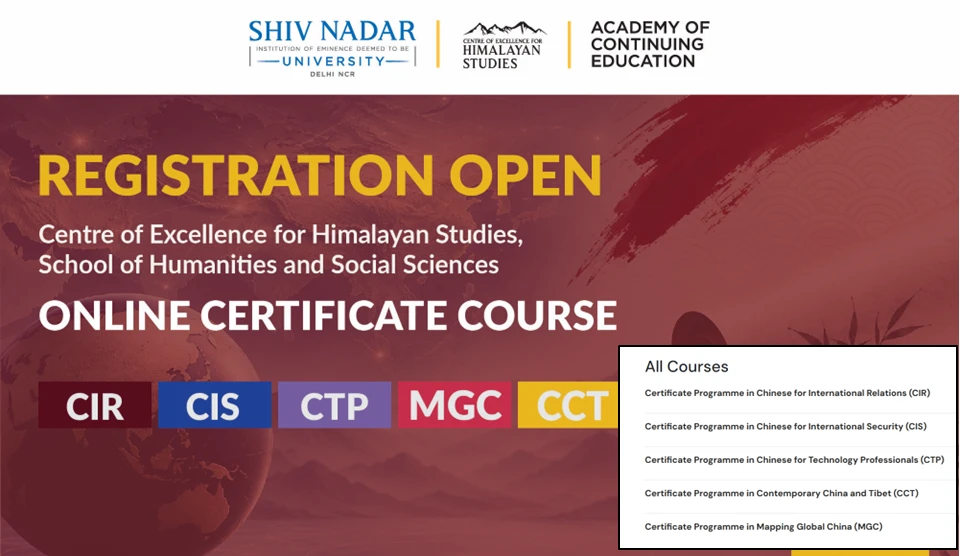
The Centre has launched a suite of online certificate courses on China, its language, its politics, and its global engagement. Taught live online by specialists, the five programmes comprise three Mandarin language courses tailored to specific professional fields (Chinese for International Relations, Chinese for International Security, and Chinese for Technology Professionals) and two courses on Chinese domestic politics (Contemporary China and Tibet) and China’s engagements outside its borders (Mapping Global China). All are open to applicants holding an undergraduate degree, while the Mandarin courses require no prior knowledge of the language. To know more about the CHS online courses, click here.
In early August, the Centre signed a MoU with Visva-Bharati University, Santiniketan, West Bengal to increase engagement with India’s oldest institution devoted to the learning of Chinese language and culture, Cheena Bhavana. Under the three-year agreement, CHS will host short-term internships for Chinese-language students of the Department of Chinese Language and Culture, and its faculty will deliver regular online lecture modules on China’s domestic politics, foreign and security policies, and research methods.
The Centre’s 2026 online Summer Internship Programme in Chinese language and studies, concluded on 20 July. This year’s cohort comprised five interns, three from Visva-Bharati University and two from Jawaharlal Nehru University, who completed 120 hours of work over two months, working with the Centre on Chinese-language and research tasks.
Publications
James Leibold, Non-Resident Senior Fellow at the CHS, examined the transformation of ethnic governance under Xi Jinping across a cluster of writings. In China Brief (Vol. 26, No. 10), his essay “New Law Engineers Unity” analyses China’s new Law on Promoting Ethnic Unity and Progress, arguing that it turns the Party’s campaign to “forge the collective consciousness of the Chinese nation” into a comprehensive system of social and political governance. Writing in Foreign Affairs with Tenzin Dorjee, Director of Research and Advocacy at Tibet Action Institute, he argues that the Law marks a major erosion of ethnic autonomy, amounting in effect to a policy of forced assimilation of Tibetans, Uyghurs, Mongols and other minorities.
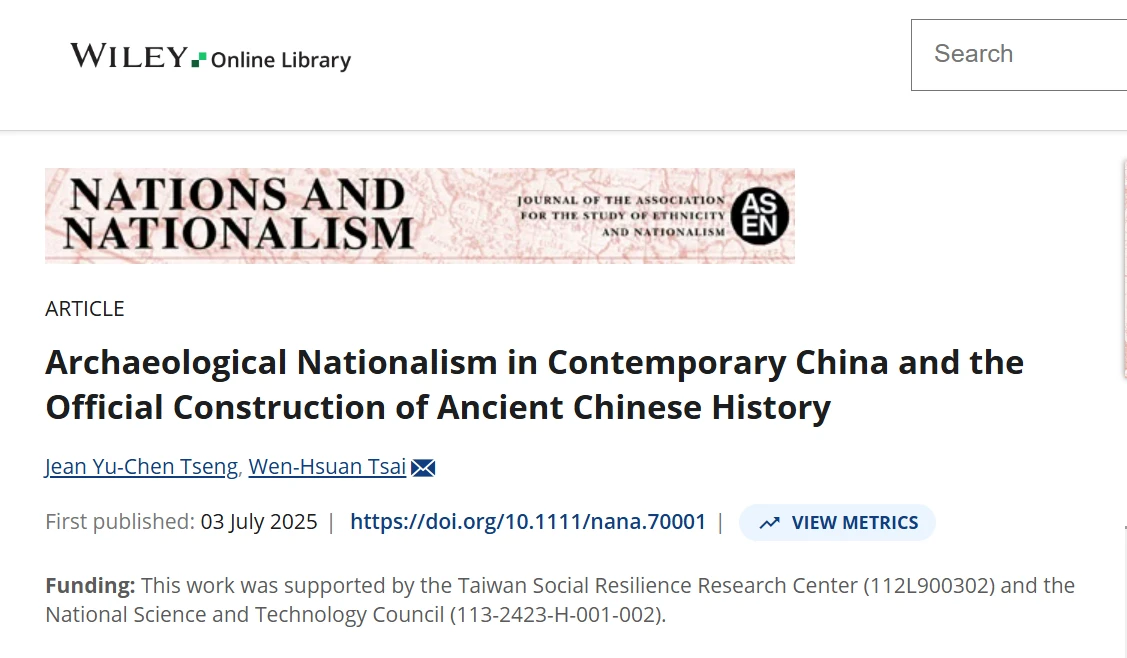
Wen-Hsuan Tsai, Non-Resident Senior Fellow, published two journal articles. Writing with Jean Yu-Chen Tseng from National Defence University, Taiwan, in Nations and Nationalism (Vol. 32, No. 3, July 2026), he examines how contemporary China deploys archaeology in the service of nationalism, showing how the state constructs an official narrative of ancient Chinese history to underwrite present-day claims about the nation. In China Report (Vol. 62, No. 3, August 2026), he explains the dramatic policy shifts of Xi Jinping’s China through the interplay of agency, structure and conjuncture, arguing that major reversals reflect not caprice but the alignment of leadership choices with structural conditions and moments of opportunity.
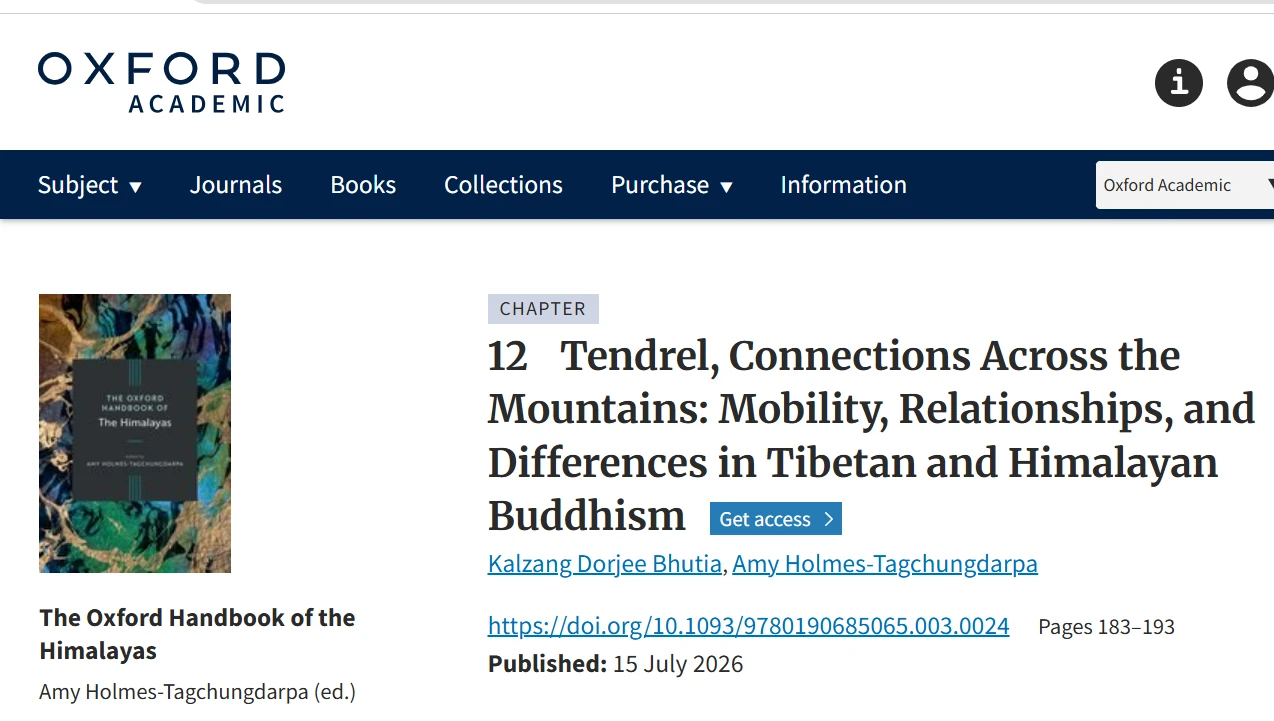
Kalzang Dorjee Bhutia, Non-Resident Senior Fellow, co-wrote a chapter with Amy Holmes-Tagchungdarpa, Associate Professor of Religious Studies and Asian Studies at Occidental College, “Tendrel, Connections Across the Mountains,” in the Oxford Handbook of the Himalayas (Oxford University Press, 2026). Taking the Tibetan and Himalayan idea of tendrel, or interdependent connection, as its thread, the chapter explores what binds together the diverse communities of the Tibetan plateau and the wider Himalayan region across geography, religion and everyday life.
Rinan Shah, former Post-Doctoral Fellow, in an Issue Brief, examines how water protection committees and the traditional institution of the samaj govern shared water rights in Darjeeling. She shows how community-based arrangements, rather than formal state provision, shape access to a scarce and contested resource, and considers what these local practices mean for equitable water governance in the eastern Himalaya.
Under the Centre’s “On China” column with The Tribune daily, Anand P. Krishnan, CHS Fellow, argues that Indian economists advising the government on China tend to gloss over Chinese domestic politics. By treating the economy in isolation from the ruling Communist Party’s tight political control over it, he contends, such analyses present a blurred picture of how decisions are actually made in China and highlights the risks this approach poses for Indian policy.
The Centre also published several Commentaries particularly covering the intersection of environment and governance. Uttam Lal, Non-Resident Fellow, and Mohan Sharma, PhD scholar, University of Sikkim, examine the tensions between customary fire-use by local communities and conservation policy in the Dibang Valley of Arunachal Pradesh, showing how fire regimes long central to local livelihoods now collide with state conservation priorities. Rhythm Prashar, PhD scholar at the Kautilya School of Public Policy, argues that the lack a common framework for regional governance in Hindu Kush Himalayas despite being a shared ecological pole limits cooperation on climate, water and disaster risk across the region’s many states. Dixchen Golay, PhD candidate at the Department of Geography, Sikkim University, meanwhile, analyses the crisis of economic sustainability facing Darjeeling tea, tracing how ageing bushes, closed gardens and labour outmigration threaten a globally prized industry.
Under the theme of geopolitics, Bahram Kalviri, PhD Scholar, University of Hyderabad, reads Khamenei’s funeral as a four-tier signal of Iran’s foreign policy, arguing that the choreography of mourning encoded distinct messages to domestic, regional and international audiences. Sruthi Kalyani, Policy Fellow, Indian Institute of Science, examines the Chinese statecraft behind open-weight Artificial Intelligence, arguing that China’s embrace of open models is a deliberate strategic choice with consequences for global technology competition.
Turning to history, Nataliya Singh, PhD scholar, Centre for Historical Studies, Jawaharlal Nehru University, revisits the earliest phase of Nicholas Roerich’s Central Asian expedition, situating the artist-explorer’s wide-ranging travels within the contested geographies of the Himalaya and Central Asia.
Translation remained central to the Centre’s dissemination during July and August, widening the readership for its research well beyond English. A commentary by Jabin T. Jacob, Director, and Devendra Kumar, Associate Fellow, on China’s administrative changes in Aksai Chin appeared in Chinese, Tibetan, Punjabi and Urdu; Anand P. Krishnan’s analysis of India’s CCTV ecosystem in Chinese, Punjabi and Urdu, and his Occasional Paper on India’s economic relations with China in Chinese; and a piece by Claude Arpi, CHS Distinguished Fellow, on trade and the Kailash Yatra in Nepali. A co-authored piece by Kalzang Dorjee Bhutia and colleagues on reclaiming the khatak was translated into Nepali while Atul Kumar’s essay on the US-Israel-Iran war was translated into Chinese, Hindi and Urdu; Amrita Saikia’s commentary on the forcibly displaced Chin into Tibetan and Urdu; Fida Hussain Tangrhong’s piece on Ladakh’s tourism economy into Tibetan; and Shih-Ting Lin’s Issue Brief on Chinese citizens in Pakistan into Chinese.
In the Media
Jabin T. Jacob appeared on Taiwan Talks (TaiwanPlus, Episode 883) to discuss the Chinese Communist Party at 105, tracing how the Party has evolved from Mao to Xi and what may lie ahead as the 2027 Party Congress approaches. Writing for Think China, Wen-Hsuan Tsai profiled Communist Party of China Politburo Standing Committee member Cai Qi’s rise, the positions that anchor his influence, what his standing tells us about how power is really structured under Xi, and what role he may play as the Party prepares for its National Congress in 2027. Devendra Kumar was quoted in the South China Morning Post on how China’s anti-corruption campaign became one of Xi Jinping’s most important policies.
James Leibold undertook substantial international media work on China’s new Ethnic Unity Law and its implications for Tibetans, Uyghurs, Mongols and other minority communities, including contributions and features in Al Jazeera, Radio Free Asia and SBS News. Kaveri Gill, Non-Resident Senior Fellow, joined Taiwan Talks on TaiwanPlus, alongside Khedroob Thondup, nephew of the 14th Dalai Lama, to discuss the Dalai Lama’s succession, Beijing’s claim to approve the next Dalai Lama, the Gaden Phodrang Trust’s authority over the reincarnation, and the unresolved case of the Panchen Lama.
On Malaysia’s Awani International, meanwhile, Jacob discussed ASEAN’s strategic future in an evolving Global South, and was quoted in a related report arguing that ASEAN needs a deeper understanding of both China and India to protect its own interests and agency. In a piece for the Scroll, Anand P. Krishnan referenced one of the greatest global sporting competitions, the FIFA World Cup, to note that even with China’s national team absent, Chinese corporate sponsors were ubiquitous across the tournament.

Faculty Updates
Jabin T. Jacob was a panellist at the 39th Asia-Pacific Roundtable, organised by the Malaysia Institute of Strategic and International Studies in Kuala Lumpur (1 July), speaking on Sino-Indian tectonics in the Global South; and at the 2026 Ketagalan Forum: Indo-Pacific Security Dialogue (4 August), on countering China’s gray-zone coercion and constructing a new framework for Indo-Pacific regional joint defence.
Kalzang Dorjee Bhutia presented a paper, “Lap as an Indigenous Framework for Multispecies Responsibility and Wellbeing in the Sikkim Himalayas,” at the Native American and Indigenous Studies Association Annual Conference in Temuco, Wallmapu, Chile (July), sharing approaches to interspecies ethics with other indigenous mountain communities in South America.
Devendra Kumar presented a paper, “Writing Belonging: Han Cadre Memoirs and Frontier Memory in Tibet,” at the Australian Centre on China in the World Annual Forum, “From Mao to Now,” at the Australian National University, Canberra (11 to 13 August).
Claude Arpi, Distinguished Fellow, delivered four talks via Video Conferencing to the 5 Mountain Division of the Indian Army at Tenga, Arunachal Pradesh in August. He covered the India-Tibet boundary, the McMahon Line and Tawang, the Dalai Lamas’ historical significance and the India-Tibet boundary’s historical legacy and future prospects.
You can stay updated with our publications, events, and activities through our website, X (@Himalayas_SNU), Facebook, LinkedIn and Instagram. You can also find previous Newsletters here.
Share this: