The Great Engineering Debate: B.E. vs B.Tech. in a Startup-Driven India
Blog / April 06, 2026
For most 10+2 students in India, the walk from the board exam hall to the college admissions office is paved with glossy brochures and a single, nagging question: "Should I choose a Bachelor of Engineering (B.E.) or a Bachelor of Technology (B.Tech.)?" This is not just a race for a respected course; for many students, it feels like a risky bet. India is experiencing significant changes with "Industry 4.0," where automation and AI are changing how work is done. This shift is causing a lot of anxiety about the future.
The primary debate of B.E. vs. B.Tech. often triggers a "reputation trap." Students spend countless hours on ranking forums, confused by the fear that the "wrong" title might disqualify them from a future at a top-tier tech firm or a prestigious research lab. However, you might realise later that the title on your degree is becoming secondary to your technical agility.
To make the right choice, we need to look beyond the shiny brochures. Understanding your future means exploring the deep ideas behind these degrees and understanding how they fit into today’s tough, venture-backed economy.
Theoretical Roots vs. Practical Wings: The Philosophical Divide
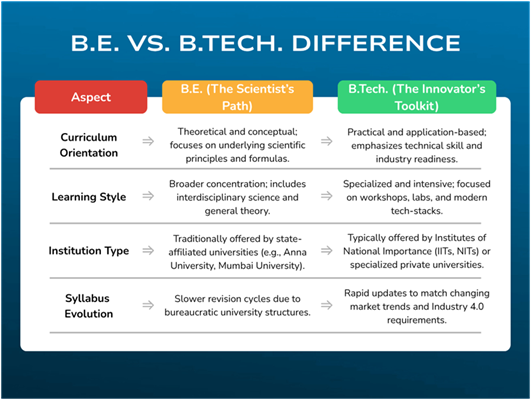
At their core, B.E. and B.Tech. programs are designed to produce different cognitive outputs. While both are recognized four-year undergraduate degrees accredited by the All India Council for Technical Education (AICTE), they diverge in their fundamental approach to the "how" and "why" of technology.
The Strategic "So What?"
For a student aiming for a Ph.D. at a global research powerhouse, the B.E.’s focus on foundational theory (the "Scientist's Path") provides an intellectual bedrock. However, for those looking to dive into India’s startup ecosystem, the B.Tech. acts as a high-velocity toolkit. Startups lack the luxury of six-month training buffers; they need "industry-ready" graduates who can contribute to a codebase or a hardware prototype on day one.
The Employability Crisis: Why an Engineering Degree Isn’t Enough
India produces 1.5 million engineers every year. However, companies are struggling to find enough skilled workers. A degree is no longer a guaranteed path to a job; it is just the first step in the competition.
The statistics from the National Employability Report are alarming—
- The 7% Reality: Only 7% of Indian engineering graduates are considered immediately employable in the knowledge economy.
- The Coding Crisis: 37.7% of Indian engineers cannot write error-free code, compared to a mere 10.35% failure rate in China.
- The Agility Gap: Only 3.84% of engineers possess the technical agility required for software roles in the startup ecosystem.
- New-Age Scarcity: Proficiency in deep-tech areas like AI and machine learning sits at a dismal 1.5% to 1.7%.
For students, these metrics mean that a college’s brand name is far less important than the presence of a rigorous, modern coding culture.
A recent report says, "Engineering has become a de-facto graduate degree for a large chunk of students today. However, along with improving the education standards, it is essential that we evolve our undergraduate programs to make them more job centric." - Varun Aggarwal, CTO, Aspiring Minds.
Why Shiv Nadar University (Institution of Eminence) is Redefining What B.Tech. Can Be
To see the future of this debate, one must look at institutions that have already discarded the outdated B.E./B.Tech. silos in favor of a research-led, multidisciplinary model. Shiv Nadar University stands as a concrete answer to the limitations of traditional engineering education.
Shiv Nadar University’s B.Tech programs are intentionally designed to combat the "employability gap" by treating students as creators, not just consumers. The university offers a robust suite of majors, including-
- Computer Science and Engineering (CSE)
- Mechanical Engineering
- Civil Engineering
- Electrical and Computer Engineering
- Chemical Engineering (including specialized tracks that reflect modern industrial needs).
The university’s core strength lies in its "research-led" undergraduate experience. At Shiv Nadar University, multidisciplinary electives and merit-based scholarships ensure that a Chemical Engineering student isn't just learning about pipes and valves but perhaps about the AI-driven optimization of chemical sensors. This approach directly addresses the 1.5% skill gap in new-age technologies by weaving AI, ML, and research methodology into the curriculum of the traditional B.Tech majors.
Conclusion
In a "VUCA" (Volatile, Uncertain, Complex, and Ambiguous) world, the market is shifting. Data from the Economic Times shows that hiring is moving to Tier-2 and Tier-3 campuses as companies like Flipkart and Godrej seek "on-ground agility" and better cultural fits over top-tier labels.
Recruiters today care far less about whether your degree says B.E. or B.Tech. and far more about the quality of the code you write, the IP you helped develop, and your ability to learn, unlearn, and relearn. The ultimate competitive advantage is the "correct institute" and the "correct attitude."
As you stand at this crossroads, ask yourself one final question: Is your goal to hold a degree or to build the future of India's technology landscape?
FAQs
- Which is better between B.E. and B.Tech.?
Neither is inherently better. B.E. builds theoretical depth, while B.Tech emphasizes practical skills. Your institute, coding culture, and real-world exposure matter far more than the degree title.
- Which one should I choose, B.E. or B.Tech.?
Choose based on your career goal: B.E. suits research-oriented paths, while B.Tech. fits industry roles.
- Which has more salary, B.E. or B.Tech.?
Recruiters prioritize skills, problem-solving ability, and project experience. A skilled graduate from either path can outperform peers regardless of degree title.
- Is B.Tech. tougher than B.E.?
B.E. can be conceptually intensive, while B.Tech. is practically demanding. The real challenge lies in mastering relevant skills and staying industry-ready.
- Why is B.Tech. better than B.E.?
B.Tech. isn’t universally better; it often appears so due to its practical, industry-aligned curriculum.