Choosing Between B.Sc. or B.Tech.? Here's What 2026 Job Trends Say
Blog / April 01, 2026
When students complete 12th grade, one of the most critical choices to be made is what degree to pursue. Given that generative AI, green technology, and data-driven decision-making were once considered "trends" but are now entering 2026 as "industry standards," the debate over whether to pursue a B.Sc. or B.Tech. has never been more pertinent.
Both degrees can prepare you for an excellent base in science and technology; however, each program provides you with different career pathways. This guide explores the job market, salary information, and statistics associated with both degree types, as well as top jobs currently expected by 2026.
Defining the 2026 Academic Landscape
The differentiation between the two degrees has changed. Although the substantive distinction is still there, the discipline of B.Sc. is theoretical, and the discipline of B.Tech. being application-based professional degree, the boundaries are increasingly becoming blurry.
- B.Tech. (Bachelor of Technology)- It is a 4-year professional course. It's 2026 and the curriculum has changed to incorporate AI, robotics, and sustainability as part of the core of engineering self-design.
- B.Sc. (Bachelor of Science)- The 3-year degree is traditional, with most of the higher-end Indian institutions currently providing honours tracks of 4-years, under the New Education Policy (NEP). It pays attention to the why of the science, thereby laying the foundation of research and advanced analytics.
2026 Job Market Trends: Where is the Demand?
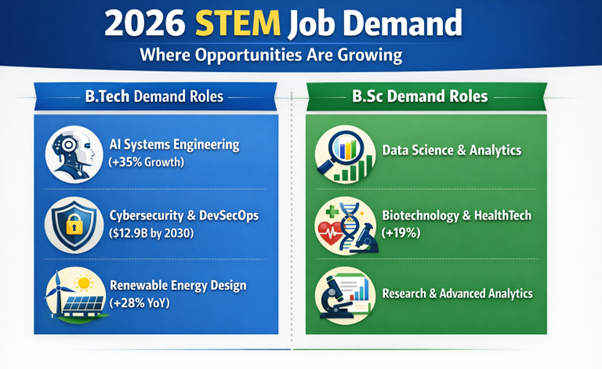
According to recent industry reports, the Indian tech sector is seeing a 35% year-on-year growth in AI and Data Science roles. However, the "entry gate" differs by degree.
The B.Tech. Stronghold: Engineering & Infrastructure
For "core" technical roles, B.Tech. remains the gold standard. Employers in 2026 prioritise B.Tech. graduates for:
- AI Systems Engineering- Developing and embedding AI algorithms into physical hardware.
- Cybersecurity & DevSecOps- A market projected to reach $12.9 billion by 2030, favouring the rigorous systems-design training of engineers.
- Renewable Energy Design- With a 28% YoY growth, B.Tech. in Electrical or Civil engineering is essential for the burgeoning green-tech infrastructure.
The B.Sc. Surge: The Insights Economy
B.Sc. graduates are no longer restricted to labs. They are the preferred choice in the "Insights Economy," where deep subject matter expertise is required:
- Data Science & Analytics- While engineers build the pipelines, B.Sc. Statistics and Math graduates are often better equipped to handle high-level data modelling and causal inference.
- Biotechnology & HealthTech- Driven by the 19% growth in the Biomedical sector, B.Sc. graduates are leading research in gene editing and personalized medicine.
Salary and ROI Analysis: The 2026 Data
When debating which is better: B.Sc. or B.Tech., financial return is a critical metric. The upfront cost of a B.Tech. is generally higher, but the starting "floor" is also elevated.
Starting Salary Comparison (2026 Estimates)
Metric | B.Tech. (Professional) | B.Sc. (Academic/Honors) |
Average Starting Salary | ₹4.6 LPA – ₹8 LPA | ₹2.4 LPA – ₹4.5 LPA |
High-End (Specialized) | ₹18 LPA – ₹40 LPA (AI/Blockchain) | ₹8 LPA – ₹15 LPA (Data Science) |
Course Fees (Avg) | ₹4 Lakh – ₹15 Lakh | ₹30,000 – ₹2 Lakh |
Time to Market | 4 Years | 3 Years |
The ROI Factor- A B.Sc. graduate enters the workforce one year earlier. For a student on a budget, this extra year of earning (and lower debt) can significantly offset the initial salary gap, especially if paired with a targeted M.Sc. or specialized certifications.
The "AI-Proof" Skillset: Which Degree Wins?
In 2026, the coding process is becoming more automated. The skills that cannot be duplicated by AI include Creative Problem-Solving, Ethical Judgment, and Systems Integration that are also sought after by recruiters.
- B.Tech. Advantage- The 4-year course includes compulsory internships and Capstone projects. AI tools affect 45% of the work in the engineering field; B.Tech. programs are uniquely designed to train the top engineers to use AI as a co-pilot in the construction of complex systems.
- B.Sc. Advantage- The focus on pure logic and theory provides a "first-principles" understanding. In a world where AI tools change every six months, the ability to understand the underlying mathematics or biology is a long-term career shield.
Strategic Pathways: Making the Final Choice
In order to determine which is superior, B.Sc. or B.Tech. in your particular case, consider purpose in comparison to these 2026 archetypes:
Choose B.Tech. if:
- Want Direct Entry to Industry - You would like to be a Software Architect, ML Engineer, or Robotics Specialist right after you graduate.
- Are Interested in Product Creation- You are interested in creating, designing, and maintaining physical (or online) products.
- Want to Explore High-Stakes Tech- You prefer to be in the industries of Aerospace, Defence, or Autonomous Vehicles, where engineering rigour and professional licensure are a deal-breaker.
Read Also: B.Tech. Courses List
Choose B.Sc. if:
- Research & Discovery Excites You- You are aiming to become a scientist, researcher or specialized consultant in some of the fields, such as Quantum Computing or Bio-Genetics.
- Want Fast-Track to Masters- You plan on pursuing an MBA, M.Sc., or Ph.D. abroad. The 3-year B.Sc. allows you to start your Master's while peers are still in their final year of B.Tech.
- Are Interested in Data & Analysis- You prefer working with numbers, patterns, and business intelligence rather than "hardcore" system coding.
Shiv Nadar University (Institution of Eminence): A 2026 Perspective on STEM Education
Shiv Nadar University, Delhi NCR, is one of the institutions that has designed its B.Tech. and B.Sc. programs to align with the modern landscape of STEM Education. Given the fact that it incorporates research as part of the undergraduate core, the university provides a unique environment in which the boundaries between the traditional distinction of academic and professional degrees are deliberately crossed.
At Shiv Nadar University, the School of Engineering and School of Natural Sciences focus on the aspect of multidisciplinary learning, and this enables students to tailor their education experience whether pursuing a B.Sc. or B.Tech.
1. B.Tech. at the School of Engineering (SoE)
B.Tech. programs at Shiv Nadar University are the 4-year professional degrees that they have with a Common First Year, where all the engineers have a common foundation, after which they are allowed to specialize.
- Major Specializations- Computer Science and Engineering, Electrical and Computer Engineering, Mechanical, Civil, and Chemical Engineering.
- Industry-Ready Tracks- Students have the option of cutting-edge minors, as well as tracks in Artificial Intelligence, Data Science, Cyber Security, and VLSI Design.
- The "REAL" Benefit- The course incorporates "Research, Experiential, and Applied Learning" (REAL) credits, so that the B.Tech. students would not just be technology consumers, but the creators of it.
- Starting Salaries - The average package at Shiv Nadar University is about 9.81 LPA, with the best packages (especially in CSE) going up to 50.79 LPA.
2. B.Sc. (Research) at the School of Natural Sciences
Shiv Nadar University has a 4-year B.Sc. (Research) degree, rather than the standard 3-year program. This additional year plays a vital role in students who want to achieve global parity because it fulfills the 16-year education requirement of most international Master and Ph.D. courses.
- Specializations Offered- Physics, Chemistry, Mathematics, and Biotechnology.
- The Research Edge- Since the second year, students are advised to join the Opportunities for Undergraduate Research (OUR) program, which involves collaboration with faculty on published scientific papers.
- Interdisciplinary Flexibility- With a Mathematics major, students can take minors in Computer Science, which is essentially the equivalent in terms of critical analysis of a scientist and the ability of an engineer to code.
Conclusion
In 2026, the workforce will reward flexibility. A B.Tech. degree can give a quicker entry point in well-compensated technical positions, whereas a B.Sc. can offer an economical and versatile base to specialization and research students.
After all, whether it’s B.Sc. or B.Tech., the degree that fits your financial situation and your intellectual interests is the better one. Both of these careers, with the correct certifications in AI and data literacy, result in well-rounded careers in the new digital economy.
FAQs
- B.Sc. or B.Tech. which is better?
A. It depends on your goals - B.Tech. is better for engineering careers and higher immediate job prospects, while B.Sc. suits research, academics, or specialized science fields.
Q. Which B.Sc. has more salary?
A. B.Sc. in fields like Computer Science, Data Science, Biotechnology, or Nursing generally offer higher salary potential.
Q. Can I do B.Sc. before B.Tech.?
A. Yes, you can pursue B.Sc. first and then apply for B.Tech. through lateral entry or fresh admission.
Q. Can I get 1 lakh salary after B.Tech.?
A. Yes, it’s possible with strong skills, good college placement, or high-demand fields like software development, though not guaranteed for everyone.