How Can I Get Admission in MBA in 2026 - A Student's Complete Guide

Blog / April 08, 2026
As per the data from the last year revealed by the conducting body, approximately 2.85 lakh students appeared for the CAT exam in 2025 out of 2.95 lakh registered. So the attendance was around 86%. This reflects that the demand for an MBA continues to grow.
Applying for an MBA in 2026 is not just a degree- a career accelerator, a network builder, and for many, a life-changing decision.
But here is the harsh reality—many students who want to pursue an MBA course have no idea where to start. The process feels overwhelming due to numerous factors- multiple entrance exams, strict deadlines, GD/PI rounds, SOP submissions, and thousands of colleges to choose from.
If you are searching "How can I get admission to an MBA?" on a search engine to find a quick, simple procedure to understand, this guide is for you.
MBA Admission Timeline for 2026
Starting your planning early really helps you avoid missing deadlines and prepare properly for each MBA admission stage. Below is a general overview of the month-by-month timeline for 2026-
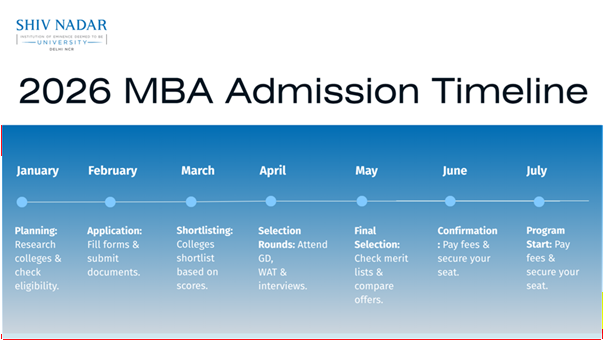
Step-by-Step MBA Admission Process in 2026
Here is the full process, broken down into actionable steps. Follow this in order, and you will not miss anything.
Step 1- Self-Assessment and Goal Setting
This is the step most students skip, and it is the most important one.
Before you open any application form, spend time answering these questions honestly-
- What industry excites me?
- What career do I want five years after my MBA?
- Do I want to stay in India or consider global programs?
- How much can I invest in this degree (time and money)?
- What are my current academic and professional strengths?
Your answers determine which MBA format suits you, which specialization to choose, which colleges to target, as well as how to present yourself in your SOP and PI.
Step 2- Research and Shortlist Colleges
India has more than 5,000 MBA colleges. You need to narrow this down to 8-12 colleges as your options, which you will actually apply to. Use the factors below to evaluate colleges-
- NIRF Rankings
- Placement records
- ROI
- Specializations offered
- Faculty quality
- Alumni network
- Location
Step 3- Register for Entrance Exams
Based on your college shortlist, register for the appropriate exams. Most serious candidates register for at least two exams- for example, CAT plus XAT or CAT plus CMAT- as backup options.
Step 4- Prepare for Entrance Exams
This is where the real work begins. Here is a practical preparation strategy.
How long do you need?
- 6 months- Ideal, gives you time to build concepts and practice as well as take multiple mock tests
- 3 months- Aggressive but doable if you are consistent and already have a strong academic foundation
- Less than 3 months- Very difficult for CAT-level exams; consider appearing for MAT or CMAT instead
Step 5- Fill Out College Application Forms
After your entrance exam, you will have a score to work with. Now it is time to apply to your shortlisted colleges.
Application form checklist:
- Entrance exam scorecard
- Graduation mark sheets (all semesters/years)
- Class 10 and Class 12 mark sheets
- Government-issued ID proof (Aadhaar/Passport/PAN)
- Passport-size photographs
- Work experience certificates (if applicable)
- Resume or CV
- Statement of Purpose (SOP)
- Letters of Recommendation (LOR)- required by many top colleges
Step 6- Attend the WAT/GD/PI Rounds
If you are shortlisted based on your entrance exam score and application, you will be invited to the selection process. This typically has two to three components.
Written Ability Test-
The WAT requires you to write a brief essay (approximately 200 - 250 words) on a specific topic in 15 to 20 minutes. This will enable testers to assess your ability to organize your thoughts, develop arguments, and express yourself adeptly in written format. It is important that you practice writing different types of short, logical essays about various current topics, including economics, technology, the environment, and social issues.
Group Discussion-
You will be assigned to a group consisting of 8 - 12 candidates, and you will be expected to have a discussion on a topic for a period of 15 to 20 minutes. Evaluators will observe each candidate's communication skills, logical reasoning, leadership, and listening ability.
Personal Interview-
The PI is your chance to present yourself as a person, not just a score. Common questions include the following:
- Tell me about yourself
- Why pursue an MBA now?
- Why this particular college?
- What are your short-term and long-term career goals?
- What are your strengths and weaknesses?
- Describe a challenge you faced and your solution
- Summarize your work experience. (For professionals)
- Why should we choose you over other candidates?
Step 7- Receive Your Offer Letter and Confirm Your Seat
If you successfully clear the GD/PI rounds, the college will send you an admission offer letter via email or their admission portal.
What to do when you receive an offer:
- Review the offer letter for program details, fees, and reporting date
- Compare offers if applicable
- Pay the seat confirmation fee on time to secure your seat
- Submit all required documents for verification
- Keep copies of all documents and payment receipts
If you are waitlisted,
Being on a waitlist isn't a rejection. Many admitted candidates may choose other colleges, allowing waitlisted applicants to move up. Check the admission portal often, respond to communications promptly, and confirm your interest in the program.
Take the Next Step Toward MBA Admission 2026 at Shiv Nadar University (Institution of Eminence)
When it comes to planning your MBA admission, it's important to select the right university, just like preparing for entrance exams. Shiv Nadar University is a multidisciplinary research university that provides an MBA course designed for students looking for industry exposure and leadership development as well as interdisciplinary learning.
Here’s what students can expect from the MBA admission process:
- Holistic evaluation, including academics and overall profile
- Acceptance of national entrance exam scores
- Statement of purpose to understand career goals
- Personal interview for final selection
- Residential learning environment with peer collaboration
- Focus on industry exposure and practical learning
This approach also allows you to compare programs and choose an MBA that aligns with your career goals.
Conclusion
If you want to apply for an MBA in 2026, then you will need to be organized with your application.
Follow these steps in sequence:
- Find out if you meet the eligibility requirements
- Decide which entrance tests you need to take
- Complete the application form with care
- Prepare for additional entrance exams and/or interviews if they are a requirement for your school of choice.
- Apply to multiple schools and create an excellent profile for yourself
If you plan ahead and prepare early, then there is a good chance you will be able to successfully apply to a decent MBA program, which will help you achieve your professional goals.
FAQs
What is the process of MBA admission?
The admission procedure involves steps like checking eligibility, appearing for entrance exams, submitting applications, getting shortlisted, attending GD or interviews, as well as receiving final selection.
Is MBA 3 years or 2 years?
Most MBA programs in India are two years full-time. Some executive, part-time, or international programs may vary in duration.
What is the eligibility for MBA?
The eligibility criteria usually demand a bachelor’s degree in any discipline with at least 50% marks. Final-year students can apply. Some universities also consider entrance exam scores, interviews, and work experience.