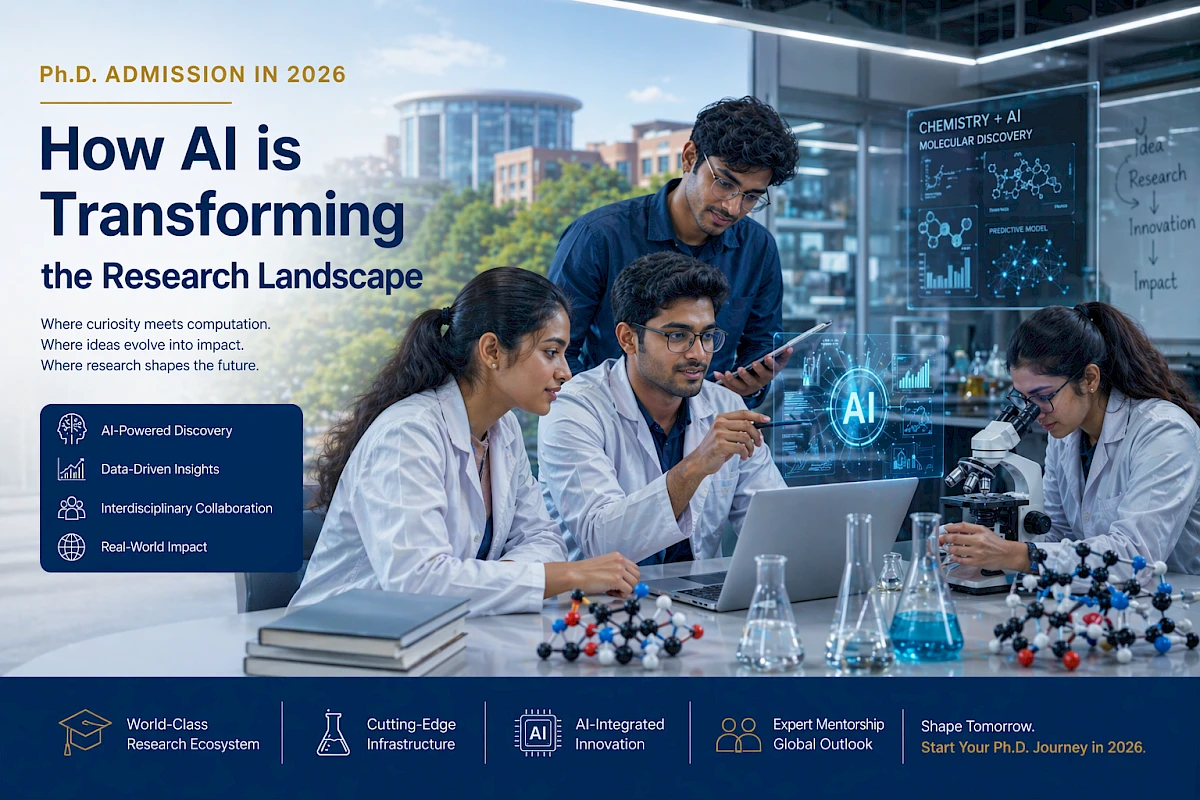
Ph.D. Admission in 2026 — How AI is Transforming the Research Landscape
Blog / April 10, 2026
In academia, artificial intelligence is no longer a future concept. The technology is already reshaping how research is conducted by students and how Ph.D. admission decisions are made.
As per the global study of more than 2400 researchers, it is found that 84% of researchers now utilize AI tools, up from 57% the previous year. In addition, 85% of researchers noted that they have seen an increase in research efficiency with the help of AI. This information indicates that AI is quickly becoming an important part of how research is done.
Universities are responding to this change- Ph.D. admissions in 2026 are also changing. With AI-supported research proposals and data-informed selection methods, institutions anticipate that candidates will demonstrate digital research preparedness in addition to academic achievement.
If you are ready to pursue your Ph.D. degree, you should understand how AI is transforming research that helps you stay competitive.
New Reality of Ph.D. Admission in the AI Era
In this AI era, Ph.D. admissions are no longer based on grades, entrance exams, as well as interviews. Today, universities are now evaluating candidates on the basis of-
- Research Fit- Align interests with an active faculty member’s work
- Academic Performance- Aim for a GPA of 3.5 or higher
- Prior Research Experience- Highlight publications, conference papers, and lab experience
- Statement of Purpose- Focus on clarity of research vision over academic history
- Letters of Recommendation- Obtain letters from faculty or senior researchers who know your intellect
- Technical Competencies- Proficiency in Python and statistical tools is essential in STEM fields
This clearly means AI has accelerated research timelines, which means institutions expect applicants to arrive better prepared than before.
Research in the Age of AI- What’s Changing Fast
- AI-Powered Literature Review
Previously, literature reviews took months. Now AI tools can-
- Scan thousands of papers in minutes
- Identify research gaps
- Suggest novel research questions
- Summarize key findings
This allows Ph.D. applicants to submit stronger research proposals during admission.
2. Faster Research Proposal Development
AI tools helps candidates-
- Structure proposals
- Refine objectives
- Improve research methodology
- Generate hypotheses
- Identify datasets
As a result, universities increasingly evaluate research potential, not just academic scores.
3. Data-Driven Ph.D. Selection Process
Many universities are adopting AI tools for researchers to-
- Screen applications
- Match students with supervisors
- Evaluate research alignment
- Predict research success
This means applicants must clearly define-
- Research interests
- Academic background
- Skills and tools knowledge.
4. Interdisciplinary Research is Becoming the New Standard
AI is merging fields like-
- Computer Science + Biology
- Economics + Data Science
- Psychology + AI
- Engineering + Robotics
Ph.D. admission committees now prefer candidates who can work across disciplines.
5. Increased Publication Expectations
AI technologies are assisting researchers in generating publications more quickly. Certain studies indicate that researchers utilizing AI tools have been able to publish as much as 60% more papers in specific fields, leading to greater competition for Ph.D. positions.
Due to this, candidates with,
- Preprints
- Conference papers
- Research internships and
- AI-assisted projects
usually carry a stronger advantage in Ph.D. admission 2026.
How to Get Admission in Ph.D. Programs- A 2026 Roadmap
Here is a clear roadmap for your Ph.D. admission-
- Prioritize Faculty Over Courses- Apply to specific advisors based on their research. Read their papers and reach out with genuine interest.
- Build a Research Portfolio- Even one publication or conference presentation sets you apart. Document all research experiences.
- Craft a Strong Statement of Purpose- Focus on your research narrative, specific questions, methodologies, and why the faculty member’s lab is a good fit. Use AI tools for refinement while keeping your authentic voice.
- Develop AI Tool Competency- Familiarize yourself with AI research tools and be ready to discuss their limitations, showcasing your modern scholarly readiness.
- Apply Strategically- Create a balanced school list with 2-3 reach, 3-4 realistic, and 2 safer options where you exceed expectations. Focus on fit over rankings.
- Prepare for Research-Oriented Interviews- Be ready to discuss your research deeply, including past work and analysis, beyond just accomplishments.
Why Shiv Nadar University (Institution of Eminence) Could Be the Right Place for Your Ph.D. Journey
If you want to thrive in this rapidly evolving AI world, Shiv Nadar University provides a research-driven environment that is designed especially for future Ph.D. scholars. The university academic model emphasizes rigorous coursework, proposal development, as well as guided dissertation research under experienced faculty mentors.
Students can explore a wide range of doctoral programs-
- Ph.D. in Chemical Engineering
- Ph.D. in Chemistry
- Ph.D. in Civil Engineering
- Ph.D. in Computer Science and Engineering
- Ph.D. in Economics
- Ph.D. in Electrical Engineering
- Ph.D. in Electronics and Communication Engineering
- Ph.D. in English
- Ph.D. in History and Archaeology
- Ph.D. in International Relations and Governance Studies
- Ph.D. in Life Sciences and Bioinformatics
- Ph.D. in Management (Executive)
- Ph.D. in Mathematics
- Ph.D. in Mechanical Engineering
- Ph.D. in Physics
- Ph.D. in Sociology
Here at Shiv Nadar University, students benefit from various facilities such as advanced laboratories, cutting-edge infrastructure, and multiple interdisciplinary research centers. This helps students to work on real challenges. For candidates planning Ph.D. admission in 2026, Shiv Nadar University provides a strong ecosystem to develop impactful as well as AI-ready research careers.
Conclusion
As artificial intelligence continues to reshape the academic landscape, the way Ph.D. programs at universities will look for new students in 2026 will change. Universities will begin to focus much more on research readiness and the ability to think interdisciplinary, along with demonstrating AI literacy as opposed to just providing your academic scores.
Thus, to gain an advantage, students should put together strong research portfolios, clear proposals as well as obtain a thorough understanding of the application of today's research tools. Start early by aligning your interests with faculty research and enhancing your analytical and technical skills.
FAQs
How to get admission to a Ph.D. program?
Start by identifying research interests, shortlisting universities, contacting potential supervisors, preparing a strong research proposal, qualifying for the required entrance exams, submitting applications, as well as attending research-focused interviews.
Is Ph.D. has an entrance exam?
Yes, Ph.D. admission often requires an entrance exam. Some institutions accept NET, JRF, GRE, or conduct their own tests, while others offer direct admission.
What is the minimum qualification for Ph.D.?
The minimum qualification is typically a master’s degree in a relevant field with strong academic performance.