The Real Biotechnology Course Details That College Brochures Don't Show You
Blog / April 13, 2026
The decision to pursue sciences as a career is made to be a binary choice between medicine and engineering. However, the fast-booming bio-economy has introduced a third new pillar in the form of Biotechnology.
Although college brochures usually center on slick shots of labs and career lists as a generic, the future of the profession in 2026 is much more lively. In case you want to get the actual biotechnology course details, you must go deeper than that to see the academic rigidity, the movement toward computer skills, and the booming economic growth of this industry.
The Industry Reality: Surpassing the $150 Billion Milestone
In order to realize why B.Sc. biotechnology course specifics are relevant in the current scenario, one should consider the real market statistics. Although lots of brochures still mention the $150 billion figure, the India BioEconomy Report (IBER) 2026 verifies that it has already overtaken the target and hit the valuation of 195.3 billion in 2025.
The industry currently adds about 4.8% of the national GDP of India and is increasing at a rate of 18% per year. This expansion is fueled by more than 11,800 biotech startups, which means that the industry is not a promising area anymore, it is a national economy block.
Beyond the Basics: What the Curriculum Actually Covers
A standard B.Sc. Biotechnology course spans three to four years and is designed to bridge the gap between biology and technology. While brochures mention "Biology," the actual biotechnology course details involve a heavy dose of physical sciences, engineering principles, and computational logic.
The Core Academic Pillars:
- Molecular Biology & Genetics- Understanding the "code of life" at a molecular level to manipulate DNA for therapeutic or industrial use.
- Bioprocess Engineering- This is where biology meets manufacturing. Students learn how to scale up biological processes, such as fermenting large batches of vaccines or enzymes.
- Bioinformatics & Computational Biology- The modern biotechnologist spends as much time in front of a computer as they do at a lab bench. This involves using algorithms to analyze massive biological datasets.
- Immunology and Virology- Particularly relevant in a post-pandemic world, these modules focus on how the human immune system interacts with pathogens and synthetic vaccines.
The "Dry Lab" Revolution
One detail brochures often omit is the increasing importance of "Dry Lab" skills. Traditional "Wet Lab" work involves pipettes and chemicals. However, the industry is shifting toward In-silico research.
Students today must be proficient in Python or R programming and molecular docking software. If your chosen course does not integrate data science, you may find yourself trailing in the modern job market where AI-driven drug discovery is becoming the standard.
Career Prospects: Expectations vs. Reality
The first myth in B.Sc. Biotechnology course details is that you are going to become a head scientist overnight. As a matter of fact, the profession is a ladder that you have to climb to gain experience. Here is how the path looks like-
- Entry Level- Roles such as Lab Technician, Quality Control (QC) Associate or Research Assistant. In 2026, the salary of graduates of the best institutes is generally 4.5 to 8 LPA.
- Mid-Level- Research Scientist, Process Engineer, or Regulatory Affairs Manager.
- Different Specialized Roles- Patent Attorneys (Biotech Law), Clinical Research Associates, and Bio-entrepreneurs.
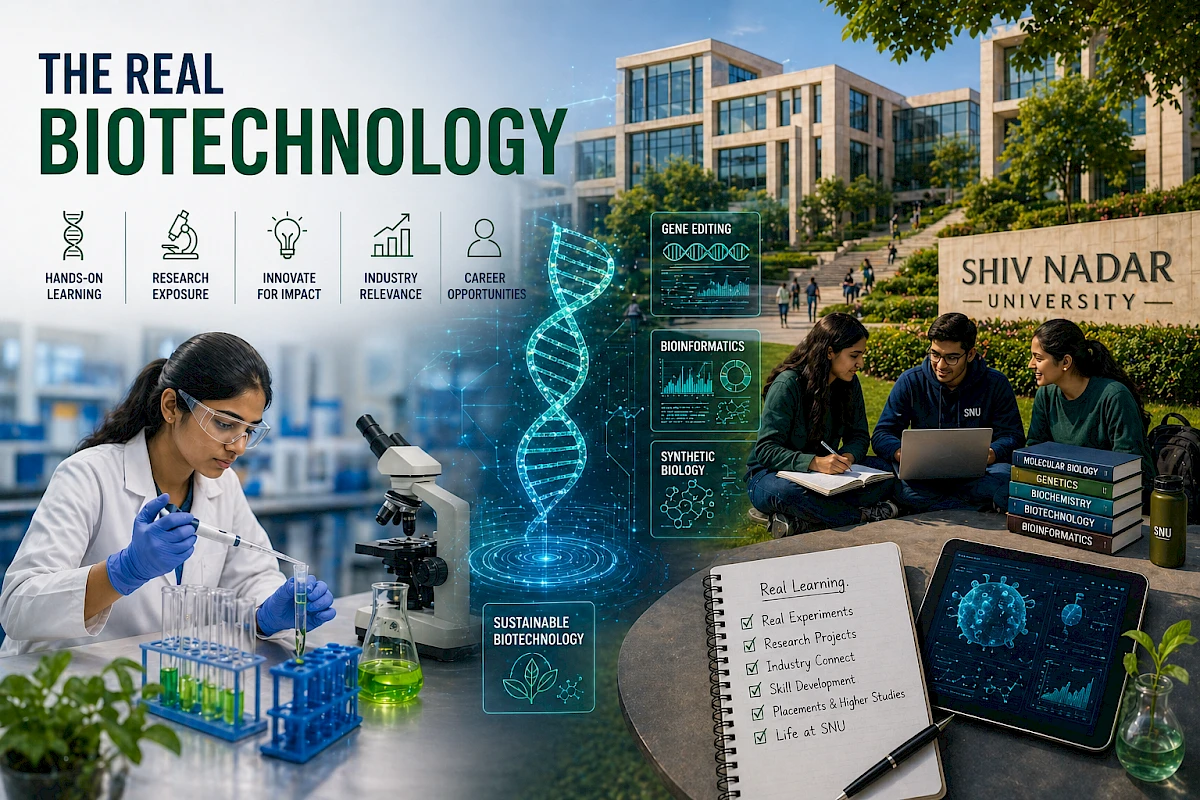
Accelerating Scientific Discovery - School of Natural Sciences at Shiv Nadar University (Institution of Eminence)
The School of Natural Sciences at Shiv Nadar University provides a unique, research-based curriculum to students who want to be aligned with the international research standards. The curriculum is constructed according to the international standards, along with faculty members from institutions such as Harvard Medical School and Yale.
Key Highlights of B.Sc. (Research) in Biotechnology:
- Research-oriented Structure- In line with the National Education Policy (NEP), the program is a 4-year, 160-credit degree, in which the fourth year is completely devoted to a research thesis.
- OUR (Opportunities for Undergraduate Research)- This is the flagship program and students as early as their second year can embark on independent research projects that last a year under the guidance of the faculty.
- Backed by Advanced Infrastructure- Students can be exposed to instrumentation normally used by postgraduates, such as Next-Generation Sequencing (NGS), Confocal Microscopy, and Flow Cytometry.
- Interdisciplinary Flexibility- The university offers its students the opportunity to have the Major in Biotechnology and Minor in Computer Science, Management, or International Relations to fit in the "Bio-Business" facet of the industry.
- Specialized Electives- In addition to the core, students could take niche courses, such as Cancer Biology, Epigenetics, Host-Pathogen Interactions and Systems Biology.
Conclusion: Making the Right Choice
While assessing the biotechnology course details, do not simply see the list of subjects. Examine the output of the faculty research, the advanced nature of the laboratory facilities, and the relationship that the university has with the biotech world.
B.Sc. Biotechnology is not merely a degree; it is a license to be innovative at the intersection of life and technology. You are developing the next generation of CRISPR-based therapies, or you are designing drought-resistant crops, but the first step is the selection of a program where discovery matters rather than documentation.
FAQs
Q.What is the scope of B.Sc. Biotechnology?
A. B.Sc. Biotechnology course offers a wide scope in research, healthcare, pharmaceuticals, agriculture, and industrial sectors with opportunities in both private and government fields.
Q. What is B.Sc. Biotechnology salary?
A. The average starting salary after B.Sc. Biotechnology ranges from ₹4.5 to ₹8 LPA, increasing with experience and higher studies.
Q. What are B.Sc. Biotechnology subjects?
A. B.Sc. Biotechnology subjects typically include genetics, microbiology, molecular biology, biochemistry, cell biology, immunology, and bioinformatics.
Q. What are the four types of Biotechnology?
A. The four main types of biotechnology are medical (red), agricultural (green), industrial (white), and environmental (blue) biotechnology.