Impact of AI in Education- Is the Classroom Ready for a New Kind of Intelligence?
Blog / October 15, 2026
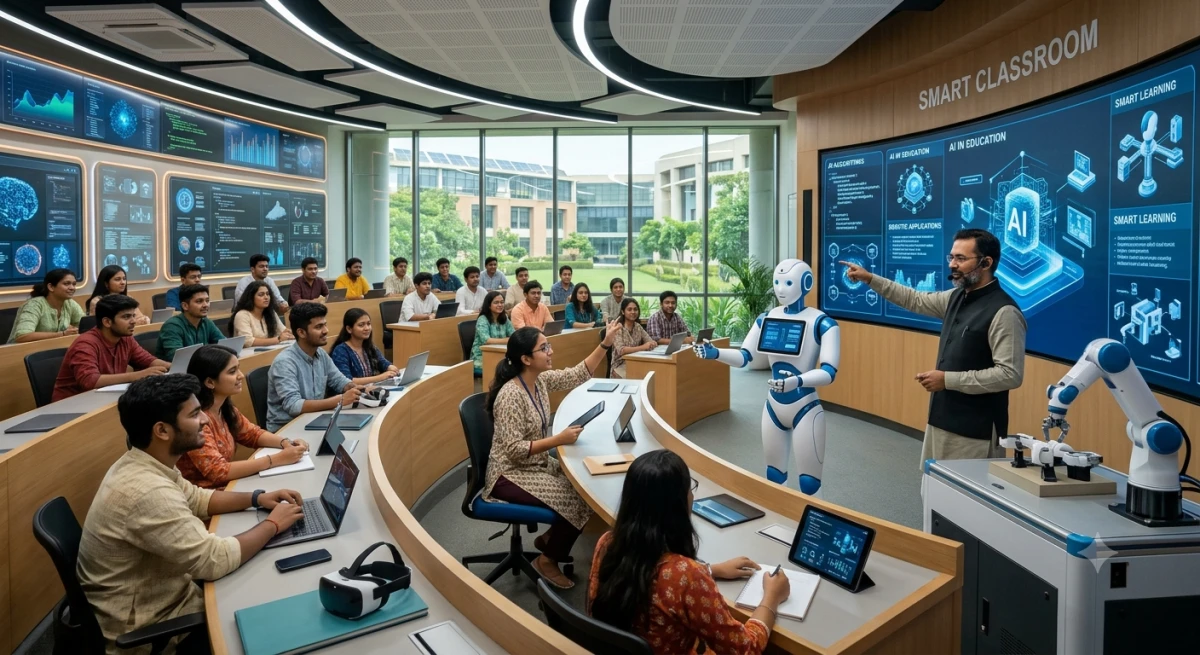
Imagine a classroom where every student receives a different explanation of the same concept. One learner understands fractions through visual examples, another through practical problems, while a third gets additional exercises to strengthen their basics. The teacher remains at the center, but technology helps make the learning experience more responsive.
This is one way to understand the impact of AI in education. Artificial Intelligence is changing how students access information, how teachers prepare lessons, and how institutions evaluate academic progress. From AI-powered tutors to automated feedback tools, its applications extend far beyond generating answers or summarising textbooks.
The change is already visible. According to the Stanford AI Index Report 2026, AI use for school-related tasks among middle and high school students ranges from 50% to 80%. The question, therefore, is no longer simply whether AI belongs in education, but how it can improve learning without weakening independent thinking.
What Is the Impact of AI in Education?
The impact of AI in education refers to how intelligent technologies influence teaching methods, learning experiences, assessment, academic research, and educational administration. AI systems can analyze information, recognize patterns, generate explanations, and provide recommendations that help students and educators work more effectively.
Unlike traditional digital learning tools, some AI systems can respond dynamically to a learner's questions and performance. A student struggling with a concept can ask for another explanation, while an educator can use data to identify topics that need more attention.
However, AI does not automatically improve learning; its value depends on the quality of the tool, the way it is used, and whether students continue to understand the material rather than simply receive answers.
What Are the Benefits of AI in Education?
AI offers several opportunities to make education more responsive, accessible, and efficient. The greatest benefits emerge when technology addresses a genuine learning need rather than being introduced simply because it is new.
Benefit | How AI helps | Practical example |
Personalized learning | Adjusts explanations and practice to a learner's needs | Providing extra algebra exercises after repeated mistakes |
Faster feedback | Reviews responses and highlights potential errors | Identifying weaknesses in a practice quiz |
Teacher productivity | Assists with lesson planning and routine administrative tasks | Drafting quiz questions for a teacher to review |
Accessibility | Supports translation, captions, and speech-to-text tools | Helping learners access content in different formats |
Research support | Helps organize information and explore ideas | Summarising research themes before a detailed literature review |
Data-informed decisions | Identifies patterns in learning performance | Flagging topics where a class may need additional teaching |
Personalized Learning for Different Students
Students rarely learn at exactly the same pace. Some grasp a concept immediately, while others need more examples, visual explanations, or extra practice time. AI-powered learning platforms can adapt exercises and feedback to individual performance. For example, a student learning calculus might receive step-by-step hints after making an error instead of being shown only the correct answer.
The important distinction is that personalization should encourage understanding. If AI simply completes every exercise for a learner, it may make the task easier without strengthening the underlying skill.
Supporting Teachers, Not Replacing Them
Teachers spend time preparing learning materials, developing assessments, organizing resources, and responding to routine queries. AI can help with some of these tasks, giving educators more time for discussion, mentoring, and individual support.
UNESCO's AI Competency Framework for Teachers identifies 15 competencies across five dimensions, including AI foundations and applications, AI pedagogy, ethics, and professional learning. This reflects a broader shift- educators need more than access to AI tools. They also need the judgment to decide when those tools are appropriate, how to evaluate their outputs, and where human intervention is necessary.
Making Education More Accessible
Language barriers, disabilities, and differences in learning environments can affect how students access educational resources. AI-enabled captions, speech recognition, translation, and text-to-speech tools can help reduce some of these barriers.
For instance, students can convert a recorded lecture into searchable text, allowing them to revisit explanations more easily. Translation tools can also help learners understand material presented in another language. However, accessibility depends on implementation. Poor speech recognition, inaccurate translations, expensive devices, and unreliable internet access can prevent some learners from benefiting equally.
How Is AI Used in Education Today?
AI is already being applied across classrooms, universities, online learning platforms, and research environments. Its uses range from everyday academic assistance to more advanced systems that analyze large volumes of information.
Application | Use in education | Potential value |
Generative AI | Brainstorming, explanations, and drafting | Supports exploration and early-stage learning |
Intelligent tutoring | Guided practice and feedback | Helps students revisit difficult concepts |
Automated assessment | Assists with quizzes and selected forms of marking | Speeds up routine evaluation |
Learning analytics | Analyses student performance patterns | Helps educators identify areas requiring support |
Assistive technology | Captions, transcription, and text-to-speech | Improves access to learning materials |
Research tools | Organizes information and supports data analysis | Assists academic investigation |
In higher education, AI can support activities such as coding practice, literature exploration, data analysis, and simulation. Students can use it to test hypotheses, compare approaches, and understand complex ideas, as long as they verify the results.
Researchers may also use AI to process large datasets or identify patterns that would be difficult to detect manually. Nevertheless, researchers must check AI-generated summaries and references against original academic sources.
The implication is significant- education must prepare learners not only to use technology, but also to question it, evaluate its results, and apply it to unfamiliar problems.
What Are the Challenges of AI in Education?
AI can make certain educational tasks easier, but its limitations need to be understood before it is widely adopted.
Challenge | Why it matters | Possible response |
Overdependence | Students may stop practicing independent problem-solving | Use AI for guidance, then solve tasks independently |
Inaccurate information | AI can produce convincing but incorrect answers | Verify claims against trusted sources |
Algorithmic bias | Outputs may reflect biases in training data | Review results critically |
Data privacy | Personal or academic information may be exposed | Use approved tools and limit sensitive data sharing |
Academic integrity | AI-generated work can obscure a student's actual understanding | Establish clear disclosure and assessment rules |
Unequal access | Students may not have equal access to devices or paid tools | Provide accessible alternatives |
UNESCO's Guidance for Generative AI in Education and Research emphasizes a human-centered approach to privacy, safety, and appropriate educational use.
Key takeaway- AI should improve the learning process without replacing independent thought, fair assessment, or human guidance.
How Does AI Affect Teachers and Students?
AI is changing not just how lessons are delivered, but also what students learn and how teachers measure progress. It's most useful when technology supports learning without replacing human judgment.
Area | Impact on students | Impact on teachers |
Learning | Personalized practice and explanations | More options for adapting teaching |
Feedback | Faster guidance on selected tasks | Additional ways to identify learning gaps |
Research | Help with exploring ideas and analyzing data | Support with preparing learning materials |
Skills | Greater need for AI literacy and verification | Greater need for responsible AI integration |
Accountability | Must follow academic-integrity rules | Must establish expectations and assess understanding |
The roles remain different. AI can suggest explanations, but teachers provide context, mentorship, and classroom judgment. Students, meanwhile, must evaluate what AI produces rather than accept every answer as correct.
What Is the Future of AI in Education?
The next phase of AI in education may involve more adaptive learning systems, multimodal tools, and AI-assisted research. Some important developments to watch include-
- Adaptive learning- More responsive practice based on student progress.
- Multimodal AI- Tools that combine text, images, audio, and video.
- AI-assisted research- Support for analyzing complex datasets and testing ideas.
- Responsible AI education- Greater emphasis on transparency, privacy, and bias.
- Interdisciplinary AI- Applications across business, healthcare, design, and the social sciences.
Students will increasingly need to understand not only how to use AI, but also how to question its outputs and recognize its limitations.
How Can Students Prepare for an AI-Driven World?
Students can begin developing practical AI literacy without necessarily pursuing a technical career.
- Build foundational knowledge- Strengthen research, communication, mathematics, and problem-solving skills.
- Practice verification- Check facts, calculations, and references before relying on AI-generated answers.
- Develop original thinking- Use AI to explore possibilities, but contribute independent ideas and analysis.
- Understand responsible use- Protect personal information and follow academic-integrity policies.
- Explore real-world applications- Investigate how AI can address problems in a chosen discipline.
- Learn continuously- Keep up with changing tools, capabilities, and limitations.
Ultimately, the goal is not simply to learn how to use AI, but to develop the judgment to know when to trust it, question it, or work independently.
From AI Literacy to AI Innovation- Explore Computer Science at Shiv Nadar University (Institution of Eminence)
Understanding the impact of AI in education can spark a deeper interest in the technology itself. For students who want to move beyond using AI tools and explore how intelligent systems are developed, computer science offers a practical starting point.
Shiv Nadar University offers a B.Tech. in Computer Science and Engineering, with opportunities to specialize in Artificial Intelligence and Machine Learning, Data Science and Big Data Analytics, and Cybersecurity and Privacy.
What Can Students Explore?
Academic area | What Shiv Nadar University offers |
AI and Machine Learning | Opportunities to study intelligent systems and data-driven models |
Computer Vision | Exploring how computers interpret images and videos |
Natural Language Processing | Understanding how computers process human language |
Data Science and Big Data Analytics | Working with data to identify patterns and generate insights |
The Department of Computer Science and Engineering at Shiv Nadar University researches computer vision, natural language processing, data mining, and computational biology. Its AI and ML Laboratory focuses on medical image computing, video analysis, and probabilistic machine learning.
For prospective students, this creates a pathway to explore AI through both foundational computer science and specialized research areas. Review the B.Tech. in Computer Science and Engineering program for program details and consult the official admissions information before applying.
Conclusion
AI is opening new possibilities for personalized learning, accessible education, and academic research. But its real impact will depend on how thoughtfully these technologies are used. Faster answers alone do not guarantee better learning; students still need curiosity, critical thinking, and the confidence to challenge what they see.
For educators, the opportunity lies in using AI to support teaching while keeping human guidance at the center. For students, it means developing the skills to work with intelligent systems without becoming dependent on them. As AI continues to reshape education, those who understand both its potential and its limitations will be better prepared to contribute to a technology-driven world.
Ready to explore computer science and AI? Apply now to Shiv Nadar University and take the next step towards building the technology of tomorrow.
FAQs
1. What are 5 advantages of AI in education?
Five advantages include personalized learning, faster feedback, automated administrative tasks, improved accessibility, and support for research and problem-solving.
2. How does AI impact the future of education?
AI is likely to make learning more personalized, interactive, and accessible while increasing the importance of digital literacy, critical thinking, and responsible technology use.
3. How is AI changing classrooms and schools?
AI supports adaptive learning platforms, automated assessments, virtual tutors, lesson planning, and learning analytics that help educators identify students' needs.
4. What are the risks and challenges of introducing AI in classrooms?
Key challenges include inaccurate information, academic dishonesty, overdependence, algorithmic bias, privacy risks, and unequal access to technology.
5. How does AI affect student privacy and data security in schools?
AI tools may collect sensitive student information, including learning records and personal details. Schools should use secure, approved platforms, limit data collection, and establish clear privacy policies.
6. Could AI replace teachers, and if so, in what roles?
AI may automate routine tasks such as generating quizzes, providing basic feedback, and supporting administration. However, human mentorship, emotional support, classroom judgment, and meaningful teacher-student relationships remain essential.
7. How can schools implement AI tools responsibly and ethically?
Schools should establish clear AI-use policies, protect student data, train teachers, check outputs for bias and accuracy, ensure fair access, and keep human oversight in important educational decisions.