Career After B.Sc. Finance: Top Jobs, Salaries and Higher Study Options

Blog / October 27, 2026
India’s BFSI sector is projected to add nearly 2.5 lakh permanent jobs by 2030, with a hiring growth rate of 8.7% in 2025-26 rising to 10% by the end of the decade. Nearly 48% of the new roles are now coming from tier II and III cities, so the work is no longer concentrated in a handful of metro cities. Mutual fund companies and wealth management firms are growing fastest, at over 9%.
If you’re in Class 12th and weighing a finance degree, or in your last semester of B.Sc. Finance, those numbers settle the first worry: there are jobs at the end of it. The hardest question is where in that market you want to land, and a career after B.Sc. Finance depends mostly on that choice.
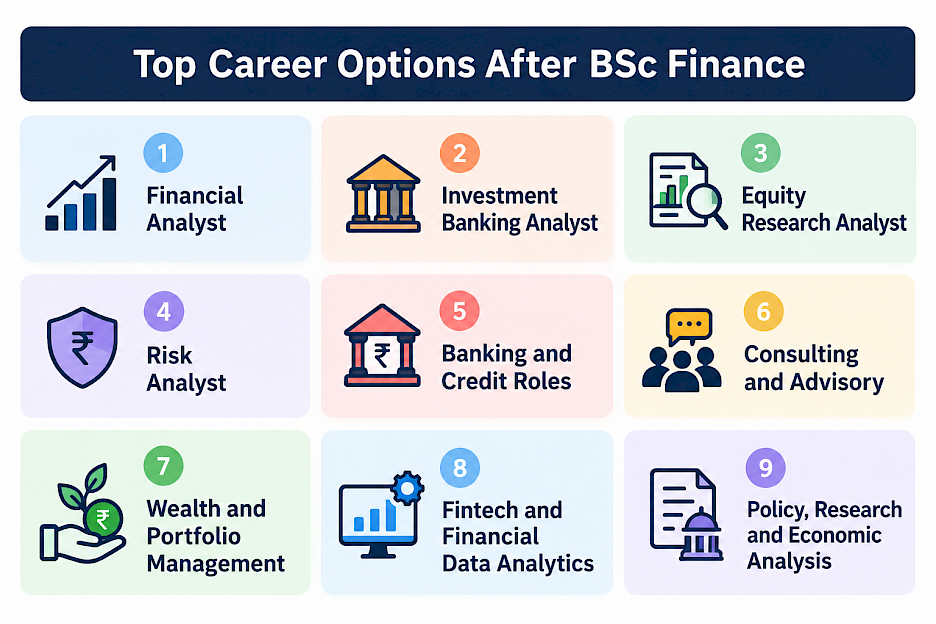
Four Career Tracks After B.Sc. Finance
1. Banking and Corporate Finance
Most graduates start here, since the entry points are easy to find and the hiring is spread across the country. Nearly half of new BFSI roles now come from tier II and III cities, so you don’t have to move to a metro city to begin your new career. Popular options are -
- Financial analyst
- Builds models, tracks budgets, and helps a company decide whether an investment is worth the money
- The usual first job, and a base for moving into management later
- Banking and credit roles
- Credit assessment and relationship management in banks and NBFCs
- Growth is steady, and the work exists well beyond the big cities
- Consulting and advisory
- Big-4 and advisory firms hire finance graduates for audit, tax, transaction advisory, and risk consulting
- Expect client work, so how you explain numbers matters as much as the numbers themselves
Good fit if you like seeing how a business runs from the inside.
2. Markets and Investments
These roles sit closest to the market, so they suit students who already follow prices, results and RBI announcements without being asked to.
- Investment banking analyst
- Works on mergers, acquisitions, and fundraising deals
- Among the better-paid routes, though the hours are long and competition for seats is heavy
- Equity research analyst
- Studies companies and sectors, then publishes views that investors act on
- Strong economic reasoning helps, and so does writing a clear one-page recommendation
- Wealth and portfolio management
- Helps individuals and institutions decide where their money should go
- Adecco India reports that mutual fund and wealth firms are growing at over 9%, faster than the sector’s overall 8.7% forecast
- CFA or NISM certification adds weight here
Works if you follow the market every day and enjoy defending a view.
3. Risk, Data and Fintech
Finance meets data in this track. Digital lending, UPI-led payments and data-driven risk assessment are among the forces shaping BFSI hiring right now, according to the India Skills Report 2026.
- Risk analyst
- Measures financial risk for banks, NBFCs and insurers
- Leans on statistics and a feel for how the wider economy behaves. Demand usually rises after a market shock
- Fintech and financial analytics
- Combines finance knowledge with Excel, SQL, Python and visualization
- A dashboard you can explain beats a table you can’t
Aim for it if you’re comfortable with uncertainty and find a dataset more interesting than a deal.
4. Research and Policy
The questions here are bigger than one company, like why inflation moves markets or how a rate change reaches a small borrower.
- Think tanks and research organizations hire graduates who can read data as well as explain it in plain language
- Development agencies and central-bank-linked bodies look for people who understand how the financial system and the economy affect each other
- Many students in this track go on to an economics master’s, and some continue to a PhD
Best if you’d rather ask why something happens than how much it’s worth.
Which Track Fits You?
Match what you enjoy to where it usually leads -
If you enjoy... | Consider... |
Deals, valuation, markets | Investment banking, equity research |
Numbers, models, uncertainty | Risk analytics, quantitative roles |
Business strategy | Corporate finance, consulting, MBA |
Data and technology | Fintech, financial analytics |
Big-picture questions on economies | Policy, research, economics master’s |
Salary After B.Sc. Finance in India
Published figures disagree, so read them as a range. Entry-level packages reportedly are at ₹4-12 LPA, rising past ₹20 LPA in some roles over time. Payscale reports an average of ₹2.2-7.2 LPA.
The difference arises because of roles, location, and the employer. There is no doubt that the analyst working on the investment desk and the branch credit officer have the same degree, yet their earnings are drastically different. The internships and skills play more of a part in defining the range than the degree itself.
Higher Studies After B.Sc. Finance
Many graduates study further, either before starting work or alongside it -
- An MBA in Finance is the usual route into management and corporate finance.
- CFA, FRM, ACCA and CMA suit specialized tracks like investments, risk and accounting.
- A master’s in economics or finance suits research, policy, analytics, and Ph.D. plans. If the quantitative side appeals to you, an M.Sc. in Economics is a two-year program with strong grounding in quantitative methods and econometrics.
- Some graduates go abroad for specialized degrees in finance, financial engineering, or economics.
Where B.Sc. (Research) in Economics and Finance at Shiv Nadar University (Institution of Eminence) Fits In
Risk, research, portfolio management, and policy roles all need markets and the economy understood together, and most finance degrees teach only one side. Shiv Nadar University’s B.Sc. (Research) in Economics and Finance is built around both. This mix of economic reasoning, finance knowledge, research habits, and real-world exposure is what many of the roles above reward.
Why Choose B.Sc. (Research) in Economics and Finance?
- Two departments teach it together - Economics (School of Humanities and Social Sciences) and Finance, Accounting and Control (School of Management and Entrepreneurship).
- Research starts early, where you take Logic and Scientific Methods & Academic Writing, sit a Research Seminar, and can join the university-wide Opportunity for Undergraduate Research (OUR).
- One full semester goes to an internship with a business, a university, a research organization, or a think tank.
- The training holds up whether you head into finance, consulting, research, policy or further study.
Final Thoughts
Your career after a B.Sc. in Finance will be determined in the first two years of your education, depending on the pathway you intend to pursue, the internships you undertake, and the skills that you cultivate early. Should you be evaluating the various options now, go for a program that teaches economics and finance and exposes you to the world of work.
Shiv Nadar University’s B.Sc. (Research) in Economics and Finance does both, with a full semester of internship built into the degree. Dive into the curriculum on the program page and apply now to start building your track from the first semester.
FAQs
1. What are the options after B.Sc. Finance?
Financial analysis, risk management, equity research, banking, consulting, and fintech are some common options. You could pursue a higher degree in the form of an MBA, CFA, FRM, ACCA, or a master’s degree too.
2. Is B.Sc. Finance a good career option?
It is a suitable option if you enjoy numbers and analysis because financial skills apply across various sectors. Your internships, certifications, and practical skills matter more than the degree itself.
3. What is the salary after B.Sc. Finance in India?
According to published information, the range for freshers lies somewhere between ₹3-8 LPA & ₹4-12 LPA, depending on the source. Your role, company, and skills will decide where you fall in that range.
4. Can I pursue an MBA after B.Sc. Finance?
A finance degree is very much compatible with an MBA program. There are candidates who opt for a master’s degree in economics or finance after completing a B.Sc. in Finance.
5. Is B.Sc. Finance plus economics beneficial for my career?
Yes, mostly for roles that analyze the interplay of economics and finance, like research, risk management, and portfolio management. Also, it keeps your future studies flexible.