How to Choose the Right B.Tech. Specialization: Find the Engineering Path That Fits You
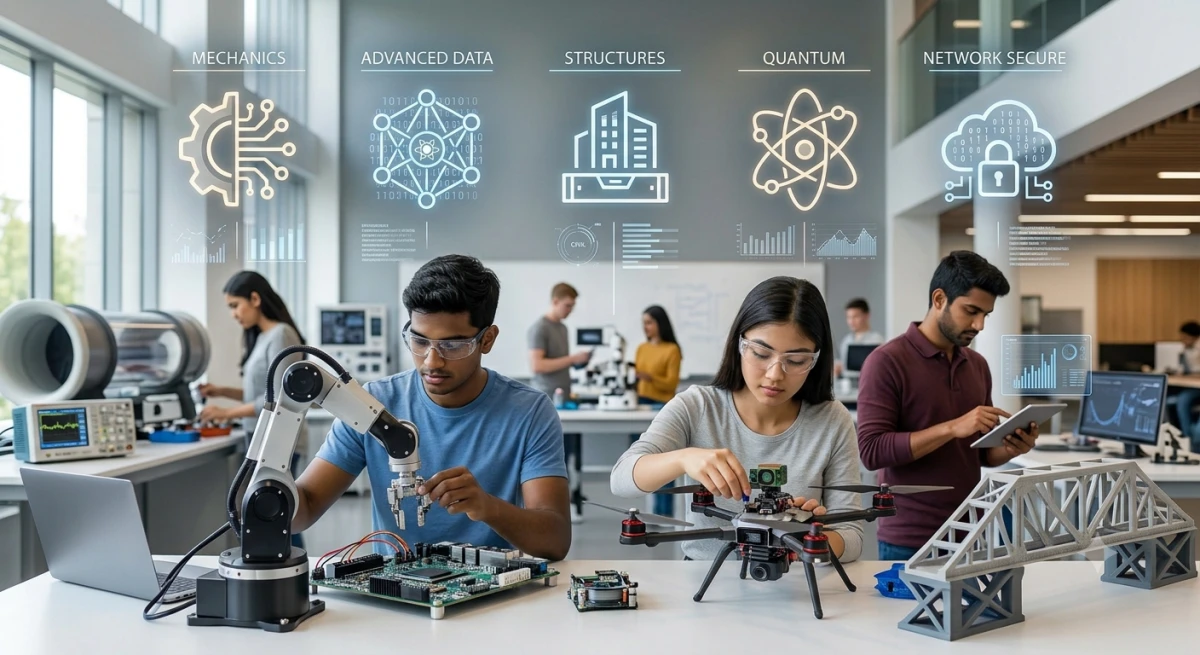
Choosing a B.Tech. specialization is one of the first major decisions you will make after school. With options ranging from Computer Science and Engineering to Civil, Mechanical, Chemical, and Electrical and Computer Engineering, the decision can feel confusing.
Every field has its own subjects, learning methods and career possibilities, so choosing a branch simply because it is popular may not be the best approach.
The right specialization should match your interests, the kind of problems you enjoy solving and the skills you want to develop over the next four years. It is equally important to understand what you will study beyond the course title.
If you are wondering how to choose the right B.Tech. specialization, start by understanding what each branch offers and how it connects with your long-term goals.
What Factors Should You Consider When Choosing a B.Tech. Specialization?
There are many things which you should consider while opting for a particular specialization such as-
- Personal interests
- Your Academic strengths
- Course curriculum
- Future scope
- Practical exposure
- Fees and ROI
Which B.Tech. Specialization Matches Your Interests?
Each engineering branch approaches technology and problem-solving differently. Understanding these differences is a first step towards making an informed decision.
1. Computer Science and Engineering
CSE is worth exploring if you are interested in programming, software development, computing systems, and digital technologies. It focuses on how computer systems work, how software is developed and how computational methods can solve complex problems.
The field covers areas such as-
- Wireless and Mobile Computing
- Networking
- Security and Privacy
- Data Science and Engineering
- ML
- Computer Vision
These subjects help students understand both the foundations of computing and its real-world applications, particularly as India's AI talent pool is projected to grow from 600,000–650,000 professionals in 2024 to over 1.25 million by 2027, according to PIB.
This projection highlights the growing importance of AI-related knowledge, although career opportunities will depend on individual skills and industry requirements.
Potential career directions include software development, data science, cybersecurity, machine learning, computer vision, and research. Building a strong foundation through technical projects, internships and practical experience can help students prepare for these areas.
2. Civil Engineering
Civil Engineering is closely connected to the built environment. It involves planning and developing the infrastructure that supports everyday life, including buildings, transportation networks, water systems and urban spaces.
The subject combines scientific principles with analytical and computational methods. Students explore how engineering decisions affect the safety, efficiency, sustainability, and long-term performance of infrastructure.
It also offers specialized areas such as-
- Sustainable Infrastructure Systems
- Water, Environment and Climate
- Urban Network Systems
These areas help students explore challenges related to sustainable construction, environmental management, water resources, and urban development.
The scale of India's infrastructure development highlights the importance of this field. For example, India had around 1,036 km of operational metro and regional rapid transit across 24 cities, according to the Economic Survey. This provides a practical example of the transport infrastructure that civil engineers help plan, develop, and maintain.
The graduates of civil engineering may have variety of employment options such as CPWD, NHAI, BRO, Indian Railways, DRDO, and CPCB, as well as PSUs such as GAIL, HAL, NTPC, and NPCIL.
3. Mechanical Engineering
This branch brings together mathematics, science, and engineering principles to understand physical systems and develop practical solutions. Depending on their interests, students can explore areas such as design and manufacturing, thermodynamics, materials science, energy technology and robotics and industrial automation.
Students can also explore specialized areas such as-
- Computational Techniques
- Energy Technology
- Robotics and Automation
India's manufacturing sector recorded 7.81% growth in industrial output in FY 2024–25, highlighting the role of industrial development in creating opportunities for Mechanical Engineering graduates in organizations such as BHEL, ONGC, HPCL, NTPC, and DRDO.
4. Chemical Engineering
CE is a suitable option for students who want to understand how raw materials are transformed into useful products through controlled industrial processes. It examines how these reactions and processes can be designed, operated, scaled, and maintained safely and efficiently.
Key subjects includes-
- fluid mechanics
- Thermodynamics
- Chemical Reaction Engineering
- Separation Processes
- Heat and Mass Transfer
- Process control
- Process Engineering Design
- Process safety
Consider this branch if you enjoy chemistry, mathematics, and physics and want to understand how scientific principles are applied in industrial processes.
India's chemicals and petrochemicals sector contributed 8.1% of manufacturing GVA in FY 2023–24, according to the Economic Survey which highlights the sector's role in the country's industrial economy.
The graduates of this field may have many career opportunities like process engineering, production, product development, quality control, environmental safety and research and development, with potential employment across chemical manufacturing, pharmaceuticals, oil and gas, and energy industries.
5. Electrical and Computer Engineering
ECE brings together electrical systems, electronics and computing. It can be an interesting option if you want to understand the technology behind electronic devices, communication systems, energy solutions and embedded computing.
The curriculum combines core engineering subjects with practical learning, electives and major projects. Students can explore specializations such as-
- Modern Energy Systems
- Wireless Systems Engineering
- VLSI Design
Interdisciplinary options include Applied Machine Intelligence, E-Mobility, Cognitive Robotics and Real-Time Embedded Systems, connecting electrical and electronic engineering with developments in computing and automation.
These fields are becoming increasingly relevant as India strengthens its semiconductor capabilities. India employs nearly 20% of the global semiconductor chip-design workforce, according to the PIB.
ECE is a good fit for those interested in research and developing emerging technologies. There are many career paths such as DRDO, HAL, NTPC, BHEL, HP, Oracle, Cognizant, HCL, Tata Power, Silicon Labs, etc. Also, those interested in innovation can develop hardware or software products through start-ups, with support from the Atal Incubation Center.
Traditional vs Emerging B.Tech. Specializations: Which Should You Choose?
Traditional B.Tech. specializations, such as Civil, Mechanical, Electrical, and Chemical Engineering, focus on core engineering principles used in infrastructure, manufacturing, energy, and industrial processes.
Emerging specializations such as AI, Robotics, VLSI Design, and Electric Mobility combine engineering fundamentals with newer technologies and interdisciplinary applications.
Traditional branches | Emerging specializations |
Focus on established engineering principles and systems | Focus on newer technologies and specialized applications |
Cover areas such as construction, machinery, and power systems | Cover AI, automation, chip design, and electric vehicles |
Offer opportunities across established industries | Offer opportunities in developing technology sectors |
Note - Choose based on your interests, preferred subjects, course curriculum and career goals rather than trends alone.
Shape Your Future with Industry-Aligned B.Tech. Specializations at Shiv Nadar University
The School of Engineering at Shiv Nadar University offers B.Tech. programs in Chemical, Civil, Computer Science, Electrical and Computer and Mechanical Engineering.
Its curriculum builds strong engineering fundamentals while introducing emerging technologies, helping students develop industry-relevant skills that can improve their readiness for employment after graduation.
One notable feature is the Common First Year for all engineering students which gives them a shared foundation before they specialize.
Students also participate in experiential and project-based learning through a year-long First-Year Engineering Project, where teams develop an idea into a prototype. Guest lectures, live projects, hackathons, and competitions provide additional opportunities to apply classroom concepts.
It has also strengthened its industry engagement through collaborations with leading organizations such as-
- MG Motors
- BPCL
- IOCL
- ISRO
- Samsung
- HPE
- Dassault
Students also benefit from specialized teaching and research labs across engineering disciplines. These include facilities for-
- IoT and Wireless Technologies
- AI and ML
- Embedded Electronics
- VLSI Design
- Mechatronics
- Manufacturing
- Renewable Energy
- Chemical Process Control
The labs support hands-on learning, experimentation, computational work, and research, helping students connect engineering concepts with practical applications.
Overall, Shiv Nadar University is a decent choice for B.Tech. specializations, offering a combination of strong engineering fundamentals, advanced laboratory facilities, industry engagement and practical learning opportunities to help students prepare for their future careers.
Conclusion
Choosing the right B.Tech. specialization requires a clear understanding of your interests, academic strengths, preferred subjects and long-term career goals. Whether you choose CS, Civil, Mechanical, Chemical or ECE, focus on building strong fundamentals and gaining practical experience.
Evaluate the curriculum, industry exposure, laboratory facilities, and future opportunities before making a decision. Shiv Nadar University offers diverse engineering programs and hands-on learning opportunities to help students prepare for evolving industry requirements.
FAQs
1. Which B.Tech. specializations have the highest placement rates?
Placement outcomes depend on the branch, student skills and hiring trends, so no specialisation guarantees the highest placement rate.
2. Are certain B.Tech. specializations better for startups or entrepreneurship?
CSE, ECE and ME support ventures in software, electronics, robotics, and hardware. Shiv Nadar University's project-based learning, Makerspace, and incubation ecosystem can help students explore and develop ideas.
3. What factors should I consider when picking a B.Tech. branch?
Consider your interests, academic strengths, subjects, career goals, curriculum, lab facilities and industry exposure.
More Blogs

The Hawthornden Literary Retreat bestowed on Dr Sambudha Sen to complete the manuscript of a novel
Professor Sambudha Sen, Head of the Department of English at Shiv Nadar Institution of Eminence, Delhi-NCR, was awarded a residency at the...
The Power of the Moving Body
Movement is an innate bodily action that humans have been exhibiting for the longest time. Long before language was invented, the body was the...

Benefits of Choosing Mechanical Engineering Course
Mechanical engineering course is a versatile course that by some means affects everyone's life. The course helps future engineers design and build...