Best Courses After Graduation: How to Choose the Right Postgraduate Program
Blog / October 15, 2026
India's overall employability has risen to 56.35% in 2026, up from 54.81% in 2025, according to the India Skills Report. That sounds like good news until you look at one number inside it. MBA graduates, however, saw a decline in employability, from 78% to 72.76% over the same period. A degree with a famous name still isn't a guarantee.
Now picture where you are. You've finished your graduation. Your cousin says MBA. Your teacher says research. A senior is already planning to study abroad, and your parents just want something safe. All of it sounds sensible. That's exactly the problem.
This guide helps you sort it out. You'll see how to match a course to your stream & goal, where each option leads to, and which one best suits you.
What Should You Actually Do After Graduation?
Before you compare multiple courses randomly, answer four questions. They are simple, take ten minutes at most, and can save you a year.
- What do you wish to do at the age of 28? You could be leading a team, writing, working in a lab, or might be working with communities. Choose the work first and later the degree.
- How soon do you want to start earning? Some master's courses take two years. Research-track programs can run much longer, and the pay-off comes later.
- Does your graduation stream limit you? Some courses accept graduates from any background. Others expect a related degree, so check eligibility before you fall in love with a course.
- What’s your budget? Tuition is only part of it. Hostel and living costs add up fast.
Keep your answers ready. Next, we'll sort the options into groups so that you can see where your interest takes you.
Which are the Best Courses After Graduation?
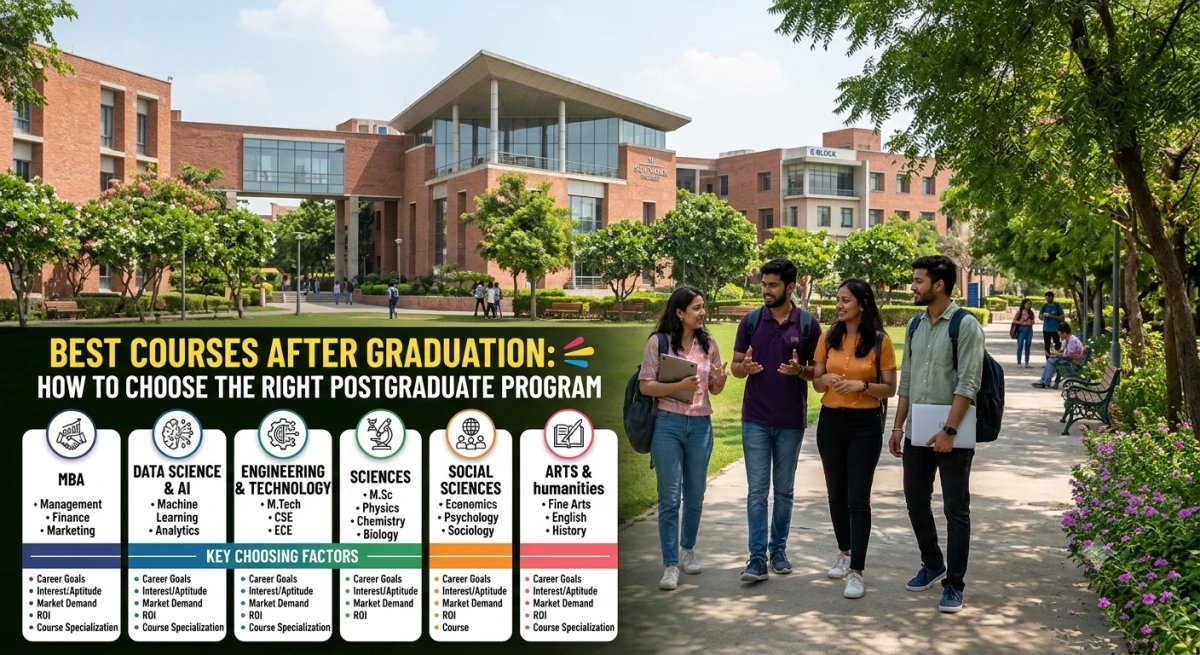
Depending upon your stream and aim, the following are the most suitable courses after graduation. An MBA for any stream, economics for number crunchers, English & fine arts for creative souls, rural management for field people, and M.Sc. - Ph.D. combined course for researchers.
The following table matches all these courses with you -
Your Situation | Course to Consider |
You like leading people and making the final call | MBA |
You enjoyed statistics and want to use it on real questions | M.Sc. in Economics |
You love reading, and you write well | M.A. in English |
You have a portfolio and a point of view | Master of Fine Arts |
You want to work directly with rural communities | M.A. in Rural Management |
You'd rather be in a lab than a boardroom | Integrated M.Sc.-Ph.D. |
1. Management: MBA
Covers marketing, finance, operations, and people management, so you can lead a team or run a product. Most programs take two years and ask for an entrance exam score.
Where it leads - Consulting, banking, operations and brand management.
2. Economics: M.Sc. in Economics
Builds your command of microeconomics, macroeconomics, and econometrics, the toolkit for testing ideas against data.
Career paths - Research, policy work, analytics, and finance. Many graduates continue to a Ph.D.
3. Humanities and Arts: M.A. in English
Trains you to read closely and write with precision, a skill that travels well across industries.
Where it leads - Publishing, journalism, content strategy, and teaching.
4. Humanities and Arts: Master of Fine Arts
A studio degree where you make work, defend it, and build a portfolio with a clear direction.
Career paths - A practicing artist's career, art education, or roles in galleries and cultural spaces.
5. Development Work: M.A. in Rural Management
Prepares you to plan and run work in villages and small towns, from livelihoods to health programs. Any bachelor's stream can be your starting point.
Where it leads - NGOs, social enterprises and development agencies.
6. Science Research: Integrated M.Sc.-Ph.D.
Folds a master's and a doctorate into one continuous track for B.Sc. graduates who enjoy lab work.
Career paths - Research labs, pharmaceutical and chemical R&D, and university teaching.
Once you've picked a direction, it helps to see what postgraduate life looks like on a campus built around research.
Why Choose Shiv Nadar University (Institution of Eminence) for Your Courses After Graduation?
Shiv Nadar University is a research-based university in Delhi NCR, which has four schools: Engineering, Management and Entrepreneurship, Natural Sciences, and Humanities & Social Sciences. For post-graduation courses, students are taught through classroom sessions as well as research guidance by mentors. Some of the research centers within the university include the Center for Advanced Materials, the Center of Excellence in Epigenetics, and the Center for Integrative and Translational Research.
Here's what the campus offers-
- An Atal Incubation Center for students who want to turn an idea into a startup.
- Eight postgraduate programs - MBA, M.Sc. in Economics, M.A. in English, M.A. in Rural Management, Master of Fine Arts, integrated M.Sc.-Ph.D. programs in Chemistry and Life Sciences, and an Accelerated Masters Program with ASU.
- International exposure through academic partner institutions, including a pathway to complete a master's at Arizona State University in the U.S.
- 15+ Ph.D. programs with a doctoral award package that covers a stipend, full or partial fee waiver, subsidized on-campus accommodation, and conference travel support.
Browse all the course options on the programs page.
Conclusion
When it comes to selecting the most suitable courses post completion of education, it becomes easier for you when you know your objective and limitations, as one program won’t be the same for everyone. You should start off by comparing the eligibility criteria along with the brochure of the two most suitable courses for you. Once you have found one, start applying for it. If you need more help, then here’s the official admissions page for you to explore.
FAQs
1. What is the right option after graduation?
This again depends on your stream and your aim. Management is suitable for leadership, economics for an analytical bent of mind, and the research track for anyone comfortable in laboratory conditions. You can use the four points given at the beginning of this post to come up with the answer.
2. Which course after graduation earns me the maximum salary?
There is much more variation in pay according to the course itself, placement records, and skill set than in the name of the degree. Get the placement records of all colleges separately and be wary of any list which ranks the courses based on salaries alone.
3. Can I go for a master's course in a different stream after my graduation?
There are courses that accept graduates from any stream, and MBA is the classic example. For science and economics streams, there may not be such courses, although most colleges will have a separate eligibility criteria page for the same.
4. What postgraduate courses can arts graduates pursue?
Arts graduates have the option to pursue an M.A. in English, Master of Fine Arts, or a Master in Rural Management. All these options are offered by Shiv Nadar University.
5. Is it possible to pursue a Ph.D. after my master's degree?
Most universities offer Ph.D. programs to master's graduates, while a few even offer integrated programs like M.Sc.-Ph.D. programs. Consider the research areas and the availability of funds before applying.
6. What career paths can graduates in science choose?
Science graduates should consider research tracks like an integrated M.Sc.-Ph.D. or an MBA program if management interests them.