Best Career Options after 12th - Finding a Career Path That Suits You
Blog / October 14, 2026
Class 12 ends, results arrive, and suddenly one question follows every conversation- What are you going to do next? For some students, the answer comes easily; others have several interests but no clear direction, and many feel caught between choosing a career they enjoy, finding a course with good job prospects, and meeting the expectations of family and friends.
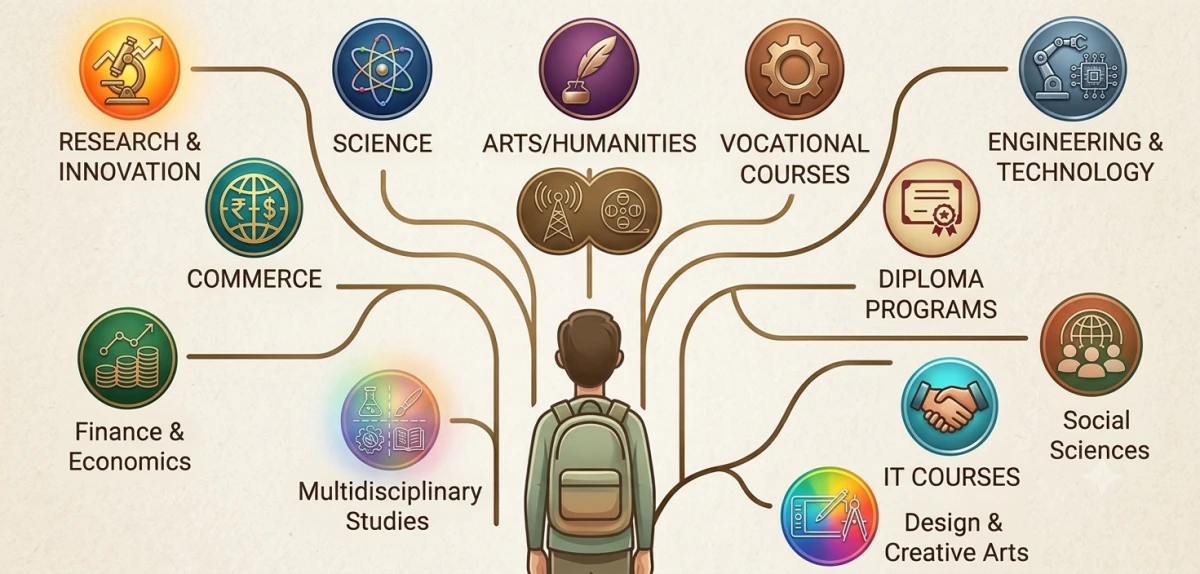
The good news is that no single route leads to a successful career. You could build things, investigate how the world works, create visual experiences, understand human behavior, manage organizations, or develop solutions to everyday problems. Each path offers different opportunities, and the right choice depends on more than a course's popularity or earning potential.
The decision is significant; according to the Ministry of Education's Annual Report 2024-25, India's higher education enrolment reached approximately 4.46 crore students, up from 3.42 crore in 2014–15.
So, what are the best career options after 12th? With so many students pursuing higher education, thoughtful choices matter. The goal isn't simply to find a degree; it is to identify a learning path that helps you build useful skills, explore your interests, and prepare for the kind of work you want to do.
What Are the Best Career Options after 12th?
There is no universal answer because careers differ in their entry requirements, daily responsibilities, and growth opportunities. A useful starting point is understanding what different professions involve before deciding which ones to explore further.
12 Career Options Worth Exploring
Career Field | Possible Career Paths | What You Could Enjoy |
Technology and computing | Software developer, cybersecurity analyst, AI specialist | Solving problems and building digital systems |
Engineering and technology | Design engineer, systems engineer, robotics engineer | Applying technical knowledge to real-world challenges |
Design and creative industries | Product designer, UX designer, visual communication designer | Turning ideas into useful or engaging experiences |
Business and management | Business analyst, management professional, entrepreneur | Organizing people, resources and strategies |
Finance and economics | Financial analyst, economist, investment research associate | Understanding markets, money and economic behavior |
Healthcare and life sciences | Healthcare professional, laboratory researcher, life sciences specialist | Improving health and understanding living systems |
Scientific research | Research assistant, laboratory scientist, academic researcher | Investigating questions and testing ideas |
Media and communication | Journalist, filmmaker, content strategist | Telling stories and communicating information |
Psychology and social sciences | Research associate, behavioral researcher, social researcher | Understanding people and society |
Education and training | Educator, learning designer, academic researcher | Helping others learn and develop |
Law and public service | Legal professional, policy researcher, civil services aspirant | Working with laws, institutions, and public issues |
Hospitality and entrepreneurship | Hospitality manager, business founder, operations professional | Creating services and managing experiences |
Note- These are possible career paths, not guaranteed outcomes immediately after Class 12. Some require professional training, competitive examinations, or further qualifications
How Should You Shortlist These Options?
Instead of choosing from a long list of job titles, narrow your options using three questions-
- What interests you? - Think about the activities, problems, and subjects you naturally enjoy.
- What kind of work suits you? - Consider whether you prefer research, practical projects, creative work, analysis, or working with people.
- What qualifications are required? - Check the degree, entrance examination, licensing, or training needed to enter the profession.
This simple exercise can help turn a broad list of possibilities into a manageable shortlist.
Which Courses Can You Pursue after Class 12?
A career often begins with choosing the right course. However, the same degree can lead to several professions, while some careers require a specific qualification.
Here are common undergraduate and professional course options across different fields-
Course or Qualification | Typical Duration | Career Directions |
B.Tech. | 4 years | Engineering, technology, research and development |
B.Des. | Usually 4 years | Product, communication, experience and other design roles |
B.Sc. or B.Sc. (Research) | Usually 3–4 years, depending on the program | Research, analytics, laboratory work and further study |
B.A. | Usually 3–4 years, depending on the program | Communication, research, public policy and further study |
BBA or BMS | Usually 3–4 years, depending on the program | Business, management, marketing and entrepreneurship |
B.Com. | Usually 3–4 years, depending on the program | Accounting, finance, commerce and business operations |
Professional healthcare degrees | Varies by qualification | Clinical practice, healthcare services and research |
Integrated law degree | Usually 5 years | Legal practice, corporate law and policy |
Hotel management degree | Commonly 3–4 years | Hospitality, tourism and service management |
Professional media courses | Varies by program | Filmmaking, journalism, production and communication |
Duration and eligibility vary by institution and program. Verify the current requirements before applying.
Degree, Diploma or Professional Course- What Should You Choose?
Route | Best Suited For | What to Consider |
Undergraduate degree | Students seeking broader academic foundations and long-term career flexibility | Duration, curriculum, projects and progression to higher studies |
Diploma | Students seeking focused, practical training in a specific area | Recognition, practical exposure and progression options |
Professional qualification | Students targeting a profession with defined entry requirements | Examination structure, accreditation and eligibility |
Skill-based certification | Students looking to develop a specific complementary skill | Industry relevance, practical application and credibility |
A short course can help you develop a useful skill, but it should not be mistaken for a recognized degree or professional license where one is required.
Which Career Options Offer Good Earning Potential?
Earning potential is an important consideration when comparing career options after 12th. However, salary depends on factors such as qualifications, experience, location, employer, industry demand, and individual performance.
Instead of relying on a single list of the highest-paying jobs, compare the factors that shape long-term earnings.
Career Area | Factors that Can Influence Earnings | What to Investigate |
Technology | Technical skills, specialization and practical experience | Project portfolio, internships and demand for specific skills |
Finance | Professional qualifications, analytical ability and experience | Role requirements, certifications and career progression |
Management | Business knowledge, leadership and industry exposure | Internship opportunities, program outcomes and alumni careers |
Design | Portfolio quality, problem-solving and specialization | Live projects, industry exposure and the quality of student work |
Healthcare | Professional qualifications, specialization and experience | Licensing requirements, training duration and progression |
Research | Subject expertise, research experience and further qualifications | Research opportunities, postgraduate routes and funding |
How Can You Evaluate a Career's Financial Prospects?
Before committing to a course, investigate-
- Entry-level salary- What do credible salary surveys and recent job listings indicate?
- Career progression- What roles could become available after three to five years of experience?
- Education costs- How much will tuition, accommodation, equipment, and other expenses cost?
- Employment pathways- Does the profession require postgraduate study, competitive exams, or additional certification?
- Job stability- How might automation, industry changes, or economic conditions affect the role?
Remember that advertised salaries and placement packages are not guarantees. Compare the data's source, year, sample size, and whether the figure represents an average, median, or highest offer.
How Do You Choose the Right Career after 12th?
Choosing a career becomes easier when you replace guesswork with a structured process. You do not need to have your entire professional life planned at 17 or 18. You need enough information to make a sensible next decision.
Step 1- Identify your interests
Write down activities you genuinely enjoy, including those outside academics. You might enjoy analyzing information, designing objects, conducting experiments, organizing events, or explaining ideas to others.
Step 2- Assess your strengths
Consider the skills you already demonstrate and the ones you are willing to develop. Your current strengths are a starting point, not a permanent limit.
Step 3- Research suitable courses
For every career on your shortlist, identify relevant degrees, entrance requirements, program duration, and potential alternatives.
Step 4- Compare colleges and programs
Evaluate more than reputation. Use this checklist-
- Curriculum and specialization options
- Faculty expertise and academic support
- Projects, laboratories, studios, or practical learning
- Internships and industry exposure
- Placement reports and alumni outcomes
- Total cost, scholarships, and financial aid
- Campus environment and student support
Step 5- Test your assumptions
Speak to professionals, attend open days, explore introductory courses, or try a small project related to the field. First-hand exposure can reveal whether you enjoy the actual work, not just the idea of the career.
What Skills Will Help You Build a Successful Career?
Your degree provides a foundation, but your ability to apply that knowledge helps you progress. Many employers value a combination of technical competence, communication, and practical problem-solving.
Skill | Why it Matters | How to Develop it |
Critical thinking | Helps evaluate information and make sound decisions | Analyze case studies and compare different solutions |
Communication | Supports teamwork, presentations, and professional relationships | Practice writing, presenting, and explaining ideas |
Digital literacy | Helps you work confidently with modern tools | Learn relevant software and digital platforms |
Problem-solving | Turns knowledge into practical outcomes | Work on projects and real-world challenges |
Collaboration | Prepares you to work with people from different backgrounds | Participate in group projects and activities |
Adaptability | Helps you respond to changing technologies and industries | Explore new tools and keep learning |
You can begin building these skills during your undergraduate years through projects, internships, volunteering, competitions, and independent work.
What Mistakes Should You Avoid When Choosing a Career?
A career decision can become stressful when it is driven by pressure rather than informed exploration. Watch out for these common mistakes.
- Following trends blindly- A popular career may not suit your interests or strengths.
- Choosing only for salary- High earning potential does not tell you whether you will enjoy the work or qualify for the role.
- Ignoring eligibility- Check subject requirements, entrance tests, and professional regulations early.
- Overlooking course content- Read the curriculum instead of judging a program by its title alone.
- Assuming a degree guarantees a job- Practical experience, communication, and demonstrable skills also matter.
- Treating the first choice as permanent- Careers can evolve through further education, specialization, and transferable skills.
The objective is not to eliminate uncertainty entirely; it is to make a better-informed decision with the information available to you.
Explore a Diverse Range of Undergraduate Opportunities at Shiv Nadar University (Institution of Eminence)
For students who want to explore different academic interests before committing to a specific professional direction, Shiv Nadar University offers undergraduate programs across engineering, natural sciences, humanities and social sciences, management, and design.
Its official undergraduate program listings include options such as-
Program Area | Undergraduate Programs | Potential Directions |
Engineering | B.Tech. in Computer Science and Engineering, Chemical Engineering, Civil Engineering, Electrical and Computer Engineering, and Mechanical Engineering | Technology, engineering, research and development |
Design | Bachelor of Design | Experience design, product-system design and visual communication |
Natural sciences | B.Sc. (Research) in Biotechnology, Chemistry, Mathematics and Physics | Scientific research, analytics and further study |
Humanities and social sciences | B.A. (Research) in International Relations and B.A. (Research) in Interdisciplinary Humanities and Social Sciences (IHS) | Research, communication, policy and related fields |
Economics and finance | B.Sc. (Research) in Economics and B.Sc. (Research) in Economics and Finance | Economic analysis, finance, research and business |
Management | Bachelor of Management Studies | Business, management and entrepreneurship |
What Should You Consider Before Applying?
When comparing programs, focus as much on the academic experience as on the qualification itself.
- Curriculum- Does the course cover the subjects and skills you want to develop?
- Learning opportunities- Does the program offer research, projects, practical work, or interdisciplinary exposure?
- Future pathways- What further study or career directions could the degree support?
- Admission requirements- Are you eligible, and which entrance tests or application components are required?
- Financial planning- What are the current tuition fees, living expenses, and available scholarships?
Explore the undergraduate programs at Shiv Nadar University to compare your options and take the next step towards a career that fits your interests and ambitions.
Final Verdict
Choosing among the best career options after 12th can feel like a decision that determines everything. In reality, it is the beginning of a longer journey of learning, experimenting, and discovering what you do well. The most suitable path is one that balances your interests with realistic opportunities, offers the right academic foundation, and helps you build skills that remain valuable as industries change.
Before choosing a course, ask yourself three questions- Will I enjoy learning about this field? Does the program prepare me for the opportunities I want to pursue? Can I see myself growing in this direction?
You do not need every answer today. Start with research, speak to people who understand the field, and compare your options carefully.
FAQs
1. What are the best career options after 12th grade?
Popular options include engineering, technology, design, management, healthcare, finance, law, research, media, and entrepreneurship. The right choice depends on your interests, skills, and career goals.
2. Which courses should I take after 12th for a successful career?
Consider courses such as B.Tech., B.Des., BBA, B.Com., B.Sc., B.A., healthcare degrees, or integrated law programs, depending on your eligibility and preferred career path.
3. What high-paying jobs can I get after 12th without a degree?
Options include sales executive, digital marketing associate, web developer, video editor, graphic designer, and freelance content creator. Earnings depend on skills, experience, industry, and location.
4. What entrance exams should I prepare for after 12th?
Common entrance exams include JEE Main, NEET-UG, CUET-UG, CLAT, NIFT Entrance Exam, NID DAT, and NCHM JEE. The relevant exam depends on your chosen course and current eligibility criteria.
5. How do I decide between engineering and medicine after 12th?
Compare your interest in technology and problem-solving with your interest in healthcare and patient care. Before deciding, consider course duration, eligibility, entrance exams, work responsibilities, and long-term career goals.
6. What career is Gen Z most interested in?
Gen Z explores careers in technology, AI, digital marketing, content creation, design, entrepreneurship, and finance. Preferences vary, so choose a field based on your interests and skills rather than trends alone.
7. What 5 jobs will be left in 2030?
No one can predict exactly which jobs will remain. However, healthcare professionals, teachers, skilled tradespeople, cybersecurity specialists, and AI professionals are likely to remain important, although their roles may evolve with technology.