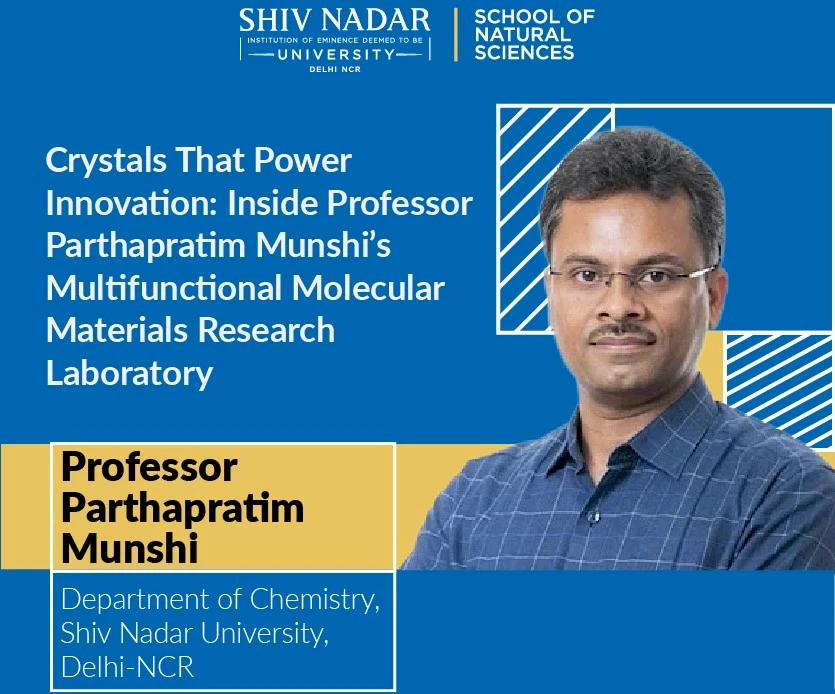
Crystals That Power Innovation: Inside Prof. Parthapratim Munshi’s Multifunctional Molecular Materials Research Laboratory
Editorial / January 27, 2026
Scientific progress often begins in places we cannot see—at the level of atoms. Crystallography, the science of understanding how atoms arrange themselves to form molecules and molecules get-together to form crystals, helps us make sense of this hidden world. Once we understand how atoms are organised and molecules interact, we gain insight into why a material behaves the way it does—and how it might be designed to behave differently.
At the Shiv Nadar Institution of Eminence, Delhi NCR, the Multifunctional Molecular Materials Group (M3G), led by Prof. Parthapratim Munshi, uses crystallography not just to study structures, but to address a broader challenge: how can materials be designed to deliver specific, desired functions?
To answer this, Prof. Munshi’s research integrates experimental crystallography, computational modelling, i.e., Quantum Crystallography to explore the relationship between molecular structure and material behaviour. His contributions have been recognised through honours such as the university’s Research Excellence Award, Fellowship of the Royal Society of Chemistry (FRSC), and leadership roles in national and international crystallographic bodies, including his current position as Vice President of the Indian Crystallographic Association.
The group’s work spans electronic materials, energy-related applications, and drug design—fields that may appear diverse yet are united by a common principle: structure governs properties. As Prof. Munshi explains, “Whether it is an electronic material or an anticancer molecule, the questions we ask are the same: What is the structure? Why does it behave this way? And how can we make it better?”
This approach is particularly powerful when working with organic materials. Built from familiar elements such as carbon, hydrogen, nitrogen, and oxygen, etc. Organic materials are lightweight, flexible, and easy to modify. Yet their behaviour can change dramatically with even subtle differences in structure. A small shift in how molecules pack together can transform electrical, mechanical, or biological properties.
One molecule, for example, can form multiple crystal arrangements—a phenomenon known as polymorphism. These different arrangements can behave almost like entirely different materials. In pharmaceuticals, this can influence how stable a drug is, how easily it dissolves, or how effectively it works in the body. Understanding and controlling polymorphism is therefore crucial not only for materials science, but also for medicine.
By examining these structural details, Prof. Munshi’s group is uncovering new ways to design functional materials for electronics, sensors, energy storage, and healthcare. One notable outcome of this work is their development of organic ferroelectric crystals that operate reliably at high temperatures.
Ferroelectric materials can store electrical information and are essential components of memory devices, sensors, and switches. While inorganic ferroelectrics dominate current technologies, they often rely on toxic metals and are rigid. Organic alternatives are more sustainable and flexible, but they typically lose performance when heated. The material developed by Prof. Munshi’s group addresses this challenge by remaining stable at elevated temperatures, switching its electric dipoles with relatively low energy, and avoiding the use of metals altogether. This achievement demonstrates that careful control of molecular arrangement can allow organic materials to rival the performance of traditional inorganic systems, opening new possibilities for lighter and greener electronic technologies.
A similar sensitivity to structure underpins the group’s research on anticancer molecules. Although drugs are commonly defined by their chemical formula, the way molecules arrange themselves within a crystal can strongly influence how a medicine behaves. As Prof. Munshi notes, “A drug is much more than its chemical formula. A different crystal form can behave like a completely different material, even in their solution phase.”
The team identified new crystal forms of several anticancer compounds and examined how these variations affected stability, solubility, and interactions with a cancer-associated protein called γ-enolase. Some crystal forms showed stronger interactions and different levels of activity against breast cancer cells, highlighting how crystal structure can shape biological response.
To understand the origins of these differences, the group employs quantum crystallography, a technique that reveals how electrons are distributed within crystals. This detailed perspective allows researchers to connect atomic-scale structure to physical, thermal, and biological behaviour, guiding the rational design of improved materials and therapeutics.
Across all these studies, a single idea remains central: small changes at the molecular scale can lead to major differences in performance. By uncovering the principles that link structure to function, Prof. Munshi’s group is helping shape materials—and medicines—with greater precision and purpose.
By Srijita Banerjee,
Academic Associate,
School of Natural Sciences,
Shiv Nadar University.
More Blogs

The Hawthornden Literary Retreat bestowed on Dr Sambudha Sen to complete the manuscript of a novel
Professor Sambudha Sen, Head of the Department of English at Shiv Nadar Institution of Eminence, Delhi-NCR, was awarded a residency at the...

The Power of the Moving Body
Movement is an innate bodily action that humans have been exhibiting for the longest time. Long before language was invented, the body was the...

How Does A Multi-Disciplinary Approach To Education Enhance Learning And Prepare Students For A Multi-Faceted World?
In today’s world, where businesses are changing almost every day, it is the responsibility of educational institutes to provide holistic...