What Connects Space, Energy, and Technology Revolutions? B.Sc. Physics Syllabus is at the Core of Them

Blog / September 07, 2025
B.Sc. Physics course detailsWhat after a B.Sc. in Physics?As kids, we all used to feel amazed by seeing the stars and the moon in the night sky. Each one of us has heard a number of stories regarding them as children.
As we progressed through our early education, we were introduced to the basic structure of the cosmos. In further study, we came to understand that everything in the universe is composed of fundamental particles: electrons, protons, and neutrons.
In high school, we learned about the concept of mass-energy conversion and understood that every existing entity is a form of energy.
But whatever you have learned as a student till class 12 is just the tip of the iceberg. You have just been introduced to a very small portion of the knowledge science has discovered yet. And this will work just as a base for making your path into space exploration, working in the field of energy, developing new age technology, or anything else in which you want to make a career as a science student.
So, what’s the way forward? The answer in B.Sc. Physics. Yes, this is the right undergraduate degree program that can help you build a career in the field of science, in your favorite domain of work.
Let’s deep dive into the details of B.Sc. Physics syllabus and uncover what you will learn throughout this program.
What is B.Sc. Physics?
The B.Sc. Physics is a 3- or 4-year undergraduate degree course that prepares you to understand the core principles of physics, their working, and applications. The curriculum includes both comprehensive theoretical study and practical laboratory work.
Starting with the B.Sc. Physics Syllabus 1st Year
B.Sc. Physics Syllabus 1st year starts with some basic introductory courses. This includes:
- Fundamentals of Physics
- Introduction to Computational Physics
- Calculus and
- Chemical Principles
These B.Sc. Physics subjects are taught to prepare a strong and firm base for advanced studies in the years to come. They cover Newtonian mechanics, special theory of relativity, electromagnetism, differential equations, partial differential equations, etc.
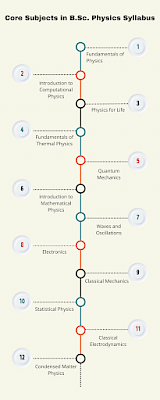
Diving Deeper Into B.Sc. Physics Syllabus
After covering the basics in the 1st year, your journey of the B.Sc. Physics course will move ahead, and will be introduced to the core learning subjects.
This section of the B.Sc. Physics syllabus covers advanced concepts of Physics and helps you understand some of the basic principles governing the behavior of matter, energy, and their interactions at the macroscopic and microscopic levels.
You will obtain a theoretical understanding of the mathematical formulations of physical laws, the nature of particles at the quantum level, and the statistical behaviour of systems. These learnings not only create strong academic foundations but also make you ready for future career choices.
Elective Subjects in B.Sc. Physics Syllabus
The elective subjects are a range of courses that are part of the B.Sc. Physics syllabus, but you will have the option to choose which one you want to study, depending on your interest and career aspirations.
Here are the top elective subjects included in the B.Sc. Physics curriculum:
- Introduction to Biophysics
- Classical Theory of Fields
- Advanced Quantum Mechanics
- Advanced Condensed Matter Physics
- Quantum Field Theory
- Introduction to High Energy Particle Physics
- Classical Field Theory and General Relativity
- Introduction to Experimental Techniques in Particle Physics
- General Theory of Relativity
- Computational and Numerical Analysis
- Non-linear Dynamics
- Topics in Quantum Many-Body Theory
- Nanomaterials and Nanophysics
- Advanced Statistical Physics
- Introduction to Quantum Field Theory
- Semiconductor Physics and Devices
- Particle Physics Phenomenology
- Experimental Techniques in Particle Physics
- Introduction to String Theory
- Multiferroics and Shape Memory Alloys
- BIOSENSORS: General Principles and Advanced Sensing Techniques
- Soft Matter Physics
- Materials Characterization Techniques
- Introduction to Thin Films
- Fundamentals of Ion-Solid Interactions
- Ion Beam Based Materials Characterization Techniques
- Astronomy and Astrophysics
- Astroparticle Physics and Cosmology
Making a Career in the Field of Physics: What Options You Will Have After B.Sc. Physics
You have thoroughly gained the key information about the B.Sc. Physics subjects. But, in the end, a question will come into your mind that, after all, where does this study lead to?
Well, this program opens the door to a career in the field of research, academics, government jobs, and other kinds of working opportunities. You can apply for different job roles, including:
- Physicist
- Lab technician
- Junior research fellow
- Research scientist
- Simulation specialist
- Quality control analyst
Not only this, but the B.Sc. Physics course opens the door to India’s most reputed institutions for you, where you can apply for job roles:
- ISRO (Indian Space Research Organization)
- DRDO
- BARC (Bhabha Atomic Research Centre)
- Saha Institute of Nuclear Physics
- ONGC (Oil and Natural Gas Corporation)
Apart from this, you can also prepare for different government service examinations, like:
- SSC
- Indian Railways
- State PSC
- PSUs and
- UPSC
Take the First Step in the Right Direction: Starting Your B.Sc. Physics Journey @Shiv Nadar University (Institution of Eminence)
Recognized as an Institution of Eminence by the Government of India, Shiv Nadar University offers a four-year B.Sc. (Research) in Physics program under the School of Natural Sciences. If you want to make a career in science, technology, research, academics, and beyond, this is the right place that can offer you the ideal environment & opportunity to learn, think, and grow.
- Research-oriented study
- State-of-the-art lab infrastructure
- Collaborative, global-ready learning environment
- Scholarships and financial aid to deserving students and
- Faculty from India’s and the world’s top institutions
Shiv Nadar University is the place where you can give wings to your dream of making a career in the field of Physics. The B.Sc. (Research) in Physics degree will ignite a spirit of scientific inquiry, nurture independent thinking, and equip you with the advanced knowledge and research skills needed to excel in your career.
Synopsis
The B.Sc. Physics syllabus is meticulously designed to offer you a well-rounded combination of theoretical knowledge as well as practical expertise. Over the four years, the program starts with introductory courses and progresses through more advanced studies. In addition to the core curriculum, you will have the opportunity to choose from elective courses and study them as well.
Admission for the B.Sc. (Research) in Physics program at Shiv Nadar University is open. Gear up and make the first move towards a rewarding career in the field of Physics. Apply Now!
FAQs
What are the basic eligibility criteria for B.Sc. Physics?
You must have 60-75% marks in Class 12 with Physics and Mathematics to apply for the B.Sc. Physics program.
Which is the best entrance exam for B.Sc. Physics admission?
CUET is the widely accepted entrance exam for admission to B.Sc. Physics course.
What gets covered in the B.Sc. Physics syllabus 1st year?
You’ll study subjects like Fundamentals of Physics, Introduction to Computational Physics, Calculus, Chemical Principles, etc, in the B.Sc. Physics syllabus 1st year.