The Universe, Between the Seen and the Hidden
Editorial / May 26, 2026
The Universe, Between the Seen and the Hidden
We are used to a world that behaves predictably. Objects fall, light travels, and matter stays where it is. This reliability is useful, but also misleading. Beyond our everyday scale, the universe behaves in ways that are far less intuitive.
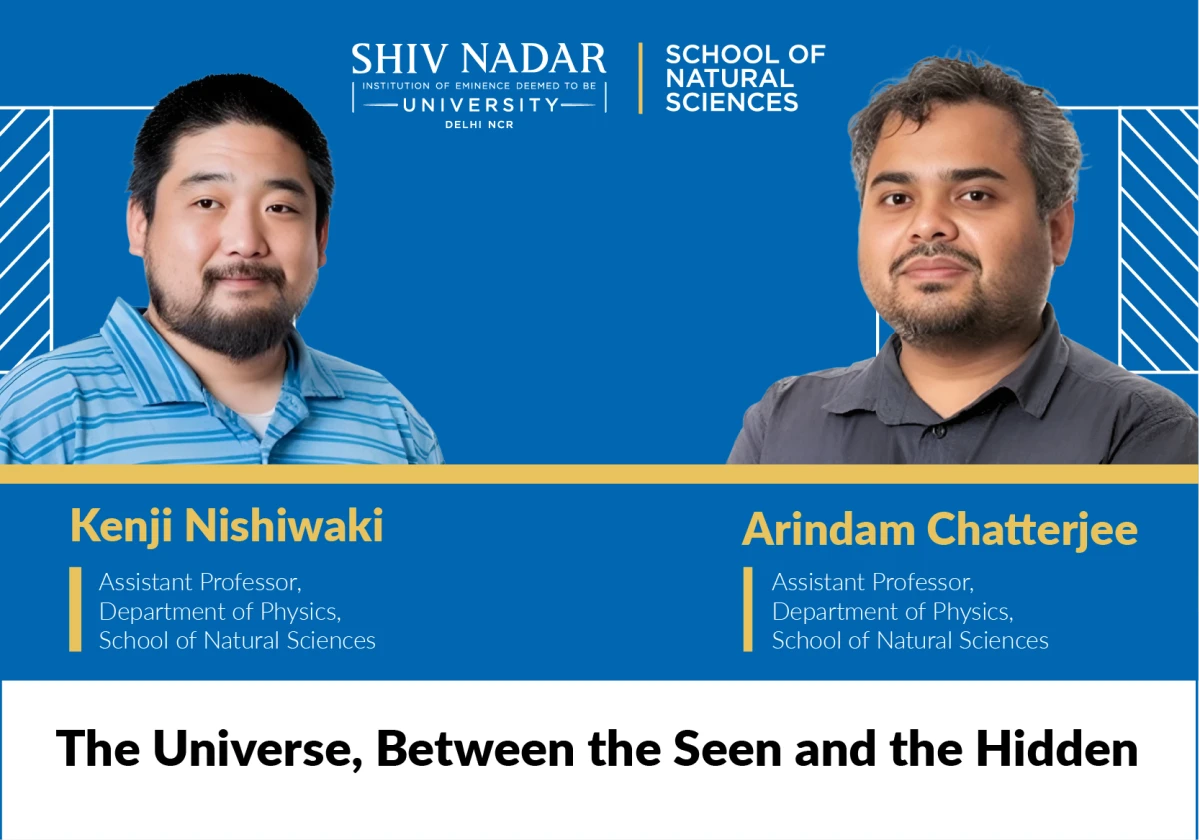
The High-Energy Physicsand Cosmology group led by Dr Arindam Chatterjee and Dr Kenji Nishiwaki works far beyond such intuitive notions, where the universe begins to behave… differently.
One example is that space itself is not still. It can ripple. These ripples, called gravitational waves, are tiny disturbances in spacetime. The waves from colliding black holes have already been detected by observatories like the Laser Interferometer Gravitational-Wave Observatory (LIGO). But scientists are now searching for signals from the earliest moments of the universe that would confirm inflation—a phase when the universe expanded extremely rapidly just after its birth. During this epoch, objects did not move through space faster than light; instead, space itself stretched.
Experiments across the world, including future missions like the Laser Interferometer Space Antenna (LISA), aim to detect traces of this phase. Within this effort, Dr. Chatterjee studies what happens when this expansion briefly slows. This is described as a flattening in the energy driving expansion, but it can be understood as a slope that momentarily becomes gentle.
This small feature can amplify tiny fluctuations (called quantum fluctuations), the minute irregularities present in the early universe, producing not just the seeds of galaxies but also an additional background of gravitational waves. If detected, these signals would not just confirm inflation, they would also reveal its internal structure. As Dr. Chatterjee says, “The early universe is not silent. If we listen carefully enough, it tells us how it evolved.”
From the largest scales, we move to something more elusive. Most of the universe is invisible. Dark matter does not emit or reflect light, yet its gravity shapes galaxies. Around the world, scientists are trying to detect it directly using underground experiments and particle accelerators. Another approach is to use the universe itself as evidence.
The Cosmic Microwave Background is a faint glow left over from when the universe became transparent. It is often described as a snapshot of the early universe. If dark matter interacted even slightly with ordinary matter, it would leave subtle imprints in this light. Dr. Chatterjee’s group studies this possibility. A tiny interaction would act like a drag force, a small transfer of motion between particles that changes how matter clumps together. These changes, though faint, can be measured. In this sense, the universe itself becomes an experiment, preserving clues from its earliest phases.
At the same time, researchers are exploring what dark matter could be. Some proposed particles interact so weakly that they are almost impossible to detect. However, quantum physics adds an important detail. Even when a process seems negligible, small corrections from virtual quantum effects can enhance the chances of detection. As Dr. Chatterjee notes, “When the main effect is small, the corrections are not secondary anymore. They can decide what we observe.”
A related question concerns neutrinos, particles that pass through matter almost undisturbed and have extremely small mass. Explaining their mass requires going beyond standard ideas. Dr. Nishiwaki studies models in which neutrinos gain mass indirectly through interactions with hidden particles. Instead of a direct mechanism, the mass arises through intermediate steps, which naturally explains why it is so small. In these models, the same hidden sector that explains neutrino mass can also provide a candidate for dark matter. “The interesting part,” says Dr. Nishiwaki, “is that one structure can explain more than one mystery.”
This idea also guides the search for extra dimensions. Some theories suggest that space has more spatial dimensions than the three we experience, but that these extra dimensions are compactified, curled up so tightly that we do not see them. If particles move through them, they would appear as heavier versions of themselves in experiments. Experiments such as the Deep Underground Neutrino Experiment (DUNE) aim to detect such effects through precise measurements.
However, identifying new physics is not always straightforward. In many analyses, particles are treated as plane waves, and waves can combine. Quantum interference, the way wave-like effects reinforce or cancel each other, can partially hide signals, depending on the specific waveform details. A new effect may not appear clearly, but as a small deviation shaped by cancellations. In this case, new physics may not be absent, only difficult to isolate.
This leads to an important caution. Not every mismatch between theory and experiment signals something new. Sometimes the issue lies in how we describe known physics. In particle physics, certain decay processes once showed large discrepancies. The resolution came from improving how particles were modeled. Instead of treating them as perfectly spread-out waves, they were treated as localized packets, closer to physical reality. With this correction, some discrepancies have disappeared. The lesson is simple. What we observe depends not only on what exists, but also on how precisely we describe it.
Taken together, these ideas are part of a global effort to understand the structure of reality. The work of this group contributes by refining the theoretical picture and guiding what we look for. Because before we detect anything, we must first know what to look for.
And in doing so, we are reminded that the universe is not built to match our intuition. It asks us to expand it. As Satyendra Nath Bose once reflected, 'In the ultimate analysis, the problems of science are the problems of philosophy.' And perhaps that is where this journey leads, not just outward into the cosmos, but inward, toward a deeper clarity about how we understand it.
Srijita Banerjee
Academic Associate,
School of Natural Sciences,
Shiv Nadar University.
More Blogs

The Hawthornden Literary Retreat bestowed on Dr Sambudha Sen to complete the manuscript of a novel
Professor Sambudha Sen, Head of the Department of English at Shiv Nadar Institution of Eminence, Delhi-NCR, was awarded a residency at the...
The Power of the Moving Body
Movement is an innate bodily action that humans have been exhibiting for the longest time. Long before language was invented, the body was the...

How Does A Multi-Disciplinary Approach To Education Enhance Learning And Prepare Students For A Multi-Faceted World?
In today’s world, where businesses are changing almost every day, it is the responsibility of educational institutes to provide holistic...