Prof. Koichi Kawakami: Unlocking the Secrets of the Brain with Tiny Zebrafish
Editorial / November 27, 2025
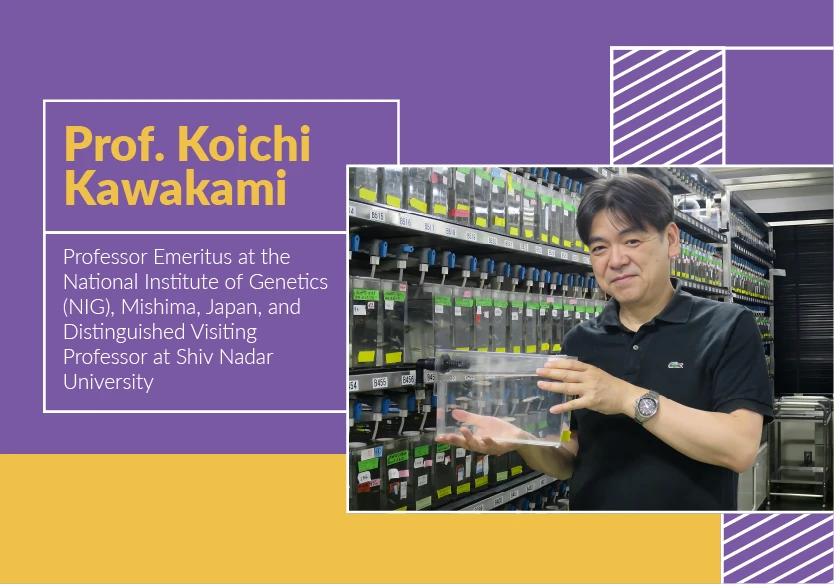
Imagine being able to watch the brain in action — to see how it thinks, learns, and responds to the world. That’s exactly what Prof. Koichi Kawakami, Professor Emeritus at the National Institute of Genetics (NIG), Mishima, Japan, and a distinguished visiting professor at Shiv Nadar University, has made possible through his groundbreaking work with a small but extraordinary animal — the zebrafish.
Zebrafish may seem like simple aquarium fish, but they share many of the same genes and biological processes as humans. What makes them even more special is that their embryos and larvae are transparent, allowing scientists to observe their internal organs and brain activity in real time. These qualities make zebrafish a powerful model for studying how our brain develops, behaves, and reacts to the world around us.
Prof. Kawakami has devoted his career to creating tools that let scientists “see” and “control” what happens inside living organisms. One of his most famous contributions is the development of the Tol2 transposon system, a genetic tool that allows researchers to easily add, remove, or track specific genes. This technique has transformed zebrafish into a favorite model for studying human diseases and brain function. It has also enabled researchers around the world to identify which genes are active in different parts of the brain and to visualize how they influence behavior.
In one remarkable discovery, Prof. Kawakami and his colleague Dr. Akira Muto found out how zebrafish learn to hunt. When the larvae see prey for the first time, certain neurons in their brain light up and send signals to the part that controls feeding. This direct connection between seeing and eating shows how visual information can instantly trigger instinctive behavior. By identifying this brain circuit, the team revealed a universal principle — how the brain converts what we see into what we do.
His team also uses zebrafish to understand neurodegenerative diseases like ALS (amyotrophic lateral sclerosis), which gradually paralyze the body. By creating zebrafish in which key disease-related proteins can be controlled with light, they can actually watch how brain cells begin to malfunction and die. This approach helps scientists understand how such diseases develop and test new treatments faster and more precisely.
Over the years, Prof. Kawakami’s lab has built hundreds of special zebrafish lines that allow researchers to study specific types of cells or brain regions. These resources are now used worldwide to explore memory, emotion, learning, and many other brain functions. His work has also helped uncover how zebrafish — and by extension, humans — learn to recognize danger and form memories of fear, suggesting that the emotional systems of fish and humans are more alike than we might think.
For his exceptional contributions, Prof. Kawakami has received several prestigious honors, including the Christiane Nüsslein-Volhard Award (2021) from the European Zebrafish Society and the Commendation for Science and Technology (2023) from Japan’s Minister of Education, Culture, Sports, Science and Technology (MEXT).
With over 240 scientific publications to his credit, Prof. Kawakami continues to inspire researchers around the world. His work with the tiny zebrafish reminds us that even the smallest creatures can unlock the biggest mysteries — like how our brains make sense of the world and shape who we are.
By Srijita Banerjee,
Academic Associate,
School of Natural Sciences,
Shiv Nadar University.
More Blogs

The Hawthornden Literary Retreat bestowed on Dr Sambudha Sen to complete the manuscript of a novel
Professor Sambudha Sen, Head of the Department of English at Shiv Nadar Institution of Eminence, Delhi-NCR, was awarded a residency at the...

The Power of the Moving Body
Movement is an innate bodily action that humans have been exhibiting for the longest time. Long before language was invented, the body was the...

How Does A Multi-Disciplinary Approach To Education Enhance Learning And Prepare Students For A Multi-Faceted World?
In today’s world, where businesses are changing almost every day, it is the responsibility of educational institutes to provide holistic...