Planning MBA Admission in 2026? Here’s the Smart Way to Start
Blog / January 14, 2026
An MBA is a transformative step toward leadership roles and long-term career growth, opening doors to senior management positions, entrepreneurial opportunities, and global career pathways. However, as MBA admissions become more competitive each year, success increasingly depends on early planning, clarity of goals, and informed decision-making at every stage of the process.
In this blog, you’ll find everything related to MBA admission in 2026, covering entrance exams, eligibility requirements, key timelines, application steps, and practical tips to help you secure admission to the right MBA program aligned with your career aspirations.
Understanding MBA Admission Eligibility
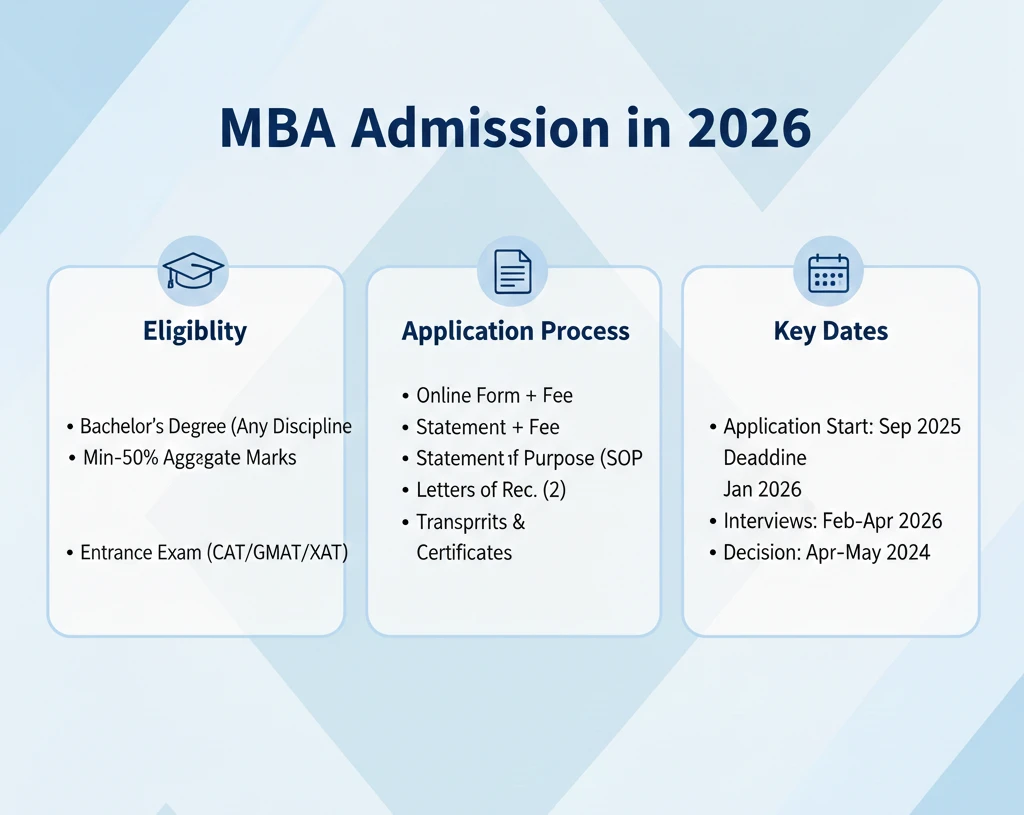
Before diving into applications, it's crucial to understand the fundamental eligibility requirements for MBA programs. Most business schools have standardized criteria, though specific requirements may vary.
|
Eligibility Criteria |
Requirement Details |
|
Educational Qualification |
Bachelor's degree in any discipline from a recognized university |
|
Minimum Percentage |
Typically 50% for general category; 45% for reserved categories |
|
Entrance Exams |
CAT, XAT, GMAT, CMAT, MAT, or university-specific tests |
|
Work Experience |
Optional for most programs; mandatory for Executive MBA |
|
Age Limit |
No upper age limit for most programs |
The MBA admission eligibility extends beyond just academic scores. Top business schools evaluate candidates holistically, considering entrance exam performance, academic records, work experience, extracurricular achievements, and personal interview performance.
The MBA Admission Timeline for 2026
Planning your MBA admission requires understanding the critical timeline. Most entrance exams occur between November and March, with applications opening shortly after results are declared.
Key Timeline:
- July-September 2025: Register for entrance exams (CAT, XAT, GMAT)
- October-November 2025: Appear for entrance examinations
- December 2025-January 2026: Results declaration and application process begin
- February-April 2026: Group discussions and personal interviews
- May-June 2026: Final admission offers and seat confirmations
- July 2026: Academic session begins
Starting your preparation at least 6-8 months before the entrance exam gives you adequate time to strengthen weak areas and build a competitive application profile.
How to Secure MBA Admission: Step-by-Step Process
Getting admission into a quality MBA program requires systematic planning and execution. Here's your roadmap to success:
Step 1: Self-Assessment and Goal Setting
Begin by evaluating your career objectives, preferred specializations, and target business schools. Understanding your goals helps you choose the right program and prepare a focused application strategy.
Step 2: Entrance Exam Preparation
Dedicate 4-6 months to entrance exam preparation. Join coaching classes if needed, practice mock tests regularly, and focus on time management skills. Your entrance exam score often serves as the first filter in the MBA admission process.
Step 3: Research Business Schools
Identify 8-10 business schools that align with your profile, budget, and career goals. Consider factors like placement records, faculty expertise, industry connections, infrastructure, and alumni network.
Step 4: Prepare Application Documents
Compile your academic transcripts, entrance exam scorecards, work experience certificates, recommendation letters, and a well-crafted statement of purpose. Your SOP should articulate your motivation, career vision, and why you're an ideal fit for the program.
Step 5: Apply Strategically
Apply to multiple colleges across different tiers to maximize your chances. Pay attention to application deadlines and ensure error-free submissions.
Step 6: Ace the Interview
The personal interview is your opportunity to demonstrate soft skills, leadership potential, and genuine interest. Prepare for common questions about your background, career goals, current affairs, and ethical dilemmas.
Choosing the Right MBA Specialization
MBA admission isn't just about getting accepted, but also about finding the right fit for your career trajectory. Therefore, consider these factors while selecting program specialization:
- Specialization Options: From finance and marketing to analytics and entrepreneurship, choose a program offering your preferred specialization with strong faculty and industry linkages.
- Accreditation and Rankings: Look for programs with NBA, AACSB, or EQUIS accreditation. While rankings shouldn't be the sole deciding factor, they indicate program quality and reputation.
- Return on Investment: Analyze the fee structure against placement statistics. Calculate average salaries, sector-wise placements, and percentage of students placed within three months of graduation.
Common Mistakes to Avoid During MBA Admission
Many candidates compromise their chances through avoidable errors. Don't make these mistakes:
- Applying to too many or too few colleges, submitting generic statements of purpose, ignoring application deadlines, overlooking college-specific requirements, neglecting interview preparation, or focusing solely on entrance exam scores while neglecting other application components.
- Research each program thoroughly and customize your application to highlight why you're specifically interested in that particular institution.
MBA at Shiv Nadar University (Institution of Eminence): Designed for Impact, Driven by Excellence
Choosing the right university is a defining step in your MBA journey. Shiv Nadar University offers an MBA program designed to build global competence, leadership capability, and industry readiness in a rapidly evolving business world.
Let’s take a look at why students prefer this course at Shiv Nadar University-
- Globally Recognized MBA Degree: A UGC-entitled MBA with strong global recognition, offering long-term academic and career credibility.
- Global Faculty & Immersive Learning: Learn from world-class faculty through dynamic, discussion-driven classrooms rooted in research and real-world insights.
- International Exposure through GIP: The Global Immersion Program broadens perspectives with hands-on exposure to global markets, cultures, and business practices.
- Industry-Integrated Experience: Business challenge practicums and summer internships enable students to solve real business problems and gain practical leadership skills.
- Leadership & Entrepreneurial Focus: A curriculum designed to develop innovative, ethical leaders with an entrepreneurial mindset.
If you’re looking for an MBA that goes beyond textbooks and prepares you for global leadership, Shiv Nadar University is a compelling choice.
Conclusion
MBA admission in 2026 is not just about cracking an entrance exam, but also about early planning, informed decisions, and choosing the right-fit institution. From understanding eligibility and timelines to preparing strategically and selecting a future-ready program, every step you take today shapes your career tomorrow.
If you’re looking for an MBA that combines global recognition, industry-integrated learning, and leadership development, the MBA at Shiv Nadar University offers a strong foundation for long-term success. Take the smart first step and explore admissions. Apply now!
FAQs
Is MBA admission open?
MBA admission cycles typically open between December and March following entrance exam results. The 2026 admission season will commence after exams like CAT, XAT, and GMAT conclude in late 2025.
How to get admission for MBA?
To get MBA admission, you need to clear entrance exams (CAT/XAT/GMAT), meet eligibility criteria (bachelor's degree with minimum 50%), apply to desired colleges, and successfully complete group discussions and personal interviews.
Is MBA a 2 year course?
Yes, regular MBA programs are typically 2-year full-time courses divided into four semesters. However, some institutions offer one-year intensive programs or part-time options spanning 2-3 years for working professionals.
Who is eligible for MBA?
Anyone with a bachelor's degree in any discipline from a recognized university with minimum 50% marks (45% for reserved categories) is eligible for MBA admission. No specific undergraduate background is required.