MBA Course Fees: Is the Investment Worth It in 2026?
Blog / January 15, 2026
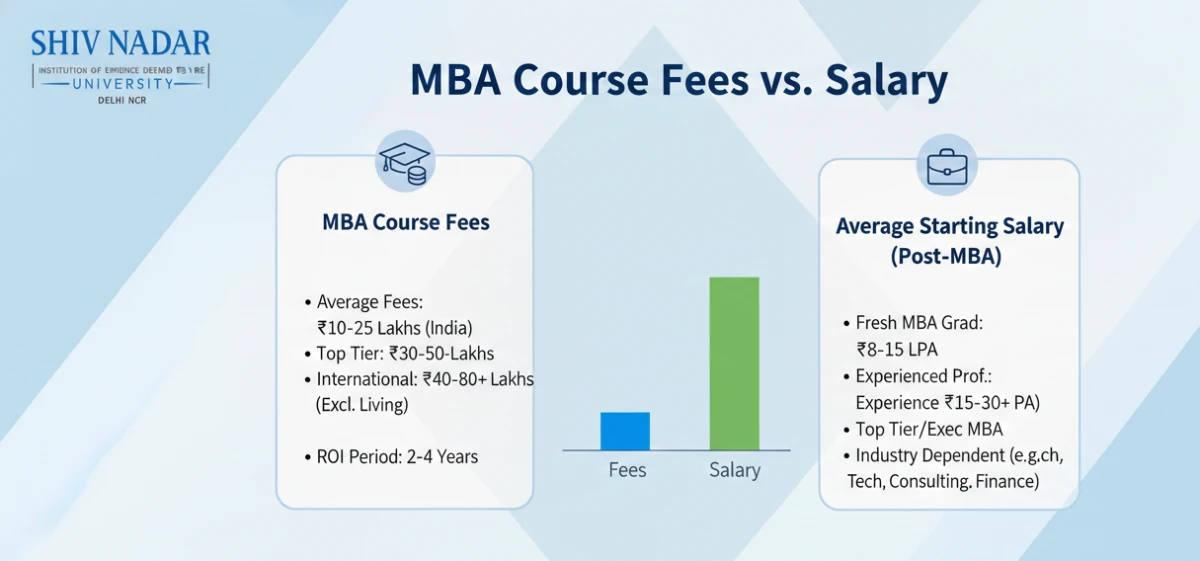
Pursuing an MBA in 2026 requires you to invest anywhere from ₹3 lakhs to ₹25 lakhs in tuition fees alone. For most aspiring managers and professionals, the central question remains: Will the salary increment justify this substantial investment?
With rising MBA course fees across Indian institutions and an evolving job market, you need to carefully evaluate the return on investment before enrolling in a program.
This blog provides you with insight into MBA course fees in relation to post-MBA salaries, helping you determine whether an MBA delivers the financial and career outcomes worth the investment in 2026.
MBA Course Fees in India: Overview
MBA course fees vary significantly based on institution type, program format, and duration. The table below breaks down the current fee landscape:
Institution Category | Fee Range (Complete Program) |
Government Colleges & IIMs | ₹2 lakhs-₹25 lakhs |
Mid-Tier Private Universities | ₹5 lakhs-₹15 lakhs |
Premium Private B-Schools | ₹12 lakhs-₹25 lakhs+ |
What Do You Actually Pay for an MBA?
When calculating your MBA investment, you must account for expenses beyond tuition that significantly impact your total outlay. Here is a general overview:
Category | Cost |
Annual Tuition Fees | ₹7,50,000 (Subject to revision of 5% to 8% in the second year) |
Admission Fees | ₹70,000 (non-refundable) |
Security Deposit | ₹25,000 (refundable) |
Application Fee | ₹1,800 (non-refundable) |
Annual Living Fee | ₹2,75,000 (Hostel, Mess, Laundry and Medical Insurance). Current estimate for a furnished single room and attached restroom; with all weather AC. |
Calculating Your ROI: Is an MBA Worth It?
Return on investment depends on three critical factors: your pre-MBA salary, post-MBA salary, and total program cost. Premium programs with higher fees often deliver faster ROI due to significantly higher post-MBA salaries. Mid-tier programs offer solid returns with moderate risk, while lower-tier programs require careful evaluation. If placement outcomes are weak, you may struggle to recover your investment.
MBA at Shiv Nadar University (Institution of Eminence): Value-Driven Education with Real Career Impact
Shiv Nadar University offers a two-year MBA program that emphasizes experiential learning, industry engagement, and leadership development. The program fee structure competes with those of other private universities, along with the opportunity for merit-based scholarships that are available to eligible candidates.
The MBA program at Shiv Nadar University focuses on innovation, analytical thinking, and ethical leadership, preparing graduates for diverse management roles. With a multidisciplinary campus environment and personalized mentorship, students receive a comprehensive business education that balances academic rigor with practical application, positioning them for meaningful career advancement.
Conclusion
The best MBA programs help you get good jobs, are reasonably priced, and fit your career goals. Look for courses that can double or triple your salary and let you pay off your investment in less than three years. Be careful of those that take more than four years to break even. Also, make sure the networking opportunities and career flexibility offered are worth the time you spend.
Thoroughly research programs, critically examine placement reports, calculate your ROI, apply for scholarships, and discuss outcomes with recent alumni before deciding. An MBA should enhance your earning potential and leadership skills, delivering returns that offset the costs. Choose wisely based on MBA course fees, outcomes, and fit in 2026's competitive job market.
FAQs
Q1. How much is the fee for an MBA course?
Ans. MBA course fees in India typically range from ₹2 lakhs to ₹25 lakhs, depending on the institution, program format, and duration. When evaluating costs, you should also factor in living expenses and opportunity cost.
Q2. Is MBA a 2 year course?
Ans. Traditionally, an MBA is a two-year full-time program, especially in India. However, one-year MBA and executive MBA programs are also available for working professionals seeking faster ROI and reduced career interruption.
Q3. Is an MBA better than a BBA?
Ans. An MBA is generally more valuable than a BBA for career advancement, as it leads to higher salaries, leadership roles, and specialization opportunities. However, it requires a significantly higher financial investment and clearer career goals.
Q4. How much is a 1 year MBA?
Ans. An MBA course fee for 1 year in India usually costs between ₹3 lakhs and ₹8 lakhs. These programs offer quicker completion, lower opportunity cost, and faster return to the workforce, making them attractive for experienced professionals.