Ph.D. in Physics vs Ph.D. in Chemistry: Comparing Research Areas, Emerging Trends & Career Opportunities
Blog / August 18, 2026
A battery in an electric car may seem like just one engineering issue, right? But from the research perspective, the battery can raise completely distinct scientific questions. For instance, a chemist can explore how electrode composition affects electrochemical reactions, while a physicist can study charge transport, interfaces or even the material's electronic properties. Same battery but distinct questions.
That's whyPh.D. Physics vs Ph.D. Chemistry in India cannot be limited to "Which subject has better scope?" Both sciences are equally important just from the research perspective alone. As per the Department of Science & Technology of India, Physics and Chemistry comprised 11% and 8%, respectively, of India's share of scientific publications in 2020.
These numbers don't tell you which Ph.D. is better; they tell you something more useful: Both are established research disciplines, but they lead into different scientific questions and increasingly overlap in applied research.
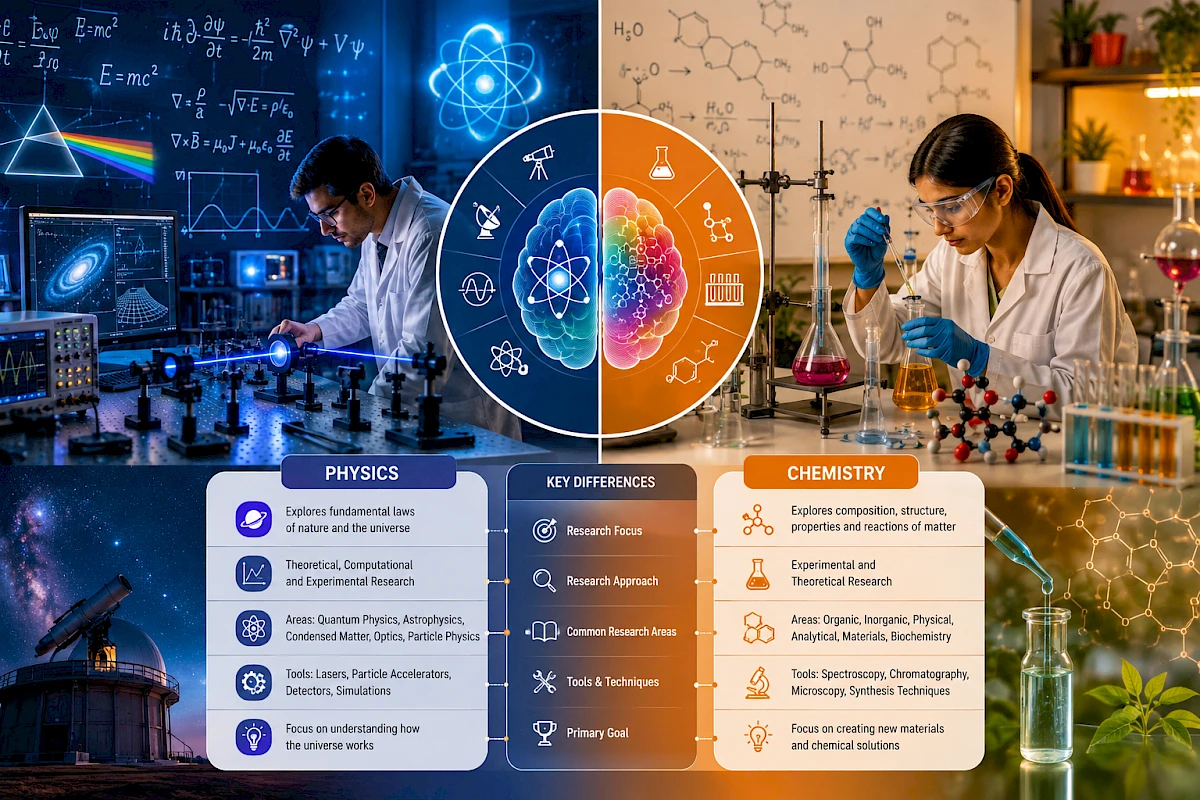
Ph.D. Physics vs Ph.D. Chemistry: Key Differences at a Glance
The difference becomes clearer when you stop thinking about undergraduate subjects and start thinking about doctoral research.
Aspect | Ph.D. in Physics | Ph.D. in Chemistry |
Core focus | Physical laws, systems and behavior | Structure, properties and transformation of matter |
Research style | Theoretical, experimental, computational | Experimental, analytical, computational |
Mathematics | Usually high | Depends on specialization |
Laboratory dependence | Research-area dependent | Often high |
Computation | Modeling, simulation, numerical analysis | Molecular modeling, quantum chemistry, simulation |
Research scale | Subatomic to astronomical | Molecular to materials scale |
Strongest traditional areas | Quantum, condensed matter, particles, astrophysics | Organic, inorganic, physical, analytical chemistry |
Major modern overlap | Materials, energy, nanoscience, spectroscopy | Materials, energy, nanoscience, spectroscopy |
Physics can ask why a system behaves as it does; chemistry, on the other hand, can ask how that system's composition and molecular structure can be understood or changed. At the Ph.D. level, that distinction matters far more than the names of the two subjects.
Ph.D. Physics vs Ph.D. Chemistry: Where Is the Research Actually Going
The numbers become more interesting when you look beyond publication totals. The Indian semiconductor market size is estimated at US$38 billion in 2023 and is expected to grow to US$109 billion by 2030, according to the Government of India’s Ministry of Electronics & IT. The Semiconductor Program has a sanctioned budget allocation of ₹76,000 crore. This creates natural overlap with research on semiconductors, quantum materials, electronics, photonics and device physics for physicists.
Chemistry has its own large research-oriented industrial ecosystem, where the Indian chemicals and petrochemicals industry is projected by the Ministry of Chemicals and Fertilizers to surpass US$300 billion by 2028 and where the sector contributes more than 9% of the country’s manufacturing GDP and almost 7% of its exports.
Let’s see some research directions for a Ph.D. in Physics or Chemistry:
Research direction | Physics | Chemistry |
Quantum technology | Strong | Emerging |
Semiconductor research | Strong | Materials overlap |
Advanced materials | Strong | Strong |
Catalysis | Emerging | Strong |
Chemical biology | Interdisciplinary | Strong |
Nanotechnology | Strong | Strong |
Photonics | Strong | Emerging |
Computational research | Strong | Strong |
Energy storage | Strong | Strong |
Spectroscopy | Strong | Strong |
So if someone tells you that Physics is only about theory or Chemistry is only about laboratory reactions, they're looking at the subjects through an undergraduate lens.
Emerging Trends Shaping Ph.D. Research in Physics and Chemistry
As scientific research becomes increasingly interdisciplinary, the boundaries between Physics and Chemistry are becoming less rigid. Areas such as quantum technology, advanced materials, nanotechnology, energy storage and computational research are creating opportunities for researchers from both disciplines. At the same time, fields such as chemical biology, catalysis and semiconductor research are opening new directions for specialized doctoral work.
Some of the key emerging trends include:
- Quantum technology
- Advanced materials and nanotechnology
- Energy storage
- Semiconductors and photonics
- Computational research
- Chemical biology and catalysis
For Ph.D. aspirants, these trends highlight an important shift: choosing between Physics and Chemistry increasingly depends on identifying the research problem and interdisciplinary area that align with your interests. This makes it useful to look beyond traditional subject boundaries when considering long-term research opportunities.
Which Ph.D. Has More Scope? Look at the Research Problem
India's Central Electricity Authority estimates that the country's energy-storage requirement could reach 411.4 GWh by 2031-32, including 236.22 GWh from battery energy storage systems. The Ministry of New and Renewable Energy also states that energy storage is essential to incorporate renewable energy into the power system.
That single research challenge brings Physics and Chemistry into the same conversation.
Problem | Physics researchers may investigate | Chemistry researchers may investigate |
Battery performance | Charge transport and interfaces | Electrode chemistry |
Semiconductors | Electronic behaviour | Material composition |
Quantum materials | Quantum phenomena | Structure and composition |
Nanomaterials | Nanoscale physical properties | Synthesis and functionalization |
Energy storage | Transport, thermal and electrical behavior | Electrochemical reactions |
Spectroscopy | Physical interpretation | Molecular structure |
This is why the better question isn't: “Physics or Chemistry?” It is: “Which side of the problem do I want to investigate?”
Which Degree Leads to More Career Opportunities?
A Ph.D. doesn't work like an undergraduate degree, where one course maps neatly to one job title. Your specialization, research methods and technical expertise become your professional identity.
Career Opportunities After a Ph.D. in Physics
- Research Scientist
- Physicist
- Materials Researcher
- Quantum Researcher
- Semiconductor Researcher
- Photonics Researcher
- Computational Physicist
- Data/Modelling Researcher
- R&D Scientist
- Academic Researcher
Career Opportunities After a Ph.D. in Chemistry
- Research Scientist
- Materials Chemist
- Computational Chemist
- Medicinal Chemistry Researcher
- Chemical R&D Scientist
- Catalysis Researcher
- Analytical Scientist
- Chemical Biology Researcher
- Spectroscopy Researcher
- Academic Researcher
Physics vs Chemistry Career Alignment
Career sector | Physics | Chemistry |
Academia & research | Strong | Strong |
Semiconductor R&D | Strong | Moderate |
Quantum technology | Strong | Emerging |
Advanced materials | Strong | Strong |
Energy research | Strong | Strong |
Chemical R&D | Moderate/limited | Strong |
Pharmaceuticals | Limited | Strong |
Catalysis | Emerging | Strong |
Nanotechnology | Strong | Strong |
Computational research | Strong | Strong |
Spectroscopy | Strong | Strong |
Space/astrophysics | Strong | Limited |
*These are disciplinary alignments, not employment guarantees.
Ph.D. Physics vs Ph.D. Chemistry in India: What Will the Fees Look Like
Once you've narrowed down the research area, the financial structure becomes the next practical question. The fee structure is largely the same across full-time doctoral programs, so there isn't a separate tuition price for Physics and Chemistry.
Fee component | Ph.D. Physics | Ph.D. Chemistry |
Annual tuition fee | ₹1,10,000 | ₹1,10,000 |
Annual tuition waiver | ₹60,000 | ₹60,000 |
Tuition payable after waiver | ₹50,000/year | ₹50,000/year |
5-year tuition | ₹5,50,000 | ₹5,50,000 |
5-year tuition waiver | ₹3,00,000 | ₹3,00,000 |
Effective tuition after waiver | ₹2,50,000 | ₹2,50,000 |
One-time admission fee | ₹25,000 | ₹25,000 |
Refundable security deposit | ₹25,000 | ₹25,000 |
Physics and Chemistry therefore have the same listed doctoral tuition structure. The bigger financial comparison comes from the stipend, hostel subsidy and research support available during the Ph.D.
Which Ph.D. Offers Better Financial Support During Research?
For an Indian Ph.D. aspirant, the financial side cannot be ignored. Five years of research means fellowship support can affect the entire doctoral experience.
The current scheme provides:
Fellowship stage | Monthly fellowship | Duration |
JRF | ₹45,000 | First 2 years |
SRF | ₹50,000 | Remaining period |
Maximum tenure | — | 5 years |
Annual Tuition Waiver | ₹60,000 | — |
Annual Hostel Fee Subsidy | ₹60,000 | — |
So funding is not something Physics and Chemistry students need to compare as fundamentally different disciplines. The fellowship route and doctoral institution generally matter more than the subject itself.
Ph.D. Physics vs Ph.D. Chemistry: Key Learning Outcomes Compared
A doctoral researcher develops a very different skill profile from a master's student.
Learning Outcomes of a Ph.D. in Physics
- Mathematical modeling
- Experimental research
- Computational analysis
- Theoretical reasoning
- Instrumentation
- Research design
- Scientific communication
Learning Outcomes of a Ph.D. in Chemistry
- Molecular analysis
- Synthesis
- Characterization
- Computational chemistry
- Experimental design
- Materials development
- Scientific communication
Ultimately, the difference lies not just in what you research, but in how deeply you learn to question, investigate and solve problems within your chosen field.
What Skills Matter Most for a Physics vs Chemistry Ph.D.?
Research doesn't stop at knowing the syllabus. You need to work with uncertainty, failed experiments, incomplete data and questions that may not have established answers.
Skill | Physics | Chemistry |
Analytical thinking | Strong | Strong |
Mathematical reasoning | Strong | Moderate/Strong |
Experimental design | Strong | Strong |
Data analysis | Strong | Strong |
Programming | Strong | Strong |
Simulation | Strong | Strong |
Laboratory techniques | Depends on specialization | Strong |
Scientific writing | ✓ | ✓ |
Research methodology | ✓ | ✓ |
Interdisciplinary work | ✓ | ✓ |
The strongest Ph.D. candidates aren't necessarily those who know the most on day one; they are the ones who can keep investigating when the first answer turns out to be wrong.
Ph.D. Physics vs Ph.D. Chemistry: Which One Should You Choose
Your interests can make the decision considerably easier.
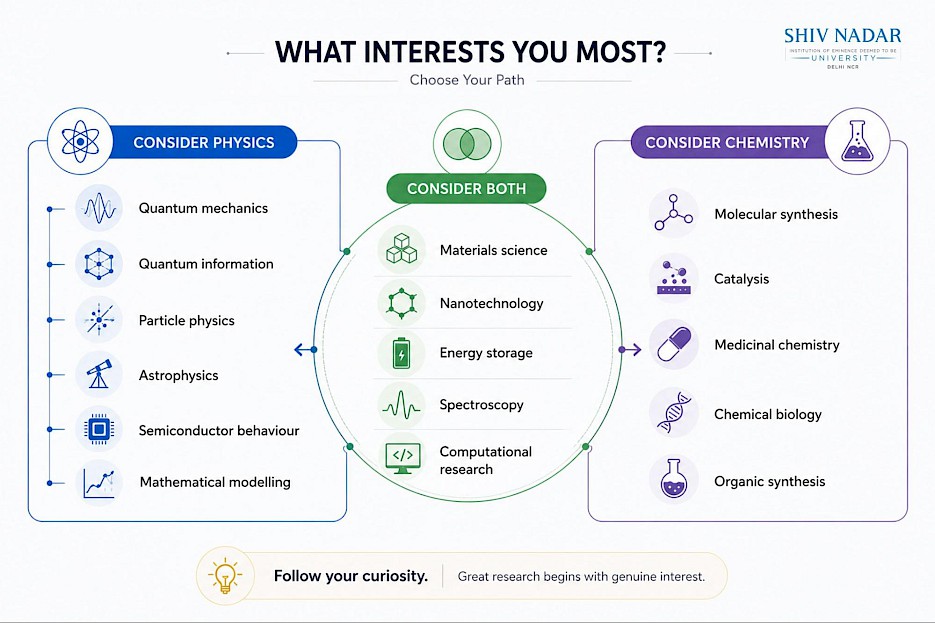
If you're repeatedly choosing “Both,” don't treat that as indecision. It may simply mean your research interests are sitting at the boundary between the two disciplines.
From Quantum Materials to Molecular Design: Shiv Nadar University's Two Ph.D. Paths
The distinction between a Ph.D. in Physics and a Ph.D. in Chemistry is clearer at Shiv Nadar University when you look beyond the course name to the structure and coursework of both programs. Both courses are structured around the research a doctorate requires, although the questions, methodology and subject specializations vary widely.
Ph.D. in Physics at Shiv Nadar University
The Ph.D. in Physics at Shiv Nadar University is a five-year program, with eight semesters of coursework followed by research with the respective guides. The coursework establishes a strong foundation in theoretical Physics before moving students towards specialized research.
Core coursework | Research direction |
Classical Mechanics | Physical systems and modeling |
Statistical Mechanics | Statistical and many-body systems |
Quantum Mechanics | Quantum systems |
Classical Electrodynamics | Electromagnetic phenomena |
Condensed Matter Physics | Materials and condensed matter |
High Energy Physics | Particle and fundamental physics |
Exploration in Research | Research development |
Physics Elective | Specialisation |
The program's research areas include experimental and theoretical condensed matter physics, nanotechnology, novel materials for energy and environmental applications and experimental and theoretical particle physics.
For students interested in quantum systems, materials, nanotechnology, energy-related materials or particle physics, these areas provide a direct connection between advanced coursework and doctoral research.
Ph.D. in Chemistry at Shiv Nadar University
The Ph.D. in Chemistry at Shiv Nadar University follows a different research journey. Its structure combines broad-based and in-depth coursework, project proposal development, research and literature seminars, dissertation research under a research advisor and a public thesis defense.
Its research landscape includes:
- Catalysis
- Chemical Biology
- Cheminformatics
- Computational Quantum Chemistry
- Crystallography
- Green Chemistry
- Materials Chemistry
- Medicinal Chemistry
- Protein Chemistry
- Supramolecular Chemistry
- Synthetic Organic Chemistry
- Ultrafast Spectroscopy
The program therefore gives students scope to work across molecular science, computational research, advanced materials, chemical biology and spectroscopy, rather than limiting doctoral research to conventional laboratory chemistry.
Shiv Nadar University Ph.D. Physics vs Ph.D. Chemistry at a Glance
Particulars | Ph.D. Physics | Ph.D. Chemistry |
Programme duration | 5 years | 5-year doctoral structure |
Coursework | 8 semesters | Broad + specialized coursework |
Research progression | Coursework → guided research | Coursework → proposal → seminars → dissertation → defence |
Key research areas | Condensed matter, nanotechnology, materials, particle physics | Catalysis, materials, chemical biology, computation, spectroscopy |
Research approach | Experimental + theoretical | Experimental + computational + analytical |
Best suited to | Quantum, materials, nanoscale and particle-focused research | Molecular, materials, chemical and interdisciplinary research |
In short, Shiv Nadar University's Physics Ph.D. suits students interested in understanding the physical behavior of matter and fundamental systems, while its Chemistry Ph.D. offers a broader route into molecular, materials, computational and chemical research.
Final Verdict
Selecting Ph.D. Physics vs Ph.D. Chemistry in India becomes relatively simple if you cease to wonder which one has more scope. Go for Physics if your passion lies in studying quantum systems, condensed matter, particles, semiconductors, photonics or astrophysics. Pick up Chemistry if your attraction lies in molecular structures, synthesis, catalysis, chemical biology, medicinal chemistry or advanced materials.
And if your area of interest is energy storage, nanotechnology, materials, spectroscopy or computational science, don’t confine yourself to the Physics versus Chemistry debate. Both can take you there.
Before making your choice, weigh:
- Research Problem
- Specialization
- Supervisor
- Research Infrastructure
- Funding
- Career trajectory
Your subject choice gets you enrolled in the PhD. The research problem shapes the scientist you will become. Ready to take your research journey further? Apply now and begin your Ph.D. at Shiv Nadar University.
FAQs
Q1. Should I pursue a Ph.D. Physics or Ph.D. Chemistry in India?
Ans. Choose Physics for interests in quantum mechanics, semiconductors, condensed matter or astrophysics. Choose Chemistry for interests in molecular synthesis, catalysis, chemical biology or medicinal chemistry. Materials and energy research can suit both.
Q2.Ph.D. in Physics vs Ph.D. in Chemistry: which is better in India?
Ans. Neither is universally better. Your research interest, specialization, supervisor and career goals matter more than the subject itself.
Q3. Choosing between a Physics Ph.D. and a Chemistry Ph.D. in India: What are the pros and cons?
Ans. A Physics Ph.D. offers strong pathways into quantum research, semiconductors, materials and computational science, but some areas demand advanced mathematical and theoretical skills. Chemistry offers broader laboratory, materials, pharmaceutical and chemical R&D pathways, but can involve intensive experimentation and specialized instrumentation.
Q4. Is a Ph.D. in Physics better than a Ph.D. in Chemistry in India for long-term career growth?
Ans. Not necessarily. Long-term growth depends on your specialization, research output, technical skills and career direction, not simply on choosing Physics or Chemistry.
Q5. What are the career prospects after a Ph.D. in Physics in India?
Ans. Career paths include academia, research, R&D, materials science, semiconductor research, quantum technology, photonics and computational research, depending on your doctoral specialization.
Q6. How do research funding and fellowships compare for Physics and Chemistry Ph.Ds in India?
Ans. Funding generally depends on the fellowship or institution, not the subject. The current UGC JRF provides ₹37,000/month initially and ₹42,000/month at the SRF stage.
Q7. Which entrance exams and admission processes differ for Physics vs Chemistry Ph.D. programs in India?
Ans. Common routes include UGC-NET, CSIR-UGC NET and GATE, depending on the institution and program. Universities may also conduct their own entrance tests, interviews or research-proposal assessments.
Q8. What are the typical stipends and starting salaries for Physics vs Chemistry Ph.D. graduates in India?
Ans. Fellowship amounts generally depend on the funding scheme, not the discipline. After graduation, salaries vary considerably based on specialization, employer, research experience and industry.
Q9. How long does a Ph.D. usually take in Physics compared to Chemistry in Indian universities?
Ans. Most doctoral programs take roughly 4–6 years, depending on the university, coursework and research progress. The exact duration varies by program and thesis requirements.
Q10. Which Ph.D. is most in demand in India?
Ans. There is no single answer. Demand is increasingly linked to specializations such as quantum technology, semiconductors, advanced materials, energy storage, computational science and chemical biology.
Q11. Is a Ph.D. in Chemistry difficult?
Ans. It can be demanding, particularly because of advanced laboratory work, experimentation, data analysis and research problem-solving. The difficulty ultimately depends on your research area and methodology.