From Research to Public Policy: Exploring Top Ph.D. Sociology Career Options

Blog / August 17, 2026
A government can announce a welfare program, publish beneficiary numbers and call it a success. A sociologist is more likely to ask a different set of questions: Who actually benefited? Who was left out? What changed inside households and communities? And why did the same intervention work differently in different places?
Answering those questions can mean years of fieldwork, interviews, data analysis, ethnography and theoretical research. That is what makes Ph.D. Sociology career options broader than the traditional image of becoming a professor. A doctoral researcher can move into academia, public policy, think tanks, development research, social-impact evaluation, government research and specialized behavioral research.
The field itself has a substantial research base in India. A scientometric study of Indian Sociology research identified 2,410 publications between 1991 and 2020, showing how the discipline has developed as a sustained area of scholarly research. But a Ph.D. takes years, so the more useful question is not simply, “Does Sociology have scope?” It is: “What can I actually do with a Sociology Ph.D. and is it worth the investment?”
How a Sociology Ph.D. Builds a Research Advantage
Ph.D. in sociology is not just an extended MA. It involves moving from studying and reviewing existing research to generating new knowledge.
In the case of a Ph.D. researcher studying migration issues, for instance, he/she may use a number of methods, including household surveying, statistics and demographics and ethnography, to find out not only about the places individuals go but also the reasons behind migrations and their impact on their lives socially and economically.
That process builds skills that can travel across sectors.
Ph.D. Skill | Where It Can Be Applied |
Qualitative research | Policy & social research |
Ethnography | Community research |
Quantitative analysis | Surveys & evaluation |
Fieldwork | Development research |
Research design | Think tanks |
Data interpretation | Policy analysis |
Academic writing | Research papers & policy briefs |
Programme evaluation | Government & social-impact projects |
Interdisciplinary research | Technology, health & urban studies |
The advantage is therefore not just the “Dr.” before your name. It is the ability to take a complicated social problem and turn it into a researchable question.
Ph.D. Sociology Career Options and Salary at a Glance
A Sociology Ph.D. can take you far beyond the traditional path of becoming a professor. Depending on your research focus, you could work in academia, public policy, think tanks, development research, social-impact organizations or behavioral research, with each path offering a different career trajectory and earning potential.
Here’s a quick snapshot of the Ph.D. Sociology career options and salary ranges in India:
Career Path | Typical Roles | Salary Range / Benchmark |
Academia | Assistant Professor, Lecturer | ₹50,000-₹1.8 L/month |
Research | Research Fellow, Researcher | ₹6.8-7.6 LPA |
Public Policy | Policy Researcher, Policy Analyst | ₹4-10 LPA |
Think Tanks | Research Fellow, Policy Specialist | ₹4-12 LPA |
Development | Social Researcher, Evaluation Specialist | ₹4-12 LPA |
Social Impact | Impact Researcher, Program Specialist | ₹4-12 LPA |
Consumer Research | Behavioral Researcher, Consumer Insights | ₹4-10 LPA |
Note: Salary reported from AmbitionBox.
The numbers tell only part of the story. The real career value of a Sociology Ph.D. comes from matching your research specialization with the right sector; whether that means turning fieldwork into policy insights, social research into a development program or original scholarship into an academic career.
What Jobs Can You Get After a Ph.D. in Sociology?
A Ph.D. in Sociology can lead to diverse careers across academia, research, policy, social development, consulting and other sectors where understanding society and human behavior is valuable. From university research to applied roles beyond academia, your career path can be shaped by your research specialization, publications, analytical expertise and ability to apply sociological insights.
1. Academia and University Research
If you enjoy teaching, publishing and developing original ideas, academia remains one of the clearest Ph.D. Sociology career options. But a doctorate is only one part of an academic profile. As your career progresses, there is a huge scope in research and publications.
That means students targeting academia should think beyond: Ph.D. → Professor. The actual journey is closer to: Ph.D. → publications + teaching + research → academic appointments → research leadership
Your research specialization, publications and ability to build an independent research profile can become just as important as the doctorate itself.
2. Public Policy and Governance
Imagine a policy designed to increase women's participation in employment. The policymaker may look at participation rates. A sociologist may ask:
- What happens inside households?
- Does unpaid care work affect participation?
- Does geography influence access to jobs?
- How do social expectations shape decisions?
- Why does the program produce different outcomes across communities?
This makes Sociology relevant to:
- Social policy
- Gender policy
- Labour research
- Migration
- Education
- Rural development
- Governance
- Welfare research
- Programme evaluation
For students who want to work at the intersection of research and policymaking, this is one of the strongest career directions after a Sociology Ph.D.
3. Think Tanks and Research Organizations
A think tank needs more than someone who understands sociological theories. It needs researchers who can build an evidence-based argument.
A typical research project may involve:
- Identifying a research problem
- Reviewing existing literature
- Designing a methodology
- Conducting fieldwork or analyzing datasets
- Interpreting findings
- Writing reports and policy briefs
- Presenting recommendations
That combination makes Sociology Ph.D. training particularly relevant to research organizations working on inequality, governance, education, migration, gender and development. The career advantage comes from being able to move from: “Here is a social problem.” to: “Here is the evidence explaining it.”
4. Development and Social Research
A doctoral project doesn't necessarily have to remain inside a university. Suppose your research examines tribal communities, migration or gender inequality. The fieldwork can expose social barriers that aren't immediately visible in national datasets.
That experience can translate into:
- Development research
- NGO research
- Community development
- Gender and inclusion
- Rural development
- Social-impact programs
- Programme evaluation
- Public-health research
This is particularly suited to researchers who enjoy working with people and communities as much as working with data.
5. Government Research and Social Policy
Government departments and public institutions regularly need research around social development, communities, welfare and policy implementation.
A Sociology Ph.D. can be relevant to research-intensive roles involving:
- Social surveys
- Policy analysis
- Programme evaluation
- Demographic research
- Social inclusion
- Community studies
- Development planning
The strongest candidates aren't necessarily those who know the most theories. They are those who can combine sociological expertise with research methodology, data interpretation and clear communication.
6. Behavioral, Consumer and Social Research
Here's where the career path gets less obvious. Companies also need to understand people. Why does one group adopt a product while another ignores it? How does culture influence consumption? How do online communities shape opinions?
These questions can overlap with sociological research; with additional skills in survey design, qualitative research, behavioral research and data analysis, Sociology Ph.D. graduates can explore consumer insights, social research and behavioral research.
This is not a guaranteed destination for every Sociology Ph.D., but it shows how research skills can extend beyond conventional academic careers.
From Digital Society to Climate Change: Where Sociology Research Is Heading
The subject you choose for your doctorate can influence the career you build afterward.
A student researching caste and inequality may move towards social policy; someone studying digital communities could move towards technology and society research; another researcher studying cities may find opportunities in urban policy and development.
Research Area | Potential Career Direction |
Gender & Inequality | Gender policy, development research |
Urban Sociology | Urban policy, migration research |
Digital Sociology | Technology & society research |
Health Sociology | Public-health research |
Political Sociology | Governance & policy |
Migration Studies | Migration & development |
Law & Society | Social & legal policy |
Environmental Sociology | Sustainability research |
Sociology of Education | Education policy |
Technology & Society | Digital policy & social impact |
This is also reflected in current doctoral research environments; research areas include urban studies, education and curriculum, tribal societies, historical sociology, rural societies and agrarian change, caste studies, North-East studies and AI and Society.
The takeaway is simple: your research specialization can become your professional identity.
Is a Sociology Ph.D. Worth It?
It’s probably the most important question to answer before applying.
A doctorate is a long research commitment, so the right decision depends on the career you want afterward.
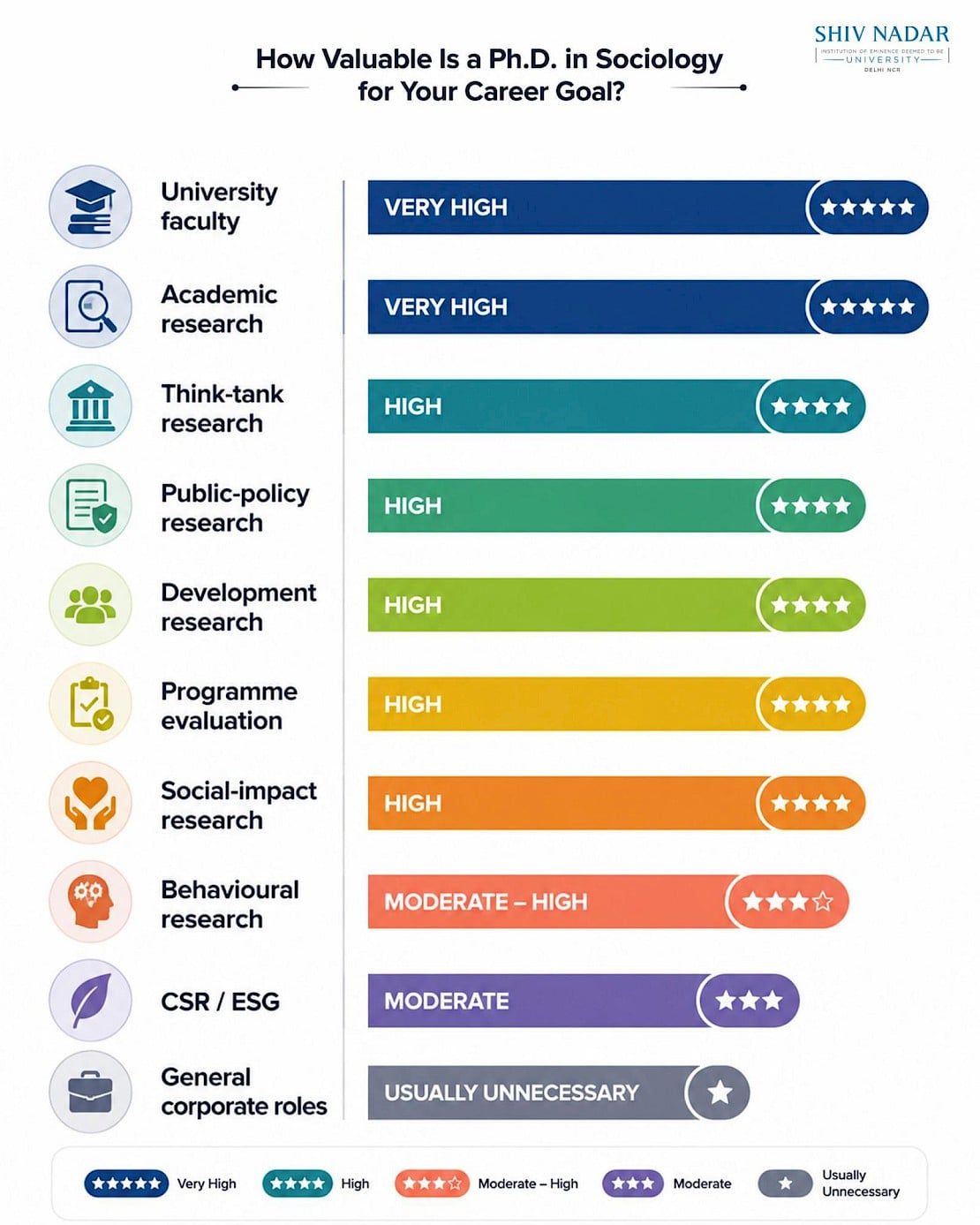
If your goal is academia, research, policy or specialized social analysis, a Ph.D. can be a strong investment. If you simply want a general corporate position, spending several years conducting doctoral research may not be the most efficient route.
So, is a sociology Ph.D. worth it? Yes, when the career you want rewards the depth of research expertise that a doctorate provides.
Choosing Your Research Niche: What Can You Specialize in
A Ph.D. is where Sociology stops being one broad subject and becomes a specific research identity.
Possible areas include:
- Caste and Social Hierarchy
- Gender Studies
- Climate Change and Society
- Inequality
- Poverty
- Religion, Identity and Social Movements
- Rural Sociology
- Urban Sociology
- Science, Technology and Society (STS)
- Environmental Sociology
- Migration and Mobility Studies
Choosing the right area therefore requires more thought than simply asking which topic is “in demand”. Instead, ask yourself: Can I see myself reading, researching and writing about this question for the next several years?
Where a Sociology Question Becomes a Doctoral Research Journey at Shiv Nadar University (Institution of Eminence)
At Shiv Nadar University, the Ph.D. in Sociology program is built around a simple idea: doctoral research should not stop at theory. Students are trained through theoretical work, fieldwork, ethnography and interdisciplinary research, with a strong focus on South Asian cultures and societies.
What the Ph.D. Journey Looks Like at Shiv Nadar University
Stage | What Students Do at Shiv Nadar University |
Year 1 | Disciplinary & multi-perspective training in theory and methods |
Coursework | 4 courses / 24 credits |
Research preparation | Pilot study + extended research proposal |
Fieldwork | Minimum 1 year of field or archival research |
Thesis | Around 3 years of writing |
Teaching experience | Teaching Assistant responsibilities |
Research exposure | Conferences, workshops & opportunities to publish |
Shiv Nadar University's Department of Sociology particularly emphasizes critical empiricism, the fieldwork and ethnographic traditions of sociology and social anthropology, sustained theoretical training, interdisciplinary research and the practice of ethnographic writing.
What Can Students Research?
Students can develop doctoral research around faculty expertise spanning:
- Law and Society
- Political Anthropology
- Identity and Governance
- Urban Research
- Mind and Mental Health
- Material Cultures
- Hierarchy and Inequality
- Ethnography and Methodology
- Biopolitics and the Social
- Anthropology of the Body
- Military Cultures
- Nomadism and Pastoralism
- Religion and Spiritual Theology
- Research/Art Interface
- Atmospheres and Ecologies
What Makes the Program Particularly Research-focused?
- Pilot study: Students develop and test their research direction before undertaking the main study.
- Extended proposal: The research proposal develops the key questions, literature engagement, and methodology.
- Field/archival research: The program moves students from classroom-based preparation into independent research.
- Teaching + research: Scholars are expected to contribute as Teaching Assistants or Research Assistants, building experience relevant to academic and research careers.
- Research dissemination: Shiv Nadar University provides opportunities and support for scholars to present their work at national and international conferences and workshops and publish in leading journals.
For the Ph.D. intake, applicants need a four-year bachelor's degree and/or master's degree in Sociology, Social Anthropology or a related discipline. The application includes a 3,500–5,000-word research proposal and a 3,000–8,000-word writing sample, making the applicant's research thinking central to the selection process. Shiv Nadar University's Ph.D. in Sociology is designed for students who want to move from asking questions about society to investigating them through rigorous theory, fieldwork and original research.
Final Verdict
The best Ph.D. Sociology career options aren't limited to becoming a professor. You can take sociological research into public policy, think tanks, development, government research, social-impact evaluation, behavioral research and academia, but the Ph.D. itself is not a guarantee of any one career.
Its value lies in what you learn to do: ask difficult questions, investigate them systematically and produce original evidence that others can use. So don't ask only: “Does Sociology have scope?” Ask: “What social problem do I want to understand and what kind of researcher do I want to become?”
If your answer involves research, policy, teaching or specialized social analysis, a Sociology Ph.D. can be worth the investment. Your career may begin with a degree, but it can be shaped by the question you choose to spend years answering.
So, ready to turn that question into meaningful research? Apply now for the Ph.D. in Sociology at Shiv Nadar University.
FAQs
Q1. What jobs can I get with a Ph.D. in Sociology?
Ans. A Ph.D. in Sociology can lead to careers in academia, public policy, think tanks, social research, development, government research, social impact and behavioral research.
Q2. Is a Ph.D. in Sociology worth it?
Ans. Yes, particularly if you want a research-intensive career in academia, policy, research organizations or specialized social analysis. It may be less useful for general corporate careers.
Q3. Does Sociology have a future?
Ans. Yes. Emerging areas such as digital society, AI and society, urbanization, migration, health, gender and environmental sociology are creating new research questions and interdisciplinary opportunities.
Q4. What is the typical career trajectory for Sociology Ph.D. graduates?
Ans. A common academic route is Ph.D. → postdoctoral/research roles → Assistant Professor → senior academic or research positions. Others move directly into policy, think tanks, development or social-impact research.
Q5. What skills from a Sociology Ph.D. are most valued by employers?
Ans. Research design, qualitative and quantitative analysis, fieldwork, critical thinking, data interpretation, academic writing and communication are among the most transferable skills.
Q6. What can you do professionally with a doctoral degree in Sociology?
Ans. You can work as a professor, researcher, policy analyst, research consultant, social-impact specialist, program evaluator or behavioral researcher, depending on your specialization.
Q7. Is Sociology a lot of math?
Ans. Not necessarily. Sociology can involve statistics, surveys and quantitative analysis, but many research areas rely more heavily on qualitative methods, interviews, ethnography and theoretical analysis.
Q8. How long is a Sociology Ph.D.?
Ans. The duration varies by university and research progress. At Shiv Nadar University, the program includes coursework, fieldwork and typically 24–36 months of thesis writing.
Q9. Do Sociology Ph.D. programs offer funding, fellowships or stipends?
Ans. Many full-time doctoral programs offer financial support, although the amount and conditions vary. At Shiv Nadar University, the current published support is ₹45,000/month in Years 1–2 and ₹50,000/month in Years 3–5, subject to applicable conditions.