MBA with Global Immersion in India: Your Pathway to Global Business Leadership

Blog / August 19, 2026
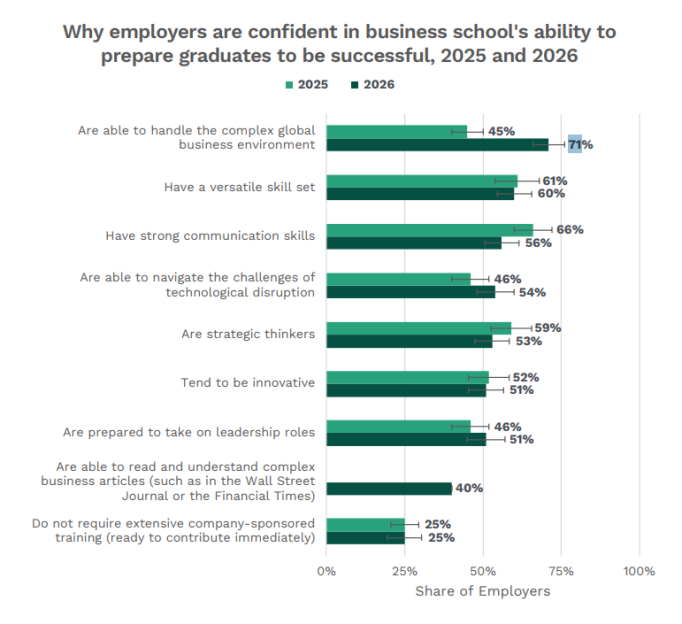
The share of employers who trust MBA graduates to handle a complex global business environment jumped to 71% in 2026, up from 45% the year before- the single largest swing in GMAC's 2026 Corporate Recruiters Survey.
Yet most Indian B-school applicants evaluate a "global immersion program" the same way they'd read a brochure bullet point, without probing what the label actually commits an institution to. The difference between programs that treat immersion as a genuine curricular pillar and those that bolt on a token study trip rarely shows up until you're already enrolled.
This piece unpacks what a GIP is meant to deliver, how it's structurally distinct from a semester exchange, and the specific questions worth asking before you let it sway your shortlist.
What Is a Global Immersion Program in an MBA?
A global immersion program is a short-term, academically structured trip abroad, typically lasting anywhere from a few days to a few weeks, where MBA students attend sessions at a partner university, visit companies, and engage with local business culture, all built into the core program rather than treated as an optional add-on.
Unlike a vacation or a purely observational tour, every element of a GIP is tied to a learning outcome. Students usually return with some form of completion certificate from the host institution, and the experience is often debriefed and folded back into coursework once they're back on campus.
In brief:
- Short-term (days to a few weeks), not a full semester
- Combines academic sessions, industry visits, and cultural exposure
- Usually built into the core MBA structure, not a separate elective
- Typically ends with a certificate or credit from the host institution
How Is It Different from a Semester Exchange or Study Tour?
A study tour is largely observational, a semester exchange means relocating abroad for months, and a global immersion program sits between the two: compact, credit-bearing, and industry-integrated, without disrupting the core MBA schedule or budget.
Students often confuse these three formats, so it helps to see them side by side.
Parameter | Study Tour | Global Immersion Program | Semester Exchange |
Duration | Few days | Days to a few weeks | 3-6 months |
Academic structure | Minimal, mostly observational | Structured modules with certification | Full semester coursework abroad |
Cost impact | Add-on, separately priced | Often bundled into tuition | Significant additional cost |
Core MBA schedule | Doesn't interfere | Fits within a semester window | Requires relocating for a term |
Industry exposure | Sightseeing-led | Company visits, guest sessions | Varies by host university |
If your priority is international exposure without pausing your core coursework or your placement timeline, a GIP is usually the more practical fit of the three.
Why Does Global Immersion Matter for MBA Placements?
Global immersion adds three things to a placement narrative: evidence of cross-cultural adaptability, a concrete story for interviews, and exposure to how business practices differ across markets, all of which recruiters at multinational firms actively screen for.
A few concrete ways this shows up during placements:
- Interview material: A specific story from an international company visit or a cross-cultural project stands out more than a generic answer about "wanting global exposure".
- Roles that value it directly: International marketing, global supply chain, business consulting, and management-trainee tracks at multinational firms tend to weigh this kind of exposure more heavily.
- A signal of initiative: Completing a structured international module, on top of core coursework, reads as proactive rather than passive learning.
None of this replaces strong fundamentals in finance, strategy, or operations. It supplements them, particularly for students targeting roles with cross-border responsibility.
Who Should Look for a GIP When Choosing an MBA?
A global immersion program matters most if you're targeting roles at multinational companies, considering entrepreneurship with international ambitions, or simply want structured exposure to how business is conducted outside India before you commit to a career path.
It matters less if your career goal is firmly domestic and sector-specific, in which case the time and (where applicable) cost of a GIP might be better spent on a domestic specialization or a longer internship.
Before shortlisting a program on the strength of its GIP, verify:
- Whether it's bundled into tuition or charged separately
- Whether it's optional or built into the core structure
- Whether it counts toward academic credit
- What the actual format looks like: lectures, company visits, or both
How Do MBA Programs Structure Their Global Immersion Component?
Most MBA programs place their global immersion component in the semester that also carries the summer internship or a business challenge practicum, so students complete academic modules, an internship, and an international immersion within the same broader term rather than as separate additions to the schedule.
A typical structure looks like this:
- Pre-departure Preparation- Documentation, orientation briefings, and coursework alignment
- On-ground Academic Sessions- Lectures at a partner university abroad
- Industry Visits- Company tours and sessions with business leaders
- Cultural Exposure- Structured interaction with the host country's business and social environment
- Post-immersion Integration- Debrief and credit or certification back on campus
The exact sequencing varies by institution, so it's worth checking a program's structure page rather than assuming a standard format applies everywhere.
Also read: Are You Planning to Do an MBA? Read This Blog to Know All the MBA Course Details
Global Immersion in the MBA Program at Shiv Nadar University (Institution of Eminence)
At Shiv Nadar University's MBA program, the Global Immersion Program is one of three pillars of the curriculum, alongside a Leadership & Entrepreneurial Mindset track and the Business Challenge Practicum. It's built to give students exposure to global markets, cultures, and business practices through international academic and industry engagement.
Here's what the program structure confirms:
- Timing: The Global Immersion Program falls within the same window as the Summer Internship, positioned across Semester 2 and Semester 3 of the two-year MBA structure.
- Cost: GIP fees are included in the tuition fee; it isn't a separate charge on top of the program cost.
- What it includes: Experiential learning opportunities in an international market, industry visits, sessions with industry leaders, and international networking opportunities.
- Student responsibility: Students are responsible for securing their own passport and visa ahead of travel.
- Where it sits academically: The Semester 3 window also carries Core Courses and the Business Challenge Practicum, so the immersion runs alongside core academic work.
The program is delivered through Shiv Nadar University's School of Management and Entrepreneurship, which also runs a dedicated Business Challenge Practicum and a compulsory summer internship as part of the same two-year MBA. To see how the full fee structure works, including the annual tuition fee and living costs, go through the program brochure.
Conclusion
A global immersion program is one of the more practical ways an MBA can add international exposure without the cost or disruption of a full semester abroad. What it actually delivers, in terms of duration, cost, and structure, varies significantly between institutions, so it's worth checking a program's specifics rather than assuming all GIPs work the same way.
If you're evaluating the MBA at Shiv Nadar University, you can review the complete program structure and apply through the admissions page to take the next step.
FAQs
Q. Does a global immersion program cost extra on top of MBA tuition?
Ans. It depends on the institution. Some programs charge a separate administrative fee for the immersion trip, while others, including Shiv Nadar University's MBA, bundle the GIP fee into the overall tuition.
Q. Is the global immersion program mandatory in an MBA?
Ans. This varies by program. Some universities make it a core, non-negotiable part of the curriculum, while others treat it as an optional module students opt into separately.
Q. Does a global immersion program carry academic credit?
Ans. Many structured GIPs are integrated into the semester alongside core coursework and internships, though whether it carries formal transferable credit depends on the specific program's academic structure.
Q. How long does a typical MBA global immersion program run?
Ans. Duration varies widely across institutions, from a few days to a few weeks. It's shorter than a semester exchange, which typically runs three to six months.
Q. What's the difference between a global immersion program and a semester exchange?
Ans. A global immersion program is a short, structured module (days to weeks) built into the existing MBA schedule, while a semester exchange means relocating abroad for a full academic term at a partner university.
Q. Do students need to arrange their own visa for a global immersion program?
Ans. At most institutions, yes. Students are typically responsible for securing their own passport and visa ahead of the international component, even when program fees are otherwise bundled into tuition.
Q. Can I choose not to participate in a global immersion program if it's part of my MBA?
Ans. This depends on whether the institution treats the GIP as a core, mandatory component or an elective module. Check the program structure page of your shortlisted MBA before assuming either way.
Q. What kind of companies do MBA students visit during a global immersion program?
Ans. This varies by program and destination, and typically spans corporate offices, manufacturing facilities, and innovation centres, giving students exposure to how different sectors operate internationally.
Q. Does a global immersion program help with roles outside India after graduation?
Ans. It can strengthen a candidate's profile for roles in international marketing, global supply chain, or consulting, since it demonstrates direct exposure to cross-border business environments, though the core weight in placements still rests on academic performance and domain skills.