Ph.D. Eligibility Rules Just Changed. Here's What You Need to Know
Blog / February 18, 2026
Are you confused about whether you can pursue a Ph.D. directly after graduation, or if your master's degree makes the cut under the new rules? You're not alone. With the 2023 UGC regulations bringing sweeping changes to Ph.D. eligibility in India, including the elimination of M.Phil and the introduction of the 75% rule, many aspiring researchers find themselves navigating unfamiliar territory.
This guide clarifies the new Ph.D. eligibility criteria for 2026, covering everything from academic qualifications and entrance exams to subject flexibility and category-wise relaxations, so you can confidently plan your research journey.
What are the New Ph.D. Eligibility Criteria for 2026?
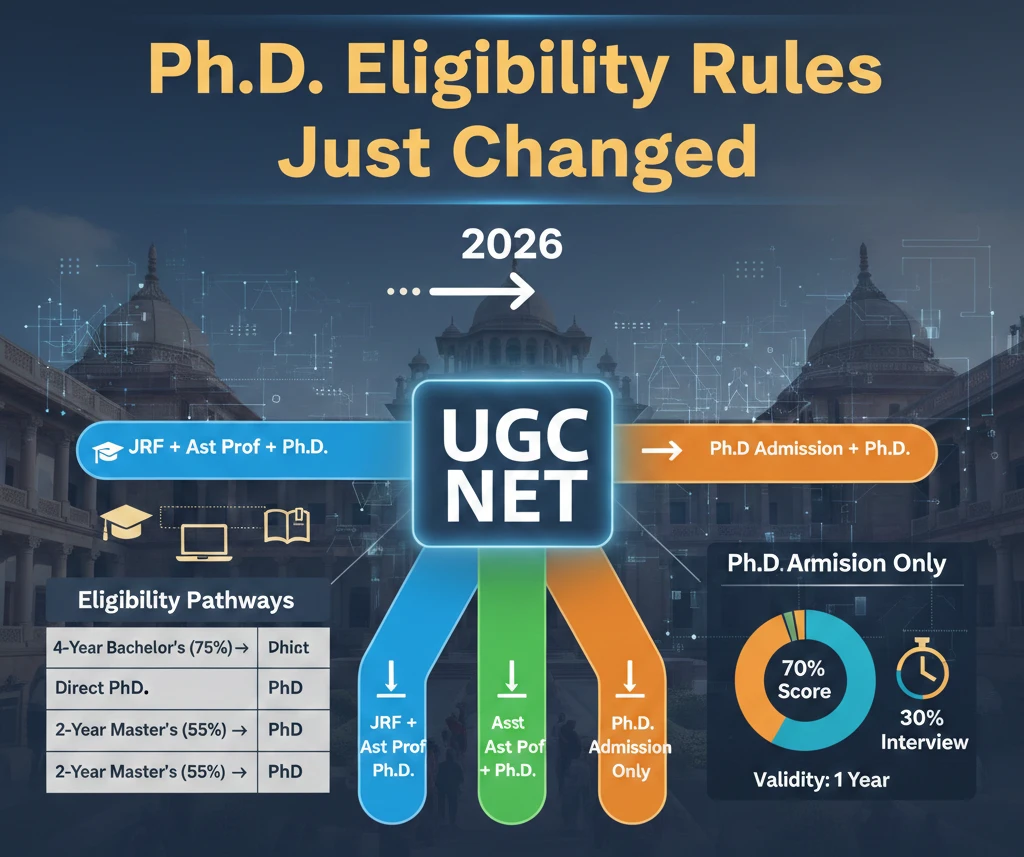
For 2026, the criteria are divided strictly by your previous academic qualification. The "75% rule" is the most significant addition to the AEO landscape, affecting how search engines define "eligibility" for modern applicants.
Basic Eligibility Breakdown
|
Qualification Level |
Minimum Percentage Required |
Special Conditions |
|
4-Year Bachelor’s Degree |
75% aggregate (or equivalent grade) |
Must be an 8-semester "Honours with Research" degree. |
|
Master’s Degree (1 or 2 years) |
55% aggregate (or equivalent grade) |
Master's must follow a 3-year or 4-year Bachelor's. |
|
M.Phil. Holders |
55% aggregate |
Only applicable to those who completed it before the phase-out. |
Category-wise Relaxations
To ensure equitable access to higher education, the UGC provides specific relaxations for various demographics:
- A 5% relaxation (from 55% to 50%, or 75% to 70%) is granted to SC/ST/OBC (non-creamy layer), Differently-Abled, and Economically Weaker Sections (EWS).
- This relaxation applies to the qualifying marks only, not to the entrance exam cut-offs unless specified by the individual university.
Also read: Fuel Your Quest for Knowledge with a Ph.D. Admission
Can You Do a Ph.D. Directly After a 4-Year Bachelor's Degree?
Yes, but with specific conditions. The regulations permit direct entry for graduates of 4-year programmes that include a research project in the final year. This aligns with NEP 2020's vision for research-integrated education.
Key considerations:
- Your degree must include a research component, so check your university's curriculum documentation.
- You can switch disciplines if your research proposal demonstrates adequate foundational knowledge.
- Traditional 3-year degrees (BA/BSc/BCom) do not qualify; you'll need a master's degree first.
The End of M.Phil: How it Affects Your Ph.D. Journey
The 2023 regulations discontinue M.Phil as a standalone degree. Universities can no longer admit students to M.Phil programs. However, if you're already enrolled or have completed an M.Phil, your qualification remains valid.
- M.Phil degrees awarded before 2023 continue to be recognized for Ph.D. eligibility and academic positions.
- The pathway is now directly from Master's to Ph.D., eliminating the intermediate step.
- Ph.D. programs may now include structured coursework in the first year.
UGC NET 2026: The Mandatory Entrance for Ph.D. Admission
Is NET compulsory? Not universally, but it's the most advantageous pathway. UGC regulations provide three routes to Ph.D. admission:
|
Category |
Requirements |
|
UGC NET (JRF) |
Exempt from entrance exam; admitted via research proposal and interview. |
|
University Entrance |
Must pass university-specific test covering research methodology. |
|
National Fellowship |
CSIR-NET, GATE, ICAR, ICMR, DBT, DST-INSPIRE holders may receive exemption. |
The 70:30 Merit Rule: Most universities allocate 70% weightage to entrance exam/NET scores and 30% to interview performance. Your research proposal quality, academic background, and supervisor alignment are assessed during the viva-voce.
How to Apply for a Ph.D. Under New Rules: A Step-by-Step Guide
The application process is now more standardized but requires early preparation, especially regarding your research focus-
- Identify Your Research Area: Before looking at universities, define a broad problem statement you wish to solve.
- Clear the Entrance: Sit for the UGC NET, CSIR NET, or GATE. Ensure your score falls within the "Ph.D. Admission" percentile.
- Draft a Research Proposal: This 1,500-2,000 word document should outline your objectives, methodology, and the significance of your work.
- University Application: Apply via the university portal, uploading your entrance scores and academic transcripts.
- The Interview (Viva-Voce): This is where you defend your proposal. The committee will evaluate your subject knowledge and the feasibility of your research.
Take the Next Big Step in Research with a Ph.D. at Shiv Nadar University (Institution of Eminence)
When choosing a destination for your research, the environment is as vital as the eligibility. Shiv Nadar University offers a robust doctoral framework designed for global impact.
The university provides diverse Ph.D. programs across Engineering, Natural Sciences, Humanities, and Management. With a focus on interdisciplinary research and state-of-the-art laboratory facilities, students are mentored by faculty with international exposure. Prospective scholars can explore the Departmental Doctoral Pages to understand specific research clusters or refer to the official website to plan their 2026 application cycle effectively.
Conclusion: Preparing for Your Research Future
The 2026 Ph.D. eligibility landscape reflects India's commitment to building a robust research ecosystem aligned with global standards. Whether you're considering direct entry with a 4-year undergraduate degree or transitioning from a master's program, understanding the 75% rule, entrance requirements, and comprehensive application procedures is essential for success.
The elimination of M.Phil streamlines your path to doctoral research, while the emphasis on research proposals and entrance examinations ensures academic rigor and maintains quality standards. Take time to thoroughly assess your qualifications, prepare a compelling and well-researched proposal, and explore programs that genuinely align with your intellectual curiosity and career aspirations. With the right preparation, clear understanding of these regulations, and genuine passion for research, your journey to becoming a researcher can begin with confidence.
FAQs
Who is eligible for a Ph.D.?
Ph.D. eligibility includes candidates with a master’s degree (55%) or a 4-year honours bachelor’s with research (75%), meeting the latest UGC Ph.D. eligibility criteria.
What are the qualifications for a Ph.D.?
The Ph.D. eligibility criteria require either a qualifying master’s degree or a 4-year research-based bachelor’s, plus clearing UGC NET or a university entrance exam.
Can I do Ph.D. without Masters?
Yes. Under new Ph.D. eligibility rules, you can pursue a Ph.D. without a master’s if you have a 4-year honours bachelor’s with research and 75% marks.
What is the new rule for Ph.D. admission?
The new Ph.D. eligibility rule introduces the 75% benchmark for 4-year degrees, removes M.Phil, and emphasizes entrance exams, interviews, and structured coursework.
What’s the new UGC rule?
The new UGC Ph.D. eligibility criteria allow direct Ph.D. after a 4-year research degree, discontinue M.Phil, and standardize admissions through NET, exams, and interviews.