MS Computer Science vs Cybersecurity vs AI: Which Master's Degree Is Right for You?
Blog / July 23, 2026
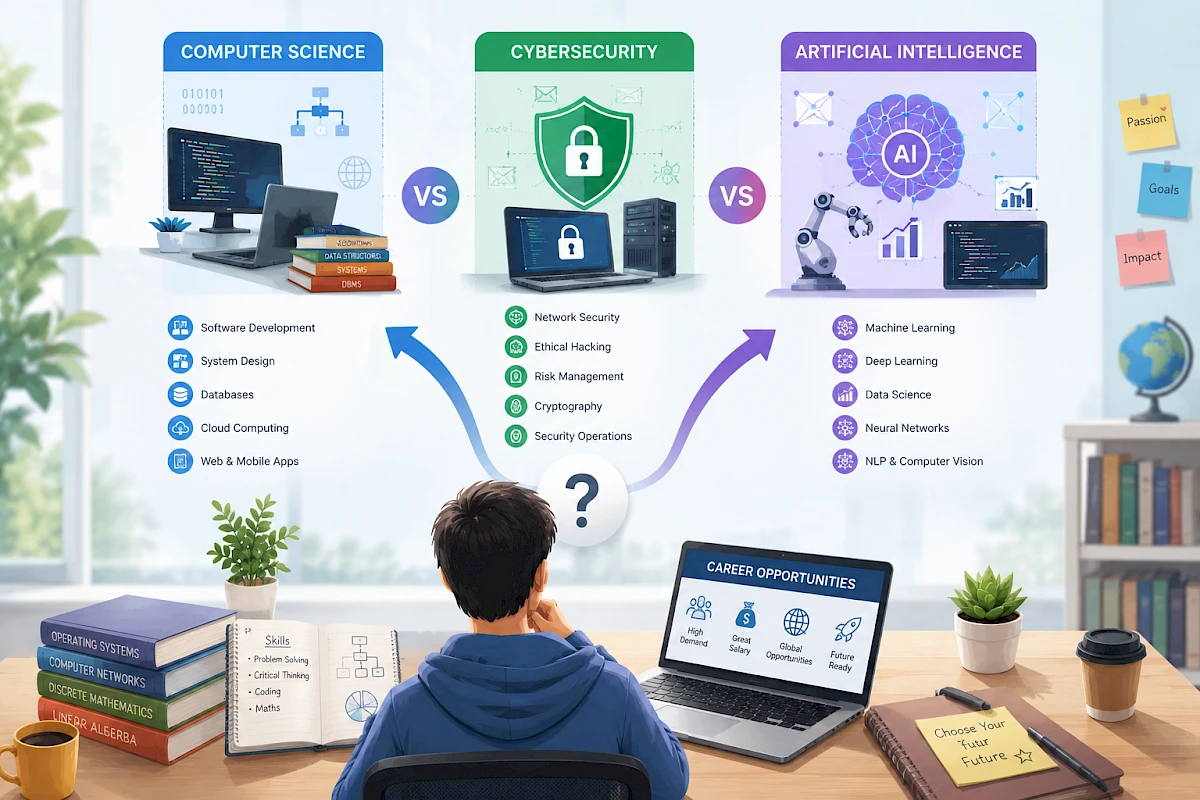
When comparing MS Computer Science vs Cybersecurity vs AI, it's easy to get lost in salary reports, course lists, and career predictions. Here's why: the numbers alone were never going to tell you which program is built for you. A friend who thrived in machine learning research will hand you completely different advice than one who built a career around a CISSP certification, and both would be right for themselves and wrong for you.
This guide walks through what each degree actually demands of you from day 1. Once you know where you'd naturally fit, we'll also explore how to earn any of these three degrees in the US without the cost of a fully residential program.
MS Computer Science vs Cybersecurity vs AI: Side by Side
Before getting into what each degree actually feels like day to day, here's how they stack up at a glance. Every salary and growth figure below comes from the same source, the Bureau of Labor Statistics, so you're comparing three programs on the same scale instead of three different survey methodologies stitched together.
Specialization | MS Computer Science | MS AI in Business | MS Software Engineering (Cybersecurity specialization) |
Typical salary (BLS median) | $133,080/year (Software Developers) | $112,590/year (Data Scientists) | $124,910/year (Information Security Analysts) |
Growth outlook (2024–2034, BLS) | 15% growth | 34% growth | 29% growth |
Entry barrier | Moderate, broad prerequisites | High, math and GRE-heavy | Lower, certification-friendly |
Best suited for | Undecided, want flexibility | Enjoy math, want highest ceiling | Want faster, steadier entry |
MS in Computer Science: The Broad Option
If you like technology in general but haven't landed on the one thing you want to specialize in, start here.
An MS in Computer Science covers advanced algorithms, software architecture, data structures, and systems engineering. Think of it as buying yourself optionality: you can pivot into AI, cybersecurity, or cloud infrastructure later without going back to school for another degree.
That optionality is paying off right now. Software developers, the closest BLS occupational match for CS graduates, earn a median of $133,080/year, with 15% projected growth through 2034, well above the average for all occupations. CS master's degrees have also overtaken the MBA as the most in-demand credential among employers hiring at the master's level, per the NACE Winter 2026 Salary Survey.
MS AI in Business: The High-Reward Specialization
If differential equations and probability theory sound like fun rather than a chore, this is your degree.
An MS AI in Business throws you into machine learning, deep learning, natural language processing, and neural networks, with a heavy dose of discrete math, linear algebra, and calculus along the way. It rewards people who enjoy math itself, not just what it produces.
And the market is rewarding that appetite well. Data scientists, the closest BLS match for applied AI and ML roles, earn a median of $112,590/year, with 34% projected growth through 2034, one of the fastest-growing occupations BLS tracks. Top programs increasingly expect strong quantitative GRE scores and some research experience to get in. Higher ceiling, steeper climb.
MS Software Engineering (Cybersecurity Specialization): The Steady, In-Demand Path
If you'd rather defend a system that already exists than design one from scratch, this is the more natural fit.
An MS Software Engineering (Cybersecurity specialization) is built around network defense, cloud security, ethical hacking, digital forensics, and governance, leaning on networking and risk management rather than pure algorithm design. That makes it one of the more approachable routes in, especially if you're coming from an IT or systems background.
The numbers make a strong case for it too. Information security analysts earn a median of $124,910/year, with the role projected to grow 29% through 2034, among the fastest-growing occupations in the country. Over 514,000 cybersecurity positions remain unfilled in the US alone, a gap that isn't closing anytime soon.
What Will You Actually Study?
Here's the actual coursework, since that's what you'll be doing for the next one to two years, not just what shows up on a transcript:
MS Computer Science:
- Software Verification, Validation, and Testing
- Software Project, Process and Quality Management
- Information Assurance and Security
MS AI in Business:
- Enterprise Data Analytics
- Python for Data Analysis
- Decision Making with Data Analytics
- Data Visualization in Business
MS Software Engineering (Cybersecurity specialization):
- Software Verification, Validation, and Testing
- Software Project, Process and Quality Management
- Information Assurance and Security
- Software Integration and Engineering
If the CS list sounds broad and the other two sound narrow, that's intentional. CS is the degree that postpones the specialization decision. AI and Cybersecurity are the degrees where you've already made it.
Admission Requirements: What Each Program Actually Expects
Since GPA and English-proficiency cutoffs differ across the three ASU tracks, here's what you'd need to qualify through the SNU-ASU pathway specifically-
Specialization | MS Computer Science | MS Software Engineering (Cybersecurity specialization) | MS AI in Business |
Bachelor's GPA | 3.25 in last 60 credit hours, or 3.00 in a master's program | 3.00 in last 60 credit hours, or 3.00 in last 12 postbaccalaureate units | 3.00 in last 60 credit hours, or 3.00 in last 12 postbaccalaureate units |
TOEFL iBT | 90+ | 90+ | 90+ |
IELTS | 7.0 minimum | 7.0+ | 7.0+ |
Duolingo English Test | 115+ | 125+ | 115+ |
Beyond scores, all three tracks ask for the same paperwork: a graduate admissions application, official transcripts, short answer questions, one letter of recommendation, a professional resume, and a written statement.
Where These Three Careers Typically Diverge In Five Years
A CS generalist five years out is usually a senior software engineer or has moved into a specialized track, often the one they discovered they liked during electives.
An AI specialist is typically deep in a machine learning engineer or applied research role, with a portfolio of shipped models rather than just papers.
A cybersecurity graduate has often moved from analyst to a more senior architect or governance role, managing a team's response strategy rather than running it themselves.
None of these are better outcomes; they're just different shapes of the same five years.
Why Accelerated Master's Program with ASU at Shiv Nadar University (Institution of Eminence) is Worth Considering
If you're weighing these three degrees and also thinking about studying in the US, Shiv Nadar University's Accelerated Master's Program with Arizona State University is built around exactly this decision.
Here's how the pathway works: you start with one semester at SNU's International College, completing a graduate certificate worth 9 to 12 transferable ASU credits. Once you meet ASU's entry requirements, you transfer over and spend 12 to 18 months on campus finishing your degree at ASU's Ira A. Fulton Schools of Engineering, the largest engineering school in the country, or the W.P. Carey School of Business, one of the oldest AACSB-accredited business schools in the US.
Program | ASU Campus | Credits (SNU + ASU) | Est. ASU Fee (USD) |
MS Computer Science | Tempe | 9 + 21 | $40,749 |
MS Software Engineering (Cybersecurity) | Polytechnic | 12 + 18 | $35,946 |
MS AI in Business | Tempe | 12 + 18 | $49,878 |
Each program totals 30 credits, roughly 10 courses, and the SNU portion costs approximately Rs 3 lakh on top of the ASU fees above. Shiv Nadar University also offers collateral-free, co-signer-free loans that can cover up to 100% of tuition and living costs at ASU, which matters given ASU estimates living expenses at around $15,000 a year.
Graduates get up to three years of Optional Practical Training (OPT) to work in the US, and past ASU graduates have gone on to companies like Amazon, Banner Health, Boeing, Honeywell, Intel Corporation, and many more. ASU itself has been ranked No. 1 in the US for innovation for 11 consecutive years running, ahead of MIT and Stanford, and No. 2 among public universities for employability. For students who want a US-recognized degree and real work experience without committing to a fully residential program from day one, this pathway is worth a serious look, whichever specialization you land on.
Conclusion
There's no single right answer between Computer Science, AI, and Cybersecurity, only the right one for where you stand right now. If you're still undecided and want to keep your options open, Computer Science gives you that flexibility. If you love math and want to chase the highest long-term ceiling, AI is where that pays off. If you want strong job security without a long runway to get there, Cybersecurity gets you there fastest.
Whichever direction you choose, a structured pathway like the SNU-ASU Accelerated Master's Program can get you a US-recognized degree without the full cost and uncertainty of a residential program abroad.
FAQs
Q1. Which is better, CSE cybersecurity or CSE AI?
Ans. It depends on your strengths. CSE with a cybersecurity focus suits students who prefer systems, networking, and defense work. CSE with an AI focus suits students who are strong in math and statistics and want a higher salary ceiling.
Q2. Is it better to study AI or cybersecurity?
Ans. Neither is universally better. AI offers higher average salaries and long-term upside for those who enjoy building predictive systems. Cybersecurity offers more immediate job security and a shorter path to employment, backed by a persistent global talent shortage.
Q3. Which is better, cybersecurity or computer science?
Ans. Computer Science gives you the broadest foundation and the flexibility to move into cybersecurity, AI, or software engineering later. However, choose Cybersecurity if you already know you want to specialize in defense and risk management from the start.
Q4. Which 3 jobs will survive AI?
Ans. Cybersecurity engineers, AI/ML engineers, and systems or cloud architects are among the roles expected to stay strong, since all three require human judgment, oversight, and design thinking that AI systems can support but not fully replace.