Dual Degree Programs in India: Your Guide to Studying Across Two Universities

Blog / July 21, 2026
Finding a bachelor’s degree is no longer limited to one subject, one university, or even one country. Nowadays, UG education is becoming more flexible, interdisciplinary, as well as globally connected. This gives students new ways to create an academic path around more than one area of interest.
Not only this, but this shift comes at a time when India has one of the world’s largest student populations entering higher education. The latest AISHE 2023-24 data showcases that total enrolment has reached a record 4.5 crore students, while STEM enrolment has crossed 1 crore. Due to these growing numbers, universities are also introducing new academic models that are completely different from a traditional single-degree route.
Dual degree programs are one such option.
These courses allow students to study across two disciplines or even two universities while working towards two qualifications via a structured academic pathway. In this guide, you will get to know everything related to dual degree programs in India.
What is Meant by a Dual Degree Program?
Many students often get confused with the term “dual degree” with double majors, joint degrees, and integrated programs. But this is not right.
Dual degree programs are structured in a way where students can work towards two separate qualifications by completing the requirements specified for both degrees. The programs are offered by the same institution or by two partner universities to students.
Let’s understand it in an easier way.
“An international dual degree may allow a student to complete the first part of undergraduate study at a university in India and the remaining part at an overseas partner university. Eligible credits completed at the first institution may count towards the academic requirements of the second, subject to the program’s transfer rules.”
How Do Dual Degree Programs Work?
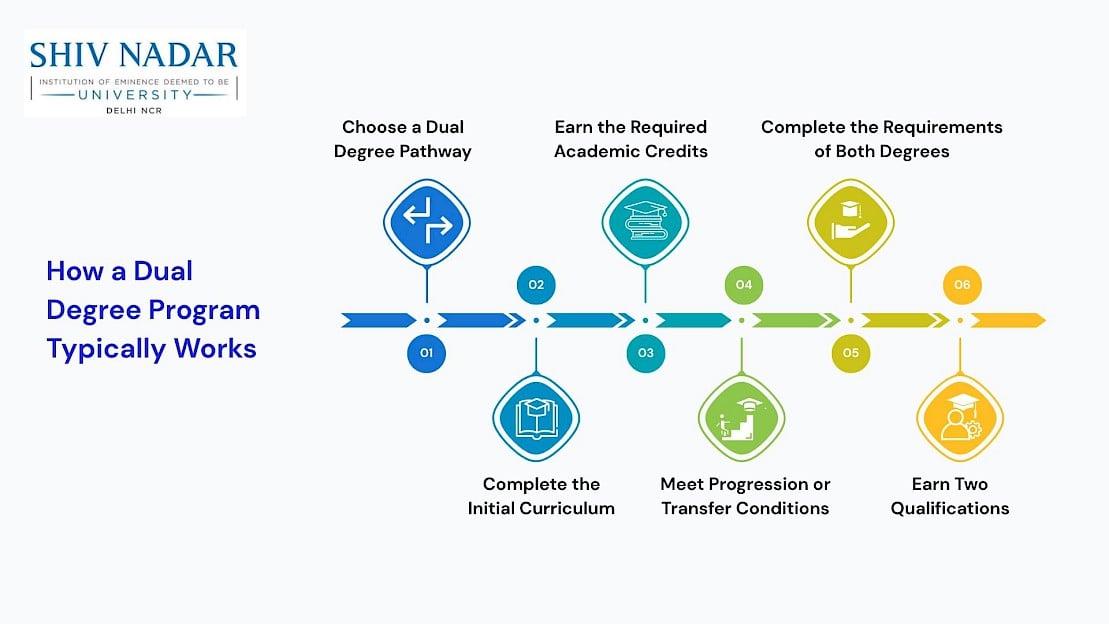
Dual degree programs work through a coordinated academic structure that defines how students complete the requirements for two qualifications. The curriculum, duration, credit requirements and institutions involved depend on the program. Below is a complete breakdown of how dual degree works-
Model | How It Generally Works | Typical Academic Outcome |
Integrated Undergraduate-Postgraduate Pathway | Bachelor’s and master’s-level study are combined into a structured academic pathway | Qualifications depend on the course structure |
Interdisciplinary Dual Degree | Students study two distinct or complementary academic fields | Two areas of specialized academic training |
Students study at partner institutions, often with a defined credit-transfer arrangement | Degrees from participating institutions, subject to program requirements | |
2+2 Dual Degree Model | Students generally spend two years at one institution and two years at another | Degree outcome depends on the institutional agreement |
How Can Dual Degree Programs Benefit Your Academic Journey?
A dual degree can offer more than the opportunity to earn two qualifications. Students may get numerous benefits depending on the program structure and subjects chosen.
- Broader academic exposure- Study across two disciplines or academic environments instead of limiting your undergraduate experience to a single area.
- Complementary skill development- Build knowledge in fields that work well together, such as computer science and business, depending on the degrees offered.
- Exposure to different learning environments- International dual degree programs may allow students to experience different teaching approaches, academic systems and campus cultures.
- A structured international study pathway- Programmes developed between partner universities can provide a defined route for studying across institutions, including planned curriculum alignment and eligible credit transfer.
- Greater interdisciplinary perspective- Learning across fields can help students understand problems from different academic and professional viewpoints.
- Wider options after graduation- Two areas of academic training may open up a broader range of choices for higher studies and career exploration.
Student’s Checklist for Choosing the Right Dual Degree Program
A dual degree should be evaluated based on its academic structure and long-term relevance, not simply on the opportunity to earn two qualifications.
Before making a decision, students should ask-
- What exact degrees will I receive?
- Which institution awards each qualification?
- How many credits must I complete?
- Are credits automatically transferable or subject to approval?
- What will the complete programme cost, including tuition, travel and living expenses?
- What happens if I do not meet the transfer conditions?
- And, most importantly, do both qualifications support my academic or career goals?
After getting clear answers to these questions, students can easily compare programs that may all use the term “dual degree” but operate very differently.
From India to the US- The Shiv Nadar University (Institution of Eminence) and ASU Dual DegreePathway
Shiv Nadar University offers international BS dual-degree pathways in collaboration with Arizona State University (ASU) in Business and Computer Science.
The course structure follows a four-year pathway in which students study during Years 1 and 2 at Shiv Nadar University. After meeting the applicable transfer requirements, they will continue Years 3 and 4 at Arizona State University.
ASU courses are integrated into the initial phase of the programs, which allows eligible credits to be transferred when students progress to ASU. Students who successfully complete the academic requirements of the pathway can earn degrees from both universities within the four-year program structure.
SNU-ASU Dual Degree Courses at a Glance
Feature | BS Business Dual Degree | BS Computer Science Dual Degree |
Overall programme duration | 4 years | 4 years |
Years 1 and 2 | Shiv Nadar University | Shiv Nadar University |
Years 3 and 4 | Arizona State University | Arizona State University |
Programme model | International dual degree | International dual degree |
Published transfer GPA requirement | Minimum 6/10 at SNU | Minimum 6/10 at SNU |
Additional feature | Optional ASU Summer Experience | Optional ASU Summer Experience |
Accreditation highlighted for ASU program | AACSB | Computing Accreditation Commission of ABET |
Majors and Concentrations Explained
The two dual degree pathways offer different areas of specialization, allowing students to align their undergraduate studies with their academic interests.
BS in Business - Majors
- AI in Business
- Business Data Analytics
- Computer Information Systems
- Finance
View the BS Business program structure
BS in Computer Science – Majors
- Cybersecurity
- Software Engineering
View the BS Computer Science program structure
Eligibility and Admission Routes (2026 Admission Cycle)
Eligibility
- BS Business: Minimum 65% aggregate in Class 12 boards, including English.
- BS Computer Science: Minimum 65% aggregate across all subjects, including Physics, Mathematics and English.
Admission Routes
- JEE Main 2025/2026
- SNUSAT (plus APT for BS Computer Science)
- College Board SAT - valid SAT score
- ACT - valid ACT score
- CUET 2026
Transfer Requirements to ASU (After Year 2)
- Minimum SNU GPA of 6/10.
- BS Business route- 1230 SAT Reasoning score, OR 25 ACT score, OR 3.4/4 GPA in ASU competency courses taken in high school.
- Students must also satisfy the applicable English-language proficiency requirements.
Program | TOEFL iBT | IELTS | PTE | Duolingo English Test |
BS Business | 61 | 6.0 | 53 | 95 |
BS Computer Science | 79 | 6.5 | 58 | 105 |
Overall, the SNU-ASU pathway offers a structured route to study across two universities and earn two degrees within four years. Explore the program structure, compare the available specializations, and choose the dual degree pathway that best aligns with your academic goals.
Synopsis
Dual degree programs are opening up new ways for students to shape their UG journey across disciplines, institutions, and even countries. However, the right choice goes beyond earning two qualifications. The degree structure, subjects, credit transfer, eligibility requirements, costs and future goals all matter.
As dual degree programs in India continue to evolve, you should compare options carefully and understand the complete academic pathway before applying. A well-chosen course can provide broader learning opportunities and an educational experience that extends beyond the boundaries of a traditional single-degree route.
FAQs
Q1. Are dual degree programs available in India?
Ans. Yes. Dual degree programs in India are available in different formats, including interdisciplinary programs, integrated academic pathways and international university collaborations.
Q2. Is a dual degree the same as a double major?
Ans. No. A dual degree generally leads to two separate qualifications, whereas a double major typically involves studying two major subjects within one degree. The terminology can vary between universities, so students should verify the final qualification awarded.
Q3. Is a dual degree worth it?
Ans. A dual degree can be worthwhile when both qualifications support a student’s academic interests and future goals. Students should consider the curriculum, workload, program duration, total cost and career relevance before deciding.
Q4. How much does the dual degree cost?
Ans. The approximate total cost of the dual degree, including living expenses, is $150,000.
Q5. What are the eligibility criteria?
Ans. A minimum of 65% aggregate in Class 12 boards is required for both programs (including English for BS Business; including Physics, Mathematics and English for BS Computer Science). Admission routes include JEE Main, SNUSAT, SAT, ACT, and CUET.
Q6. Can I get a scholarship for this dual degree program?
Ans. Yes. ASU's New American University (NAMU) Scholarship offers $3,000 to $10,000 per year to eligible incoming transfer students based on GPA and English test scores, with no separate application required.