Data Science vs. AI: Understanding the Real Difference
Blog / July 27, 2026
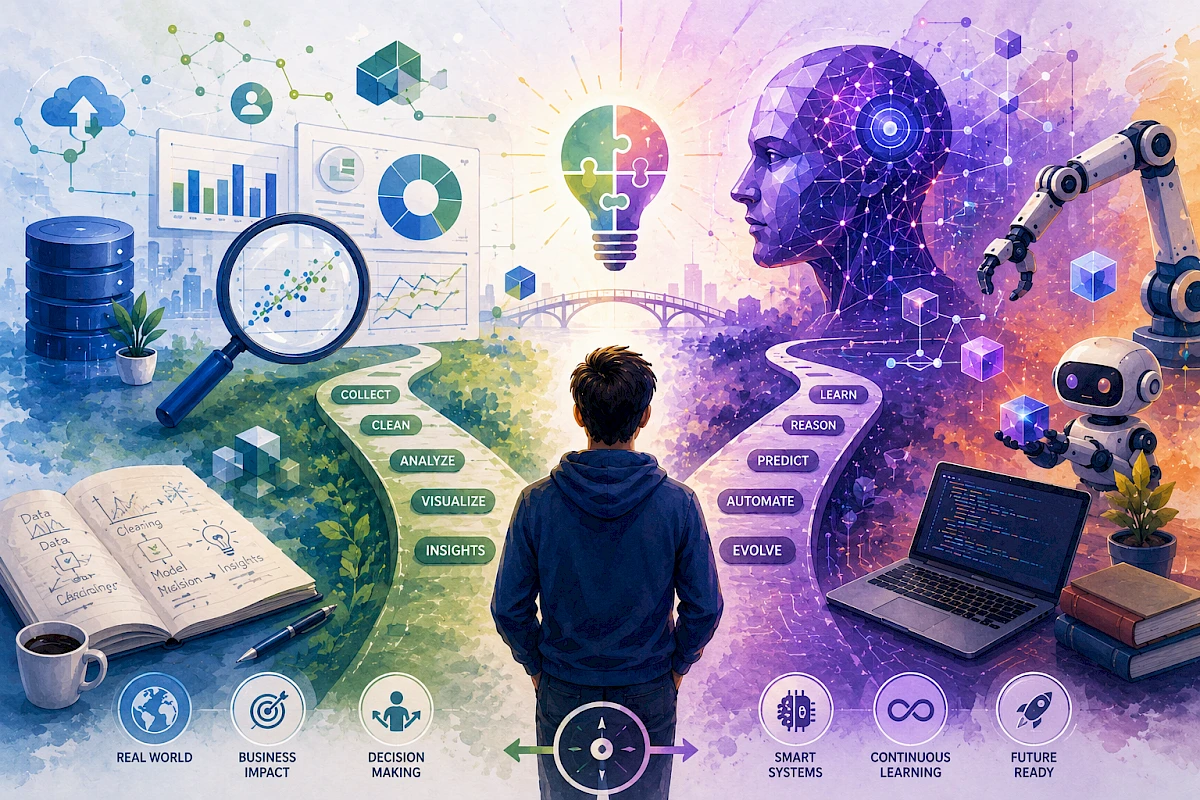
If you're comparing data science vs AI to decide what to study or where to build your career, you're not choosing between two unrelated fields. Data science studies what your data is telling you. AI takes that data and acts on it, often without a person in the loop.
The confusion is understandable since both fields use Python and rely on machine learning, and job postings often blur the line between them. This blog breaks down what each field actually does, where they overlap, and how to decide which path fits you.
What Is Data Science?
Data science is the discipline of collecting, cleaning, and analyzing data to find patterns that guide decisions. A data scientist's job ends with an insight: a report, a dashboard, or a prediction that a person or team acts on.
Most of a data scientist's week goes into preparing messy data before any analysis happens. You clean inconsistent entries, reconcile different data sources, and build the pipelines that make raw numbers usable. Only after that foundation is solid does the actual modeling and storytelling begin. Core tools include Python, R, SQL, and visualization platforms like Tableau or Power BI.
What Is Artificial Intelligence?
Artificial intelligence is the branch of computer science that builds systems capable of performing tasks that normally require human judgment, such as recognizing speech, interpreting images, or making decisions in real time.
Unlike a data science report that a person reads and acts on, an AI system acts on its own. A recommendation engine, a fraud detection model, or a chatbot are all AI systems doing their job without a human approving each step. Building these systems calls for deep learning frameworks like TensorFlow and PyTorch, along with a strong grounding in neural networks and natural language processing.
Data Science vs AI: Key Differences
The clearest way to separate data science from AI is to look at what each one produces at the end of the process. The table below breaks down the practical differences in goals, skills, tools, and output.
Aspect | Data Science | Artificial Intelligence |
Primary goal | Find patterns and generate insights from data | Automate decisions and actions without human input |
Core skills | Statistics, SQL, data visualization | Deep learning, NLP, software engineering |
Common tools | Python, R, Tableau, Pandas | TensorFlow, PyTorch, Hugging Face |
Typical tech stack | SQL, Jupyter, Pandas/NumPy, Tableau/Power BI, scikit-learn | Python, TensorFlow/PyTorch, cloud ML platforms (AWS/GCP/Azure), vector databases for GenAI |
Typical output | Reports, dashboards, predictive models | Chatbots, recommendation engines, autonomous systems |
How Do Data Science and AI Overlap?
Data science and AI share the same foundation: mathematics, programming, and machine learning. The overlap becomes clear once you look at how the two fields feed each other inside a real organization.
- Machine learning is the bridge both fields use to find deeper patterns and make systems smarter over time.
- Data scientists often build the predictive models that AI engineers later deploy into live products.
- Both rely on the same base skills in statistics, Python, and data handling.
- A recommendation engine typically starts as a data science model before an AI team turns it into a production system.
Deep Learning vs. Traditional Machine Learning
Not all machine learning is deep learning, and the practical differences matter. Traditional ML models (decision trees, linear regression, SVMs) work well on smaller, structured datasets and are easier to interpret; you can usually explain why a model made a decision. Deep learning models, built on neural networks, need far more data and compute, but they handle unstructured data (images, audio, raw text) that traditional ML struggles with.
In practice, a data scientist is more likely to reach for traditional ML on a tabular sales dataset, while an AI engineer building a chatbot or image classifier is almost always working with deep learning. Most programs introduce traditional ML in a shared core course before offering deep learning as a separate, more advanced elective- the jump in mathematical difficulty is real enough to justify treating them separately.
Ethical Considerations in Data Science and AI
Both fields inherit the same core ethical risks, though they surface differently. In data science, the main risk is bias baked into historical data- a hiring model trained on past decisions can quietly replicate past discrimination even when nobody intends it to. Privacy is the other recurring issue: aggregating personal data for insights, even anonymized, can still expose individuals if datasets are combined carelessly.
AI systems inherit those same risks and add one more: accountability. When a data science report is wrong, a human catches it before acting. When an AI system acts autonomously (approving a loan, flagging a transaction as fraud), the error can cause harm before anyone reviews it.
This is why responsible AI development increasingly includes explainability requirements, audit trails, and human-in-the-loop checkpoints for high-stakes decisions. Anyone entering either field should expect ethics and fairness testing to be a normal part of the job, not a footnote.
Which Pays More, and Should You Learn Data Science Before AI?
AI roles pay more on average, but the gap is smaller than most people expect at the fresher level. Yes, you should learn data science fundamentals first, but every AI role still expects you to know how data is cleaned, modeled, and evaluated.
Role | Actual Average Salary (India) |
Data Scientist | ₹8 L/yr - ₹17 L/yr |
Data Analyst | ₹6.6 L/yr - ₹7.3 L/yr |
AI/ML Engineer | ₹11.5 L/yr - ₹12.8 L/yr |
Generative AI / LLM Engineer | ₹14.2 L/yr - ₹15.6 L/yr |
Computer Vision Engineer | ₹10.8 L/yr - ₹11.9 L/yr |
NLP Engineer | ₹6 LPA to ₹9 LPA |
Source:The above salary estimates are based on Glassdoor & AmbitionBox salary insights.
The pattern holds across roles: the further you move from analysis toward deployment and specialization, the higher the starting number climbs, but that specialization has to sit on top of the same base. If you're unsure which one fits you, start with the fundamentals everyone shares; the specialization decision doesn't have to be made on day one.
Do You Need a Degree, or Can You Self-Teach Data Science and AI?
Both paths produce working professionals, but they optimize for different things. Self-taught routes (online courses, bootcamps, personal projects) get you job-ready faster and cost less upfront. They work well if you already have a strong reason to focus narrowly, like switching careers into a specific tool or role.
A structured engineering degree trades speed for depth. It builds the mathematical foundation (linear algebra, probability, algorithms) that self-taught paths often skip, and that shows up later when you need to debug why a model fails rather than just call a library function. It also keeps both specialization paths open at once, since electives are chosen after the foundation is built rather than before.
Recruiters at product companies increasingly look for both: a formal grounding plus a visible portfolio. The degree gets you the interview; the projects get you the offer. Neither path alone covers both needs as well as the two combined.
Where Can You Build Both Skill Sets? A Look at Shiv Nadar University (Institution of Eminence) B.Tech. CSE Program
If you want to keep both paths open instead of picking one before you've even started, look for a program that builds a shared core before asking you to specialize. Shiv Nadar University's B.Tech. in Computer Science and Engineering does exactly this.
Every student at the University completes the same foundation, including Data Structures and Algorithms, Probability and Statistics, and a core Artificial Intelligence and Machine Learning course, before choosing a specialization track from the fifth semester onward.
- Shared core curriculum in AI, machine learning, statistics, and data structures across all CSE students before specialization begins.
- A dedicated AI specialization track with electives in Deep Learning, Natural Language Processing, Computer Vision, and Generative AI.
- A dedicated Data Science specialization track with electives in Foundations of Data Science, Algorithms for Big Data, and Advanced Database Management Systems.
- Formal specialization recognition on your degree once you complete a minimum of 12 elective credits with a CGPA of 7 or higher in that track.
Conclusion
Data science vs AI isn't really a competition, it's a sequence. You'll lean on data science skills to understand what your data is telling you, and on AI skills to build systems that act on it. Choosing a program that lets you build both, rather than forcing an early choice, gives you the flexibility to decide once you actually know what excites you.
Shiv Nadar University's B.Tech. CSE gives you exactly that setup: a shared foundation strong enough to open both doors, and a specialization track that only asks you to commit once you know which one you want to walk through. Ready to start building that foundation? Apply now!
FAQs
Q1. Which is better, data science or AI?
Ans. Neither field is inherently better; they solve different problems. Data science suits you if you enjoy finding patterns and communicating insights. AI suits you if you'd rather build systems that act automatically. Many careers use both, so the better path depends on the kind of work you want to do daily.
Q2. Will data science be replaced by AI?
Ans. No. AI actually depends on data science. Every AI system needs clean, well-prepared data and sound models before it can be deployed, and that groundwork is data science's job. The two fields are more likely to merge further than to replace each other.
Q3. Which pays more, AI or data science?
Ans. AI roles typically pay more on average because they require additional software engineering and deployment skills beyond data science. Junior data science and AI roles pay similarly, but the gap widens as specialization deepens.
Q4. Should I learn data science before AI?
Ans. Yes, in most cases. Data science fundamentals such as statistics, Python, and model evaluation form the base every AI role still expects you to know. Learning data science first gives you the groundwork to specialize into AI later.
Q5. Can you do data science without using AI?
Ans. Yes. Most data science work (cleaning data, running statistical analysis, building dashboards, and reporting insights) doesn't require any AI or deep learning at all.
Q6. Do I have to choose between data science and AI when picking a degree?
Ans.No. Programs like Shiv Nadar University's B.Tech. CSE build a shared foundation in both fields before asking you to specialize through electives from your third year onward, so you can decide once you have more clarity.