Beyond the Classroom: Top Career Options After B.Sc Physics in India
Blog / July 30, 2026
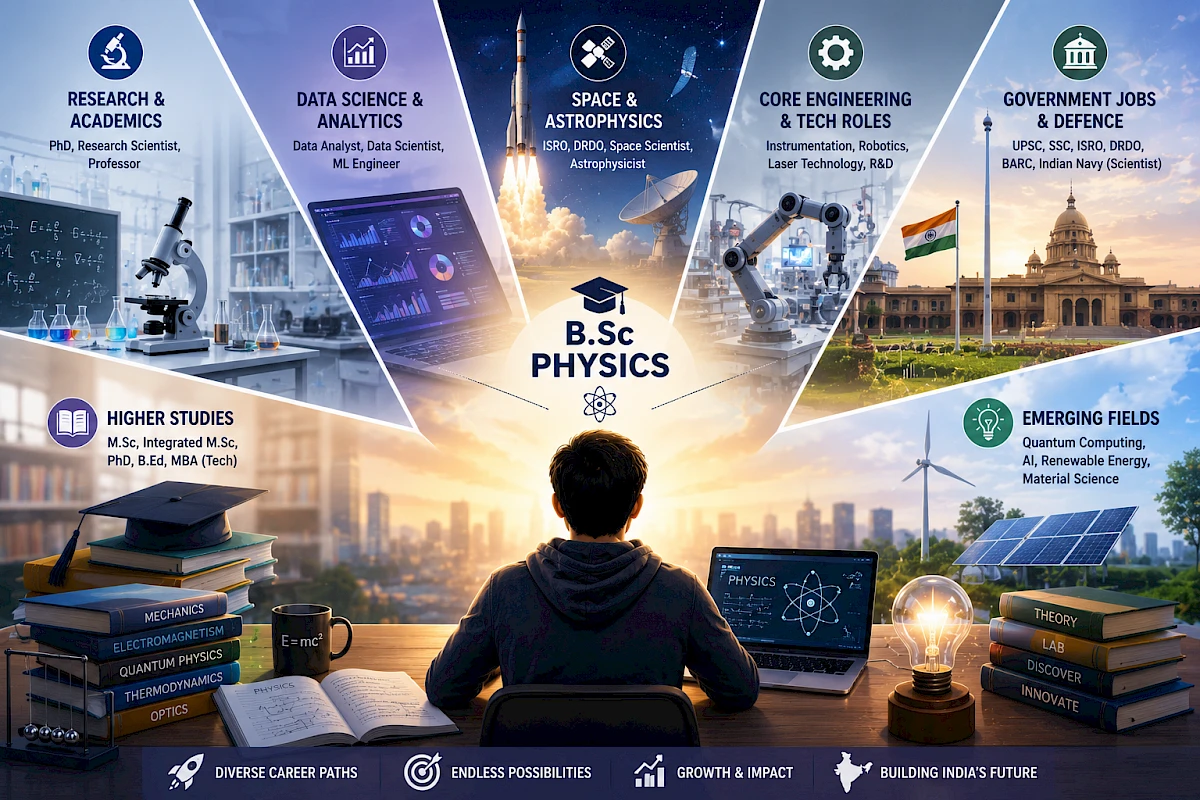
Physics is more than just formulas and theories; it is the foundation of modern science and technology. From developing satellites and medical imaging equipment to advancing artificial intelligence and renewable energy, physics plays a vital role in shaping the world around us. If you have a curious mind and enjoy solving complex problems, pursuing a B.Sc. in Physics can open the door to diverse and rewarding career options.
Many students believe that a physics degree only leads to teaching or research. However, the career landscape has changed significantly. Today, graduates are in demand across industries such as quantum computing, defense and space research, medical physics, and quantitative finance. The analytical thinking, mathematical skills, and problem-solving abilities developed during the course make physics graduates valuable in both scientific and non-scientific sectors.
Why Pursue B.Sc. in Physics?
A B.Sc. in Physics develops scientific knowledge, analytical thinking, and technical skills, creating opportunities across research, technology, education, and emerging industries while preparing students for diverse career paths. Beyond understanding the fundamental laws of nature, the program equips students with practical and transferable skills that are highly valued across industries. Some of the key benefits of pursuing a B.Sc. in Physics include:
- Strong analytical, mathematical, and problem-solving skills
- Practical learning through laboratory experiments and research
- Diverse career opportunities across research, technology, healthcare, education, and government sectors
- Helps build a solid foundation for higher studies such as MBA and Ph.D.
- Excellent long-term career prospects in India's growing science and technology sectors
Top 6 Career Options after B.Sc. in Physics
A B.Sc. in Physics offers diverse career opportunities across research, technology, healthcare, education, manufacturing, and government sectors. The program builds strong analytical, mathematical, and problem-solving skills, enabling graduates to pursue technical roles, higher education, or competitive examinations while adapting to emerging fields such as AI-accelerated computational physics and bio-physics. Here are six of the most promising career options after completing a B.Sc. in Physics:
1. Research Scientist
Research Scientists explore scientific concepts through experiments and innovation to solve real-world problems. This career is ideal for physics graduates who enjoy research, critical thinking, and discovering new technologies across academic institutions, government laboratories, and industrial research centers.
Details | Information |
Primary Role | Conduct scientific research and innovation |
Work Environment | Research institutes, universities, R&D centers |
Key Skills | Research methodology, analytical thinking, data interpretation |
Average Salary |
2. Data Analyst
A Data Analyst transforms raw data into meaningful insights that help organizations improve decision-making. Physics graduates excel in this role because of their strong mathematical foundation, logical reasoning, and ability to analyze complex datasets.
Details | Information |
Primary Role | Analyze and interpret business data |
Work Environment | IT companies, consulting firms, finance, healthcare |
Key Skills | SQL, Python, Excel, Power BI, statistics |
Average Salary |
3. Physics Lecturer or Teacher
Teaching is an excellent career for graduates who enjoy explaining scientific concepts and mentoring students. After gaining the required qualifications, physics graduates can teach at schools, colleges, universities, or online learning platforms.
Details | Information |
Primary Role | Teach physics and guide students |
Work Environment | Schools, colleges, universities, coaching institutes |
Key Skills | Subject expertise, communication, presentation |
Average Salary |
4. Medical Physicist
Medical Physicists apply physics principles to healthcare by ensuring the safe and effective use of advanced diagnostic and treatment technologies. This career combines scientific expertise with patient care in modern hospitals and cancer treatment centers.
Details | Information |
Primary Role | Support diagnosis and radiation treatment |
Work Environment | Hospitals, cancer centers, diagnostic labs |
Key Skills | Radiation physics, imaging technology, quality assurance |
Average Salary |
5. Aerospace and Space Scientist
With India's expanding space ecosystem, physics graduates can contribute to satellite technology, aerospace engineering, and space exploration projects. This field offers exciting opportunities to work on cutting-edge scientific and technological advancements.
Details | Information |
Primary Role | Develop space and aerospace technologies |
Work Environment | Space agencies, aerospace companies, research labs |
Key Skills | Computational physics, modeling, problem-solving |
Average Salary |
6. Financial Analyst
Physics graduates can build successful careers in finance by applying their quantitative and analytical skills to evaluate investments, assess financial risks, and support strategic business decisions across banking and financial services.
Details | Information |
Primary Role | Analyze financial performance and market trends |
Work Environment | Banks, investment firms, financial institutions |
Key Skills | Financial modeling, statistics, analytical reasoning |
Average Salary |
Government Jobs After B.Sc. Physics in India
Government organizations regularly recruit physics graduates for scientific, technical, and administrative positions. These jobs offer stable career growth, attractive salaries, and additional benefits. Some popular government career options include:
Organization | Popular Roles |
ISRO | Scientist, Technical Assistant |
DRDO | Scientist, Research Fellow |
BARC | Scientific Assistant |
Indian Railways | Technical Officer |
SSC | Scientific Assistant |
UPSC | Civil Services |
State PSCs | Administrative & Scientific Roles |
Defense Services | Technical Branches |
Many graduates also prepare for competitive examinations such as UPSC, SSC CGL, Banking, and State Public Service Commission exams.
Tips to Get High-Paying Jobs After Completing B.Sc. Physics
Securing a high-paying job after a B.Sc. in Physics requires more than academic knowledge. Developing technical expertise, gaining practical experience, and continuously upgrading your skills can significantly improve your employability and open doors to rewarding career opportunities across industries. To maximise your career potential and stand out in a competitive job market, keep the following tips in mind:
- Build strong fundamentals in mathematics, physics, and data analysis.
- Learn in-demand technical skills such as Python, MATLAB, AI, or data analytics.
- Gain practical experience through internships, research projects, and laboratory work.
- Pursue industry-recognised certifications in emerging technologies.
- Develop communication, teamwork, and problem-solving skills alongside technical expertise.
- Prepare for competitive exams if targeting government or research organizations.
- Consider higher education such as M.Sc., MBA, or Ph.D. to access specialised roles.
- Stay updated with advancements in renewable energy, space technology, and more.
- Network with professionals through seminars, conferences, and alumni communities.
- Build a strong resume and LinkedIn profile showcasing projects, certifications, and achievements.
Why Choose Shiv Nadar University (Institution of Eminence) for B.Sc. (Research) in Physics?
Choosing the right university is just as important as selecting the right program. If you aspire to build a career in scientific research, innovation, or advanced technology, Shiv Nadar University offers a research-driven B.Sc. (Research) in Physics designed to combine strong academic foundations with practical research experience. The curriculum encourages critical thinking, interdisciplinary learning, and hands-on experimentation, helping students develop the skills required for higher studies and careers in academia, research laboratories, and technology-driven industries.
Some of the key highlights of the B.Sc. (Research) in Physics at Shiv Nadar University include:
- Research-focused curriculum with extensive laboratory work and faculty-guided research projects.
- Interdisciplinary learning that integrates physics with mathematics, chemistry, biology, computer science, and engineering.
- Opportunities to learn from experienced faculty actively engaged in research across materials science, astrophysics, particle physics, condensed matter physics, computational physics, and soft matter physics.
- Flexible Major and Minor options that allow students to tailor their academic journey based on their interests and career goals.
- A multidisciplinary learning environment that nurtures analytical thinking, innovation, creativity, and problem-solving skills.
- Strong preparation for higher education, scientific research, and careers in advanced technology sectors, R&D organizations, and academia.
With its emphasis on research, interdisciplinary education, and experiential learning, the program prepares graduates to address complex scientific challenges and succeed in a rapidly evolving global landscape.
To Sum Up
A B.Sc. in Physics is more than just a science degree; it equips students with analytical thinking, technical expertise, and problem-solving skills that are valued across industries. Whether you aspire to work in research, technology, healthcare, education, data analytics, or government organizations, the program offers a strong foundation for long-term career growth.
By gaining practical experience, developing in-demand technical skills, and pursuing higher education or professional certifications, graduates can significantly enhance their career prospects and earning potential. With India's growing investments in scientific research, space technology, and renewable energy, the scope of B.Sc. Physics is expected to expand further, creating exciting opportunities for future professionals.
FAQs
- Is B.Sc. Physics a good course for the future in India?
Yes. B.Sc. Physics is considered a promising course due to the growing demand for professionals in fields such as electronics, renewable energy, space technology, healthcare, data science, and research. The degree also provides a strong foundation for higher education and specialized careers.
- Can I pursue Data Science after B.Sc. Physics?
Yes. Physics graduates have strong analytical and mathematical skills, making them well-suited for Data Science. By learning programming languages like Python, SQL, and machine learning tools through certifications or postgraduate programs, they can transition into data-driven roles.
- Is coding necessary after B.Sc. Physics?
Coding is not mandatory for every career path after B.Sc. Physics. However, learning programming languages such as Python, MATLAB, or C++ can improve job prospects in research, data science, artificial intelligence, scientific computing, and software development.
- Can I pursue an MBA after B.Sc. Physics?
Yes. Many students choose to pursue an MBA after B.Sc. Physics to build careers in management, consulting, finance, operations, marketing, or business analytics. An MBA combined with strong analytical skills can open up leadership and managerial roles across industries.
- Which skills should I develop during B.Sc. Physics to improve employability?
Along with academic knowledge, students should focus on programming, data analysis, scientific computing, communication, critical thinking, and research skills. Participating in internships, research projects, and certification courses can further enhance employability.