How to Become a Financial Analyst: A Complete Step-by-Step Guide

Blog / September 14, 2026
Every merger, every stock recommendation, every company budget that survives its own board meeting has a financial analyst behind it, quietly running the numbers before anyone else signs off. It is one of the few careers where you, fresh out of college, can influence a real investment decision within your first year on the job.
The field is also growing faster than you might expect, and that works in your favor. The U.S. Bureau of Labor Statistics projects 7% employment growth for financial analysts between 2025 and 2035, well ahead of the average for all occupations, with roughly 29,500 new openings expected every year- openings you could be one of.
In India, compensation is climbing just as fast for those who add the right credentials. CFA Institute's 2026 compensation study puts the aggregate average pay for CFA charterholders and candidates at INR 22.1 lakh a year, up from INR 19.3 lakh in 2022. So if you are quietly weighing whether this career is worth four more years of effort, the numbers say yes.
So, if you’re still wondering, “How to become a financial analyst?”, then this blog right here is your way to find out the answer. In this piece, you will find the exact roadmap you can follow to become a financial analyst, along with subjects, degree, skills, certifications, timeline, and salary, in the order you will actually need them.
What Does a Financial Analyst Actually Do?
Strip away the job title, and here is what you would actually be doing all day: turning raw financial data into a decision someone else can act on. What that looks like on your desk depends on where you end up sitting.
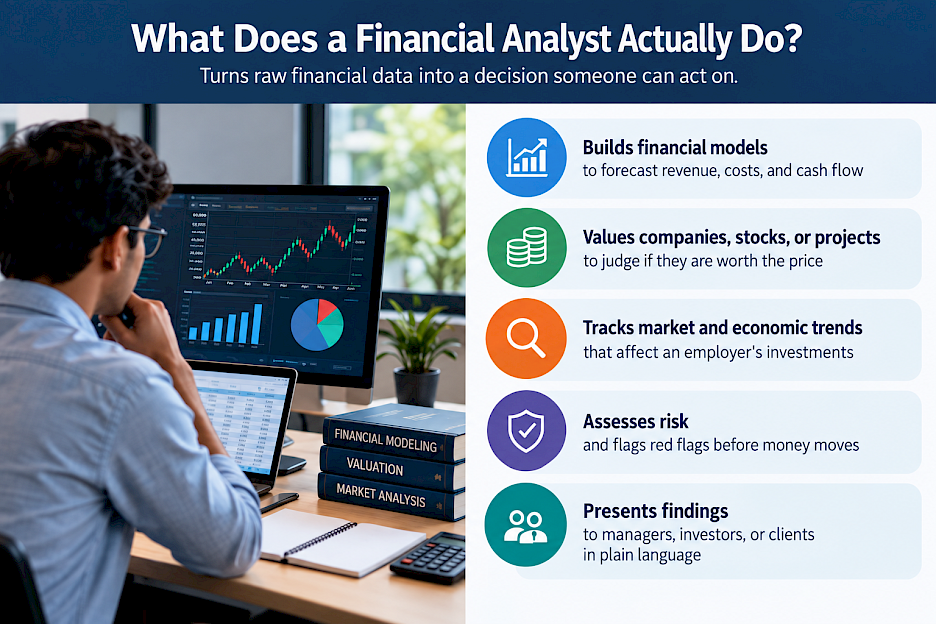
You will find analysts inside investment banks, mutual funds, insurance companies, and the finance team of almost any large company. The title stays the same; the specialization (equity research, corporate finance, risk, portfolio management) is what changes.
What Subjects Should You Choose After Class 10th?
If you are choosing between commerce and science right now, you can relax a little; both paths lead to this career. What actually decides your head start is not the stream you pick but how comfortable you get with math, and how early you start building that comfort.
Stream | Why It Works | Watch Out For |
Commerce + Math | Direct exposure to accounting, economics, and business statistics from day one | Skipping math is the single biggest mistake commerce students make here |
Science (PCM) | Strong quantitative base transfers well into financial modeling and valuation | You will need to self-study accounting basics before college starts |
Which Undergraduate Degree Should You Pick?
By the time you are filling out college applications, this is the question that shapes your next four years. A bachelor's degree in economics, finance, or a related quantitative field is the standard entry ticket into financial analysis, and that holds true whether you apply in India or abroad.
According to reports, most students reach an entry-level analyst role within 4 to 5 years of starting their bachelor's degree, while senior or CFA-backed specialist roles typically take 8 or more years. So the degree you pick now sets the pace for everything that follows.
Here is what actually separates a strong finance degree from a weak one in 2026-
- Does it teach financial modeling and valuation, not just theory?
- Do you touch real tools like Excel, Python, or Bloomberg before graduating?
- Is there a specialization track for investments, markets, or portfolio management?
- Does the program end in a thesis or internship you can actually put on a resume?
An interdisciplinary program that pairs economics and finance with data analytics and programming checks every one of these boxes better than a traditional, lecture-only commerce degree, so use this list while you are still comparing options, not after you have already enrolled.
What Skills Do Employers Actually Screen For?
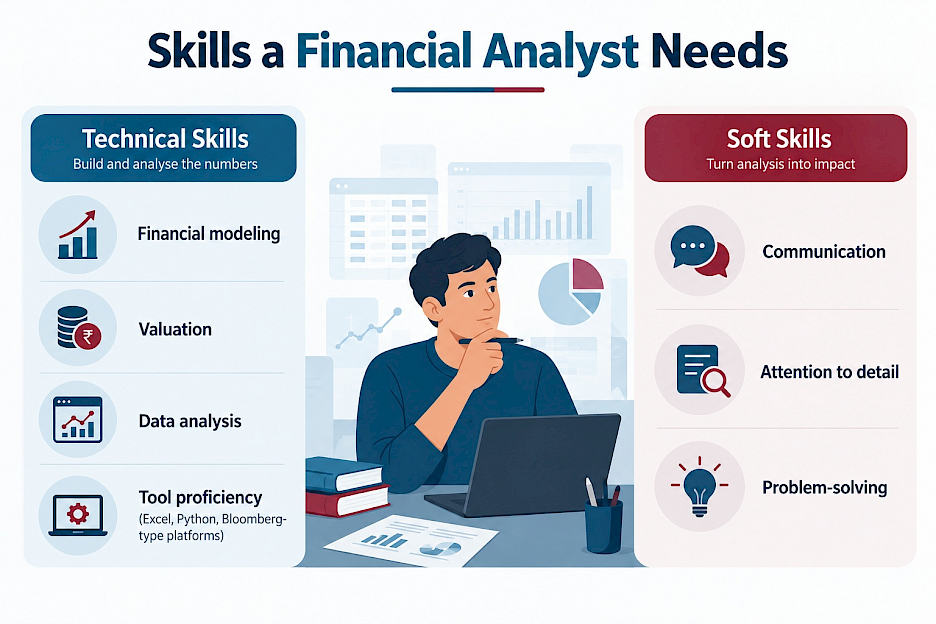
Job descriptions for financial analyst roles repeat the same skills so often that they have become a checklist. Once you know what is on it, you can decide which of these to prioritize while you still have time in college, before an interviewer asks you about them. Here’s a table to help you with it.
Skill | Why It Matters | Where You Build It |
Financial modeling | Lets you forecast revenue, costs, and cash flow so a company can plan ahead | Corporate finance and valuation coursework, Excel-based projects |
Valuation and equity research | Core to judging whether a stock, project, or company is fairly priced | Equity research electives, fundamental analysis assignments |
Data analysis and statistics | Analysts increasingly work with large datasets, not just spreadsheets | Econometrics, statistics, and programming courses |
Tool proficiency (Excel, Python, Bloomberg-type platforms) | Employers expect comfort with the software analysts use daily | Hands-on labs using market data and financial software |
Communication | Analysis is only useful if you can explain it clearly to decision-makers | Presentation-heavy coursework, case study defenses, research seminars |
Do You Need CFA or Another Certification?
Short answer, in case you are wondering whether to add this to your plate: not for your first job, but almost always if you want to get promoted past it. Here is how the main certifications compare, so you can pick the one that matches where you actually want to end up-
Certification | Best For | Typical Timeline |
CFA (Chartered Financial Analyst) | Equity research, portfolio management, investment analysis | 2.5-4 years across 3 levels |
CFP (Certified Financial Planner) | Personal wealth and financial planning roles | 1-2 years |
CIMA (Certificate in Investment Mgmt) | Investment management specialists | 6-12 months per level |
What Does the Career Timeline Actually Look Like?
Instead of picturing one long blur of years ahead of you, think of your path in four stages. This Learn, Apply, Certify, Advance framework is the simplest way to place yourself on the timeline and see what comes next.
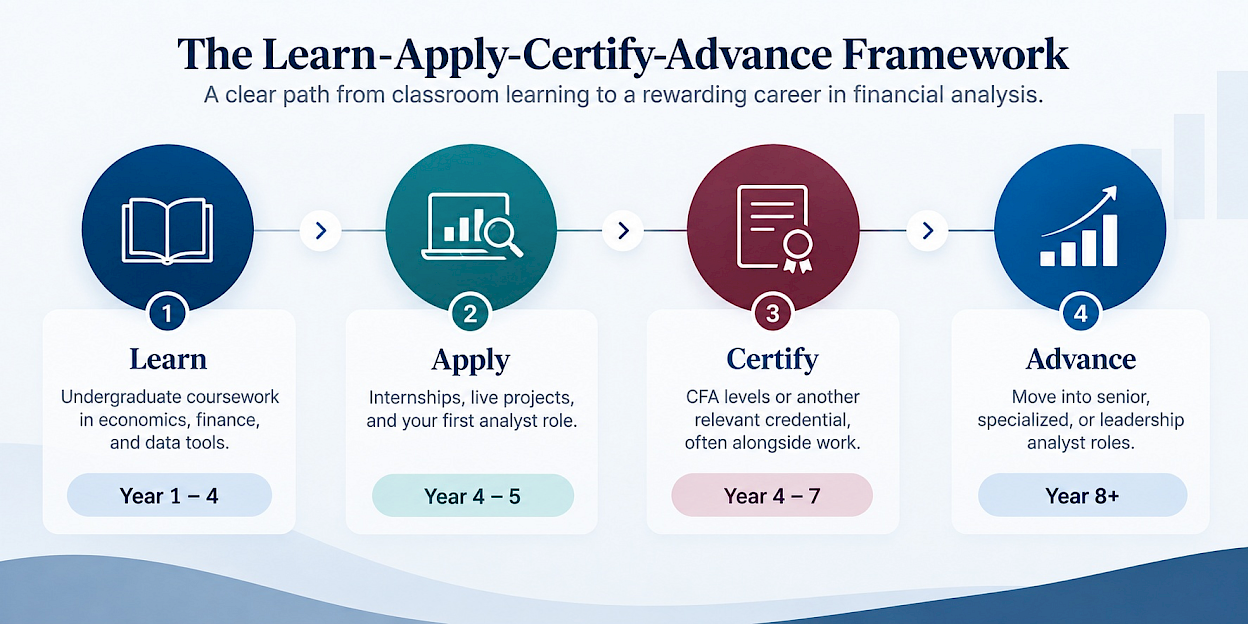
Most graduates move from a final-year internship straight into an entry-level analyst role, then spend the next few years stacking CFA levels on top of real deal or project experience, likely the exact stretch you are planning for right now.
What Can You Expect to Earn as a Financial Analyst in India?
Whatever number you have in your head right now, here is the real spread. Salary in this field depends less on your degree and more on how fast you stack experience and certifications on top of it.
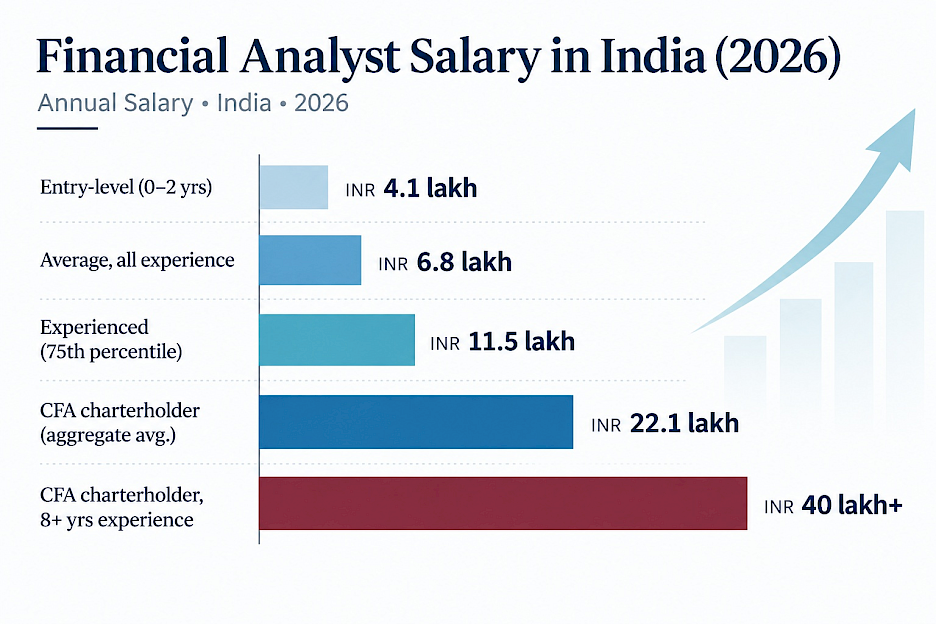
The figures above come from Glassdoor's 2026 India salary data and the CFA Institute's 2026 compensation study. Actual pay will still shift with your city, industry, and employer, so use these as a benchmark, not a promise.
How Shiv Nadar University's B.Sc. (Research) in Economics and Finance Prepares You for This Career
The roadmap above matches closely with the curriculum of the B.Sc. (Research) in Economics and Finance at Shiv Nadar University. This course is built as one interdisciplinary program rather than teaching economics, finance, and data as separate subjects.
Here’s why it Stands Out-
- A dedicated Investments & Markets specialization track covering capital markets, portfolio strategy, as well as valuation
- Hands-on exposure to industry tools including Excel, Python, Bloomberg, ACE Equity, and Prowess
- Coursework in equity research, corporate valuation, financial modeling, and AI/ML applications in finance
- Recruiters for the program's graduates include Goldman Sachs, D.E. Shaw, JPMorgan Chase, KPMG, and Deloitte
- A postgraduate pathway through Shiv Nadar University's MBA, which offers Finance electives like Investment Management and Security Analysis and Portfolio Management for further specialization
Whether your goal is to become an analyst right after graduation or to pursue investment banking over the long term, the program is built to close the gap between classroom and job offer in four years.
Conclusion
The path to becoming a financial analyst is not a mystery once you have it laid out in front of you. It is a step-by-step process that includes picking the right subjects early on, choosing a degree that teaches about real tools instead of leaning just on theory, stacking a certification like CFA on top, and letting experience do the rest of the work.
What changes your timeline from here is whether you learn that sequence one piece at a time on your own, or find a program that hands it to you already assembled.
If this path interests you, explore the BSc (Research) in Economics & Finance program at Shiv Nadar University to see how it fits your goals.
FAQs
1. How to become a financial analyst without a finance degree?
You can enter financial analysis from an engineering, science, or mathematics background as long as you build finance fundamentals through coursework, certifications, or self-study. Strong quantitative and analytical skills transfer well into the role.
2. Is CFA mandatory to become a financial analyst?
No. CFA is not mandatory for entry-level roles but is widely regarded as the strongest credential for investment-focused positions and career advancement.
3. How long does it take to become a financial analyst in India?
Most students reach an entry-level analyst role within four to five years, covering a bachelor's degree plus initial internship or job experience. Senior and specialized roles typically take eight or more years.
4. What is the difference between a financial analyst and an investment banker?
A financial analyst focuses on evaluating financial data, forecasting, and advising on decisions within or across companies, while an investment banker focuses on raising capital and executing deals like mergers, acquisitions, and public offerings. The two roles often share overlapping skills but differ in day-to-day focus.
5. Can commerce and science students both become financial analysts?
Yes. Commerce students typically have an early head start with accounting and economics, but science and engineering students with strong math skills regularly move into financial analyst roles as well.
6. What is the starting salary for a financial analyst in India?
Entry-level financial analysts in India typically start around INR 2.1 LPA, with the average rising to about INR 4.5 LPA as experience and certifications build.
7. Which skills matter most for a financial analyst role?
Financial modeling, valuation, and data analysis are the core technical skills, while communication and attention to detail are equally important for presenting findings clearly.
8. Does Shiv Nadar University offer a program for aspiring financial analysts?
Yes. The BSc (Research) in Economics & Finance (ENF) at Shiv Nadar University includes an Investments & Markets specialization track, industry-standard tools like Bloomberg and Python, and direct pathways into analyst roles at firms including Goldman Sachs and JPMorgan Chase.