Biotechnology vs Chemical Engineering: Should You Decode Life or Design the Future?
Blog / September 11, 2026
Imagine two engineers who are both trying to improve something, make it better and sustainable. The first engineer begins from a cell, while the second one begins from a process. In other words, one engineer focuses on genes, microorganisms, enzymes, and biochemical processes, considering what can be created using the properties of life itself, while another engineer considers how it can be produced effectively and safely.
That difference sits at the heart of Biotechnology vs Chemical Engineering, and the timing could hardly be more interesting. India’s bioeconomy grew from $10 billion in 2014 to $165.7 billion in 2024, with the government targeting $300 billion by 2030. At the same time, India is the world’s sixth-largest chemical producer, contributes about 7% of national GDP, and the domestic market is projected to expand to 300 billion dollars by 2028, according to the latest government data.
So this isn't simply a choice between biology and chemistry; it is a choice between two different ways of solving problems that could define the next generation of healthcare, manufacturing, energy, and sustainability.
Do you want to understand and engineer biological systems? Or do you want to design the processes that turn scientific ideas into products at scale? That is where the real Biotechnology vs Chemical Engineering conversation begins.
Biotechnology vs Chemical Engineering: Two Degrees, Two Ways of Thinking
The names may sit next to each other on a list of science and engineering programs, but the questions they ask differ.
Biotechnology works with biological systems- cells, microorganisms, genes, enzymes, and biological processes, to develop useful products and technologies, while Chemical Engineering takes chemistry, physics, and mathematics into the world of processes, equipment, and production, figuring out how materials can be transformed efficiently and safely.
Factor | Biotechnology | Chemical Engineering |
Central focus | Biological systems | Chemical and industrial processes |
Strong foundation | Biology, chemistry, and biological sciences | Mathematics, chemistry, physics, and engineering |
Typical environment | Laboratories, research facilities, healthcare and biotech companies | Plants, laboratories, manufacturing facilities and engineering companies |
Major applications | Healthcare, pharmaceuticals, agriculture, diagnostics and biomanufacturing | Chemicals, energy, pharmaceuticals, materials, food and manufacturing |
Core question | What can biological systems help us create? | How can we produce something efficiently at scale? |
The distinction becomes clearer when you stop looking at the degree names and start looking at the problems each field solves.
What Do You Study in Biotechnology and Chemical Engineering?
The difference becomes much clearer once you look at what actually happens inside the classroom and laboratory.
Major Subjects in Biotechnology
Biotechnology typically moves from understanding life at a fundamental level to applying that knowledge.
Subjects can include:
- Cell Biology
- Molecular Biology
- Genetics
- Microbiology
- Biochemistry
- Immunology
- Genomics
- Proteomics
- Bioinformatics
- Recombinant DNA Technology
- Industrial Biotechnology
- Plant and Animal Biotechnology
- Drug Discovery
- Systems Biology
Practical work is an important part of the discipline; you may learn to formulate hypotheses, conduct experiments, analyze data and communicate scientific findings.
Major Subjects in Chemical Engineering
Chemical Engineering applies scientific principles to processes and systems; core areas include:
- Thermodynamics
- Fluid Mechanics
- Heat Transfer
- Mass Transfer
- Chemical Reaction Engineering
- Process Control
- Process Design
- Separation Processes
- Transport Phenomena
- Process Safety
- Process Simulation
The learning gradually shifts from understanding individual scientific principles to asking how to design, control, improve and scale an entire process.
Biotechnology vs Chemical Engineering: Skills You Need
Both fields demand strong technical foundations, but the skills you develop take different directions depending on the problems you want to solve.
Skill Area | Biotechnology | Chemical Engineering |
Scientific knowledge | Biology, genetics, microbiology and biochemistry | Chemistry, physics, mathematics and thermodynamics |
Laboratory skills | Experimental techniques, biological analysis and sample handling | Process experiments, equipment handling and process testing |
Data analysis | Interpreting biological and experimental data | Analyzing process, production and engineering data |
Research skills | Experimental design, scientific research and documentation | Process analysis, modeling and technical research |
Problem-solving | Understanding and solving biological problems | Optimizing processes and solving engineering problems |
Technology skills | Bioinformatics and computational tools | Process simulation, modeling and engineering software |
Attention to detail | Important when working with biological samples and experiments | Important for process safety, measurements and quality control |
Communication | Scientific writing, research presentations and collaboration | Technical communication, reporting and teamwork |
Industry awareness | Pharmaceuticals, diagnostics, biomanufacturing and life sciences | Chemicals, pharmaceuticals, energy, materials and manufacturing |
In short: Biotechnology leans toward biology, research and experimentation, while Chemical Engineering combines science, mathematics and process design to solve problems at industrial scale.
Biotechnology vs Chemical Engineering: Career Opportunities
The two degrees can take graduates into different professional environments.
Career Options After Biotechnology
A Biotechnology graduate may explore roles such as:
- Biotechnologist
- Research Associate
- Laboratory Scientist
- Microbiologist
- Quality Control Analyst
- Quality Assurance Executive
- Clinical Research Associate
- Bioprocess Associate
- Bioinformatics Analyst
- Regulatory Affairs Associate
Potential industries include pharmaceuticals, diagnostics, healthcare, agriculture, food biotechnology, research and biomanufacturing. For students interested in independent scientific research, postgraduate study can become particularly important, as independent research roles for biochemists and biophysicists typically require a doctoral or professional degree.
Career Options After Chemical Engineering
Chemical Engineering graduates can explore roles such as:
- Chemical Engineer
- Process Engineer
- Production Engineer
- Plant Engineer
- Process Design Engineer
- Quality Engineer
- Safety Engineer
- R&D Engineer
- Energy Engineer
- Environmental Engineer
The field connects with chemicals, pharmaceuticals, energy, food processing, materials, polymers, water treatment, and manufacturing. Chemical Engineering professionals design equipment and processes for large-scale manufacturing and work in areas such as production, testing and process improvement.
Biotechnology vs Chemical Engineering: Industry Growth and Demand
The industries surrounding both disciplines are changing rapidly. India's BioEconomy reached $195.3 billion in 2025, compared with $86 billion in 2020. That represents a 17.8% CAGR over five years. The sector's growth includes biopharma manufacturing, bioindustrial production, agricultural biological inputs, and research services. The biotechnology startup ecosystem is expanding too. In 2025, 1,780 new biotechnology startups were registered, taking the cumulative number to 11,855.
Chemical Engineering operates within an equally broad industrial ecosystem. India produces more than 80,000 chemical products, while chemical and petrochemical production increased from 45,638 thousand metric tonnes (MT) in FY16 to 58,617 thousand MT in FY25.
Industry Indicator | Biotechnology | Chemical Industry |
Latest major figure | $195.3B BioEconomy, 2025 | 58,617 thousand MT in FY25 |
Recent growth | 18% YoY | 2.8% production CAGR, FY16–FY25 |
Startup ecosystem | 11,855 biotech startups | Large manufacturing ecosystem |
Major applications | Biopharma, diagnostics, bioindustrial products | Chemicals, pharma, energy, materials |
The numbers tell two different stories: biotechnology is rapidly expanding, while chemical manufacturing remains deeply embedded in India's industrial base.
What Industries Hire Biotechnology and Chemical Engineering Graduates?
Think about a medicine- biotechnology could explain the biological mechanism behind it, while chemical engineering could design the manufacturing process. Now think about sustainable fuel- biotechnology could explore biological feedstocks or microorganisms and chemical engineering could help design the system that converts those materials into fuel efficiently.
That is why the industries overlap more than the degree names suggest.
Biotechnology Industries
- Pharmaceuticals
- Diagnostics
- Healthcare
- Agricultural biotechnology
- Food biotechnology
- Biomanufacturing
- Environmental biotechnology
- Research and development
Chemical Engineering Industries
- Chemicals
- Pharmaceuticals
- Energy
- Oil and gas
- Food processing
- Fertilisers
- Polymers
- Advanced materials
- Water treatment
- Manufacturing
Industries may differ, but opportunities often overlap, especially in pharmaceuticals, biomanufacturing, sustainable technology and advanced materials, where biological knowledge and engineering expertise increasingly work together.
Biotechnology and Chemical Engineering: Where the Two Fields Meet
This is perhaps the most interesting part of the comparison; the boundary between the two fields is becoming increasingly blurred.
Bioprocess Engineering
Biological systems need engineering to move from laboratory experiments to industrial production.
Pharmaceutical Manufacturing
Biotechnology can help develop biological products, while Chemical Engineering can make production scalable and controlled.
Fermentation
Microorganisms may be the biological engine, but controlling temperature, flow, separation and production conditions requires engineering.
Biofuels
Biological materials can provide the starting point, while engineering determines how efficiently they convert into usable energy.
Sustainable Manufacturing
Both fields can contribute to reducing waste, improving resource efficiency and developing alternatives to conventional materials and processes.
The future is therefore not necessarily about choosing biology over engineering; in many emerging industries, it is about knowing where the two meet.
Biotechnology vs Chemical Engineering: Fees, Salary and Career Outlook
Before choosing between the two, it helps to look at both the cost of the degree and the earning potential after graduation. Fees vary by institution, while salaries depend on role, experience, location and industry.
Fee Comparison
Fee Component | B.Sc. (Research) Biotechnology | B.Tech. Chemical Engineering |
Duration | 4 years | 4 years |
Annual Tuition Fee | ₹3,50,000 | ₹4,00,000 |
Annual Living Charges | ₹2,14,000 | ₹2,14,000 |
Annual Total | ₹5,64,000 | ₹6,14,000 |
One-time Admission Fee | ₹60,000 | ₹60,000 |
Refundable Security Deposit | ₹30,000 | ₹30,000 |
Entrance Fee | ₹2,500 | ₹2,500 |
Students must also pay a ₹2,500 entrance fee, ₹60,000 one-time admission fee and a ₹30,000
refundable security deposit. Tuition and living charges may increase by up to 8% annually.
Salary Comparison in India
Salary can vary significantly by role, experience, location, industry and specialization, so the degree alone does not determine earning potential.
Current India salary data gives a useful starting point:
Career | Average Base Salary in India | Typical Base Salary Range | Senior-Level Range* |
Biotechnologist | ₹2,47,279/year | ₹2–₹4.2 lakh/year | Varies by specialization |
Chemical Engineer | ₹3,45,677/year | ₹3–₹8 lakh/year | ₹12–₹25 lakh/year |
*Senior-level figures are indicative salary ranges reported for the respective job title and can vary substantially between employers and locations.
Source- Indeed
The career paths also differ- Biotechnology graduates can move into biopharma, diagnostics, research, quality control and bioprocessing, while Chemical Engineering graduates can build careers in chemicals, pharmaceuticals, energy, manufacturing, process design and materials.
In short, compare salary expectations by the role and industry you want to enter and not simply by the degree you choose.
Emerging Opportunities in Biotechnology and Chemical Engineering
The future of both disciplines is moving beyond traditional job descriptions.
Biotechnology is moving towards:
- Synthetic biology
- Biopharmaceuticals
- Bioinformatics
- Precision healthcare
- Industrial biotechnology
- Gene technologies
- Sustainable biomanufacturing
Chemical Engineering is moving towards:
- Green hydrogen
- Carbon capture
- Battery materials
- Advanced materials
- Sustainable chemicals
- Renewable energy
- Water treatment
- Process automation
India's chemical sector is already closely tied to sustainability and new technologies. Government policy is also placing greater emphasis on areas such as carbon capture, utilization and storage, renewable energy and cleaner industrial production.
This creates an interesting middle ground where biological systems, chemistry, engineering and computing increasingly work together.
How to Choose Between Biotechnology and Chemical Engineering?
Don't start by asking which degree has more scope; start with the kind of work you can imagine yourself doing.
Biotechnology may fit you if:
- You enjoy biology and life sciences.
- Cells, genes and microorganisms interest you.
- You like laboratory experimentation.
- Healthcare and pharmaceuticals appeal to you.
- You enjoy research and scientific discovery.
- You are interested in biological data.
Chemical Engineering may fit you if:
- You enjoy mathematics and chemistry.
- You like solving process-based problems.
- Industrial systems interest you.
- You enjoy physics and engineering.
- You want to work with energy, materials, or manufacturing.
- You like understanding how complex systems operate.
And if both lists sound interesting, look at the intersection. Bioprocessing, pharmaceutical manufacturing, fermentation, biofuels, and sustainable production are examples of areas where the two disciplines can work together.
What Should You Look for When Comparing These Degrees?
The degree title is only the beginning. Before applying, compare the actual program. Look at:
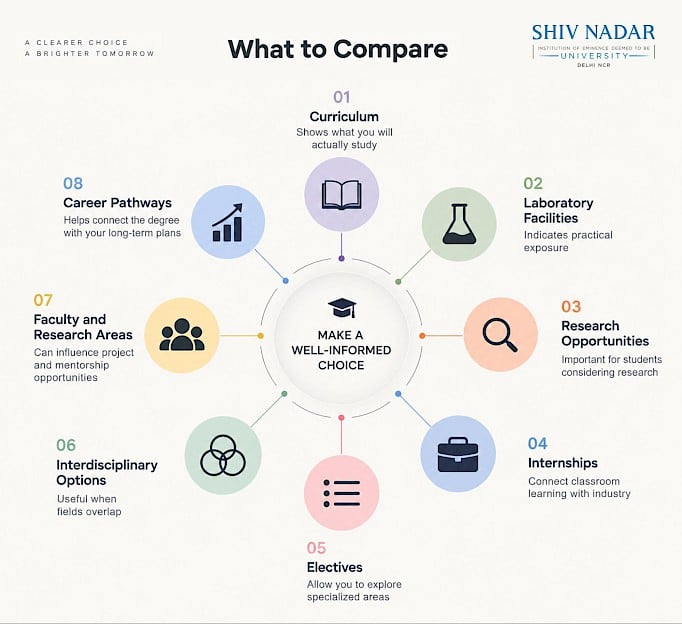
The program must provide you with adequate grounding in your chosen field without being too prescriptive so that you have the space to pursue wherever it takes you.
Build Your Future in Biotechnology or Chemical Engineering at Shiv Nadar University (Institute of Eminence)
Both Biotechnology and Chemical Engineering have different academic tracks at Shiv Nadar University, yet they apply scientific principles to solving problems. While Biotechnology is concerned with living things and biological studies, Chemical Engineering is concerned with chemical operations and processes.
Biotechnology
The program is a 4-year, 160-credit B.Sc. (Research) pathway with a strong emphasis on biological sciences and research. Students explore areas such as Cell Biology, Molecular Biology, Genetics, Microbiology, Biochemistry, Genomics, Proteomics, Bioinformatics, Recombinant DNA Technology, Industrial Biotechnology and Drug Discovery.
Students also get opportunities to:
- Build laboratory and experimental skills
- Explore biological data and computational tools
- Work across different areas of biotechnology research
- Undertake a 6-month to 1-year research project
- Develop skills in hypothesis formulation, experimentation, data analysis, and scientific reporting
Chemical Engineering
The B.Tech. program spans 8 semesters and requires a minimum of 163 credits, covering areas such as Thermodynamics, Fluid Mechanics, Heat and Mass Transfer, Chemical Reaction Engineering, Separation Processes, Process Control, Process Design and Process Safety.
Students can pursue two undergraduate specializations:
- Modeling and Simulation
- Bioenergy and Biomaterials
The program also provides opportunities to:
- Work with engineering and process-based laboratories
- Explore computational modeling and simulation
- Study sustainable energy and biomaterials
- Work on engineering projects and practical applications
- Explore interdisciplinary areas connecting engineering with biology, energy and sustainability
Biotechnology vs Chemical Engineering at Shiv Nadar University
Particular | Biotechnology | Chemical Engineering |
Degree | B.Sc. (Research) | B.Tech. |
Duration | 4 years | 8 semesters |
Minimum credits | 160 | 163 |
Core direction | Biological sciences, biotechnology and research | Processes, reactions, materials and engineering systems |
Key areas | Genetics, molecular biology, genomics, bioinformatics, drug discovery | Thermodynamics, reaction engineering, process design, heat and mass transfer |
Specializations/pathways | Research-led and interdisciplinary life-science areas | Modelling & Simulation; Bioenergy & Biomaterials |
Practical exposure | Biological laboratories and experimental research | Process, engineering and computational applications |
Research focus | Molecular biology, genomics, industrial biotechnology, drug discovery | Process engineering, modeling, energy, biomaterials and sustainability |
Project exposure | 6-month to 1-year research project | Engineering projects and practical applications |
Interdisciplinary scope | Biology, healthcare, data and biotechnology | Energy, materials, biology, sustainability and engineering |
The broader academic environment also allows students to explore interdisciplinary learning and research, making it possible to look beyond the boundaries of a single discipline.
In short, Biotechnology takes you deeper into biological systems and research, while Chemical Engineering takes you towards processes, materials, energy, and engineering solutions at scale.
Final Verdict
Biotechnology vs Chemical Engineering- there is no universal winner here.
If you are fascinated by cells, genes, microorganisms, healthcare and biological discovery, Biotechnology gives you a route into that world; and if you are more interested in processes, reactions, energy, materials, manufacturing and engineering systems, Chemical Engineering may be the direction that feels more natural, and if you are somewhere in between, that is worth exploring rather than ignoring. Some of the most interesting problems today exist precisely where biology meets engineering.
The better question isn't “Which degree is better?” It is: “What kind of problems do I want to become really good at solving?” That answer can tell you much more than a ranking ever will.
So, Apply Now and turn your interest in science into a career direction. Explore the program that matches the problems you want to solve and take the next step towards your undergraduate journey.
FAQs
Q1. Should I study Biotechnology or Chemical Engineering?
Ans. Choose Biotechnology if you prefer biology, research, and biological systems; choose Chemical Engineering if you prefer chemistry, mathematics, processes, and industrial applications
Q2. Which field has higher starting salaries- Biotechnology or Chemical Engineering?
Ans. Starting salaries of both fields are almost similar and may vary by role, industry, and employer.
Q3. Can I switch from Chemical Engineering to a biotech role later?
Ans. Yes. You can move into areas such as bioprocessing and pharmaceutical manufacturing by developing relevant biotechnology skills and experience.
Q4. Which industry hires more Biotechnology graduates versus Chemical Engineers?
Ans. Biotechnology graduates commonly enter pharmaceuticals, diagnostics, research, and biomanufacturing, while Chemical Engineers work across chemicals, pharmaceuticals, energy, materials, and manufacturing.
Q5. What lab and technical skills are needed for Biotechnology compared to Chemical Engineering?
Ans. Biotechnology requires laboratory, experimental and biological data skills, while Chemical Engineering emphasizes process analysis, simulation, design, and optimization.
Q6. Which is harder, Biotechnology or Chemical Engineering?
Ans. Neither is inherently harder; Biotechnology involves substantial biology and laboratory work, while Chemical Engineering involves mathematics, chemistry, physics, and process engineering.
Q7. Which has more scope in India: Biotechnology or Chemical Engineering?
Ans. Both have opportunities across different industries; Biotechnology is expanding in areas such as biopharma and biomanufacturing, while Chemical Engineering remains relevant to manufacturing, energy, chemicals, and materials.
Q8. Are Biotechnology and Chemical Engineering connected?
Ans. Yes. They overlap in areas such as bioprocess engineering, pharmaceuticals, fermentation, biofuels, and sustainable manufacturing.
Q9. Which degree is better for research?
Ans. Biotechnology is particularly suited to biological and life-science research, while Chemical Engineering supports research in processes, materials, energy and industrial systems.
Q10. Can Biotechnology graduates work in pharmaceuticals?
Ans. Yes. They can pursue roles in pharmaceutical research, bioprocessing, quality control, quality assurance, and related areas.