How a Civil Engineering Course Helps You Build the World Instead of Just Living in It

Blog / September 06, 2025
civil engineering courseB. Tech. Civil EngineeringA civilization gets remembered less by what it consumed and more by what it built. The monuments they raised, the systems they left, the lives they made possible.
From the Pyramids of Egypt to the Konark Temple in Odisha, monuments and buildings have always signified the might and spirit of all societies. They were not intended only to impress; they were constructed to stand the test of time.
Now turn your focus from the past to the present day.
Today, we all inhabit cities we never planned, walk on streets we never paved, and depend upon systems we never comprehend. But there are those who step into that arena and build it; they are the Civil Engineers.
A Civil Engineering course is a fundamental prerequisite for the building of our surroundings. It is an organised way of studying how people live, and how to reliably, safely, and sustainably build the physical world around them.
This blog looks at how this course transitions your role from being a user of the world’s infrastructure to a builder of it.
How Civil Engineers Turn Human Needs into Human Achievements
You need shelter, clean water, safe streets, and a way to move from home to work.
Civil engineers turn all that into action.
You sit in a classroom built to survive harsh weather. You drink clean water from taps without thinking twice. You cross bridges, board metros, and live in homes that can handle storms.
These are not luxuries. They are engineered responses to basic human needs.
Break it down:
- Shelter → Strong buildings that can take the load.
- Water → Safe pipelines and efficient treatment systems.
- Mobility → Roads, railways, airports designed for volume and safety.
- Safety → Earthquake-ready structures, flood-proof towns, fire-safe buildings.
- Environment → Protect rivers, manage waste, reduce emissions.
No one thinks about a flyover when it works perfectly. We only notice it when it breaks. Civil engineers operate in this quiet zone, building things that must not fail.
This is what makes the Civil Engineering course so important. It is not just about projects; it is about purpose. And purpose begins with the right education.
So what exactly do you study in this field? And how do these subjects connect to real-life solutions?
Let us break it down.
Civil Engineering Course Subjects That Train You to Design, Plan, and Build Real Systems
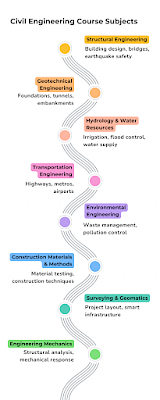
A Civil Engineering course is structured to reflect the complexity of the real world. Each subject tackles a unique aspect and teaches you to solve a problem our world cannot afford to ignore: from materials and land to water and machines.
Here are the key subjects taught during the course:
Top Electives that Build Specialized Skills
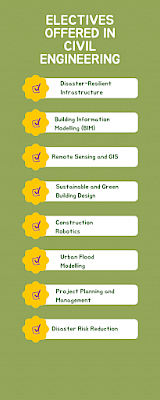
The civil engineering core subjects lay a strong foundation of knowledge related to this field. Apart from that, the Civil Engineering course includes some elective subjects. You can pick them based on your career choices and interests and get expertise in a dedicated domain.
How Civil Engineering Answers the World’s Toughest Questions
A Civil Engineering course teaches you much more than design codes and site drawings.
When floods destroy homes, roads collapse in earthquakes, and cities choke in traffic, a civil engineer raises their hand to accept the challenge and solve it for all.
This is where classroom knowledge meets real-world action.
In Odisha, cyclone shelters are not just brick buildings. They are designed to withstand extremely high-speed winds and bad weather. Civil engineers decide the elevation, shape, and materials, all built from course subjects like geotechnical engineering and structural dynamics.
In urban India, cities like Mumbai and Delhi fight extreme traffic. Here, metro systems were not built overnight. Engineers trained in transportation systems planning mapped capacity, peak hour loads, and route efficiencies.
Each disaster, each challenge, is a live test of concepts taught in civil engineering courses. In these moments, the Civil Engineering course subjects become the primary toolkit to handle the situation.
Choosing Civil Engineering Courses to Build a Legacy That Generations Will Depend On
You build something today, and people still use it a hundred years later.
That is the weight and value of civil engineering.
The Konkan Railway connects coastal Maharashtra to Karnataka and Goa. It runs through mountains, crosses rivers, and travels on viaducts that still stand tall. It was not just built for convenience; it was built to transform regional growth. Similar is the case with railway and highway construction in the North-East and the Himalayan regions.
Think of the Delhi Metro. A daily lifeline for millions. From planning tracks under heritage zones to building stations above flood lines, civil engineers made it possible.
This is what legacy means.
You can walk past a dam, a bridge, or a highway and say - I helped build that.
This course is not about jobs that disappear with software updates. It is about systems that people depend on. As the world faces climate change, rapid urbanization, and resource shortage, civil engineers are not optional; they are essential.
You are not choosing a desk job. You are choosing a career that changes the way people live. The Civil Engineering course teaches you how to design with care, build with logic, and plan with foresight.
If you care about what lasts, if you want your work to mean something, this is where you start.
Civil Engineering Course Details You Must Know Before Applying for the Program
If you are an engineering aspirant and want to pursue the B.Tech. Civil Engineering, then there is some key information you must know. Here are the necessary Civil Engineering course details for you:
B.Tech. Civil Engineering Eligibility
If you want to pursue B.Tech. CE, then you must have passed class 12th with at least 60-75% marks from a recognised board. PCM is the ideal subject combination preferred by top engineering universities in India.
While generally many universities accept students with 60-65% marks in class 12th, top institutes like NITs and IITs have the admission criteria of 75% marks in the board exam. For a clear picture, check the official website of the university to which you are willing to apply.
B.Tech. Civil Engineering Entrance Exams
JEE Main is a widely accepted entrance exam for the B.Tech. course, while the IITs accept the JEE Advanced score for admission. Apart from this, there are many state-level entrance exams too, like WBJEE and MH CET. Some universities also conduct their own entrance exams for admission to B.Tech. course.
B.Tech. Civil Engineering Course Fees
In India, the B.Tech. Civil Engineering course fees can go up to 4 lakhs per year, excluding hostel fees and other expenses. While this figure depends on your college. Generally, government colleges have lower program fees in comparison to private universities. Also, you can avail the scholarship offered by universities to the meritorious candidates if you fulfill the necessary criteria. So, before applying for the B.Tech. CE must check the exact program fee on the university website and also check if there is any scholarship available for you.
Design Infrastructure, Engineer Impact - Start your Journey in Civil Engineering at Shiv Nadar University (Institution of Eminence)
Not all engineering programs are built the same. Some teach formulas, others build foresight.
If the idea of civil engineering feels meaningful to you, not just as a job, but as a responsibility, then choosing the right university matters just as much as choosing the discipline.
At Shiv Nadar University, recognized as the Institution of Eminence, the B.Tech. Civil Engineering course is built to develop scientific rigor and professional expertise in the students. It is developed with an aim to produce future industry leaders who meet the real-world requirements, can lead in R&D, and have an entrepreneurial vision.
The program, offered under the School of Engineering, gives students the opportunity to get specialised in three domains:
- Sustainable Infrastructure Systems
- Water, Environment, and Climate
- Urban Network Systems
A global standard-aligned curriculum, labs equipped with modern instruments, research opportunities, a world-class infrastructure, and faculty from the world’s top institutes ensure that students do not just complete the syllabus but they master the skills that are needed to solve real-world problems that have a global impact. They built the expertise to solve today’s problems and shape a better future.
Conclusion
A Civil Engineering course is your path to becoming the person who builds the world everyone used to live in peacefully.
You learn through subjects that teach you how to shape the earth, handle water, manage cities, and protect communities. And, you apply those lessons when disasters hit, when systems fail, and when people need solutions, not speeches and promises.
You leave behind more than just numbers in a report. You leave bridges, water systems, hospitals, roads, and homes.
This course is not just for a career. It is for those who want their work to live on in the world.
Apply to the B.Tech. in Civil Engineering at Shiv Nadar University and start building the world, not just living in it.
FAQs
What is the Civil Engineering course fees in India?
The Civil Engineering course fees in India can go up to 4 lakhs per year. It can vary depending on the university in which you will pursue the course.
What is the career scope after completing a B.Tech. Civil Engineering course?
You can work in infrastructure development, public planning, construction, environmental management, transportation, or pursue research and academic roles after completing the Civil Engineering course. The field has strong demand in both the government and private sectors.
Is Civil Engineering only about construction?
No. It covers planning, design, environmental protection, transportation, and water management. You work with nature, society, and technology, all at once.