Guiding Restless Molecules into Meaningful Materials
Editorial / March 10, 2026
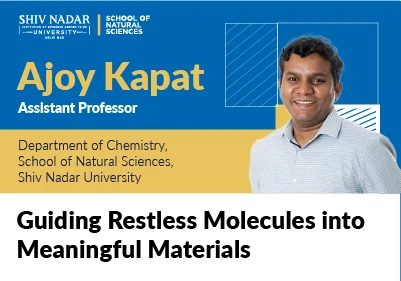
In the Radical Chemistry and Catalysis Laboratory at Shiv Nadar University, led by Dr Ajoy Kapat, chemistry is approached as a pathway to solving real-world problems rather than a collection of isolated reactions. The group’s work centres on radical chemistry, an area once viewed as difficult to control but now valued for enabling efficient reactions under mild reaction conditions. By carefully controlling these highly reactive processes, the laboratory develops molecules and materials that can contribute to healthcare, sustainable manufacturing, and emerging technologies. As Dr Kapat reflects, “Chemistry becomes meaningful when the molecules we create begin to answer real-world questions.”
Nature serves as an important source of inspiration for the laboratory’s research. Many medicines originate from natural molecules, yet reproducing their complexity in the laboratory can be challenging. The team therefore designs smaller, nature-inspired molecules while developing strategies that make their preparation simpler and more sustainable. These efforts are directed toward compounds with potential anticancer, antiviral, and antitubercular activity, developed in collaboration with biological researchers. The work represents a careful balance between creativity in synthesis and the need for accessible, environmentally responsible methods.
Another important focus of the laboratory is precision in molecular design. Medicines often require molecules in a specific three-dimensional arrangement to function properly, and achieving this level of control remains a significant scientific challenge. To address this, the group develops catalytic enantioselective methods that reliably guide reactions toward the desired structure. By working across different catalytic approaches, the laboratory aims to make chemical synthesis more predictable, atom-economic and efficient. In this context, Dr Kapat notes, “Selectivity is what allows chemistry to move from possibility to reliability.”
The laboratory also explores how adding fluorine atoms to molecules can influence their behaviour during late-stage functionalisation. Although fluorine-containing compounds are rare in nature, they play a crucial role in many pharmaceuticals, imaging tools, and advanced materials. The group investigates ways to introduce fluorine into molecules at later stages of synthesis, allowing scientists to fine-tune stability and performance without redesigning entire chemical structures. This work reflects the broader theme of the laboratory: making subtle molecular changes that can lead to meaningful improvements in function.
A recurring challenge across these projects is managing highly reactive intermediate species. These fleeting chemical states can open doors to new transformations but require careful control to be useful. By combining laboratory experiments with computational insights, the team works to understand and guide these reactions, creating a foundation that supports both fundamental discovery and practical application.
This connection between understanding and application is clearly evident in the laboratory’s recent patents on light-driven polymer formation. Using light to trigger the formation of solid materials offers a simple and energy-efficient alternative to traditional wet-lab techniques, mostly relying on various parameters (including temperature, solvent, etc.). One patent introduces a dental composite developed through this approach, designed to produce tooth-filling materials with improved colour stability, efficient curing, and the ability to fill deeper cavities. The material can be prepared without harsh conditions, making it relevant not only for dentistry but also for coatings and additive manufacturing.
A second patent focuses on the preparation of a key ingredient used in this light-driven process. The work describes an efficient and resource-conscious method for synthesising co-initiators using accessible and environmentally benign starting materials. By reducing concerns associated with certain conventional systems while maintaining performance, the process supports broader efforts toward sustainable material development. Reflecting on this progression, Dr Kapat observes, “Understanding the fundamental chemical principle is the key for both major scientific breakthrough and solving real world problems”.
Beyond dentistry, the principles behind this research extend to coatings, adhesives, electronics, and precision manufacturing, where controlled material formation under mild conditions is increasingly important. Light-activated processes can reduce energy consumption, simplify manufacturing steps, and offer greater control over material properties, making them attractive across diverse applications.
Research rarely advances in a straight line. Instead, it grows through curiosity, unexpected connections, and the gradual integration of ideas. In this laboratory, studies in drug-inspired molecules, catalytic methods, fluorine chemistry, and light-driven materials form a connected narrative rather than separate research themes. The recently secured patents represent milestones within this ongoing journey, illustrating how careful attention to molecular behaviour can lead to technologies that are both practical and sustainable.
As the work continues, the underlying philosophy remains consistent: thoughtful molecular design, guided by a clear understanding of chemical reactivity, can lead to materials and methods that quietly improve everyday technologies while responding to emerging societal needs.
Srijita Banerjee,
Academic Associate,
School of Natural Sciences,
Shiv Nadar University.
More Blogs

The Hawthornden Literary Retreat bestowed on Dr Sambudha Sen to complete the manuscript of a novel
Professor Sambudha Sen, Head of the Department of English at Shiv Nadar Institution of Eminence, Delhi-NCR, was awarded a residency at the...
The Power of the Moving Body
Movement is an innate bodily action that humans have been exhibiting for the longest time. Long before language was invented, the body was the...

How Does A Multi-Disciplinary Approach To Education Enhance Learning And Prepare Students For A Multi-Faceted World?
In today’s world, where businesses are changing almost every day, it is the responsibility of educational institutes to provide holistic...