From Waste to Wonder: Rethinking Materials for a Sustainable Future
Editorial / April 13, 2026
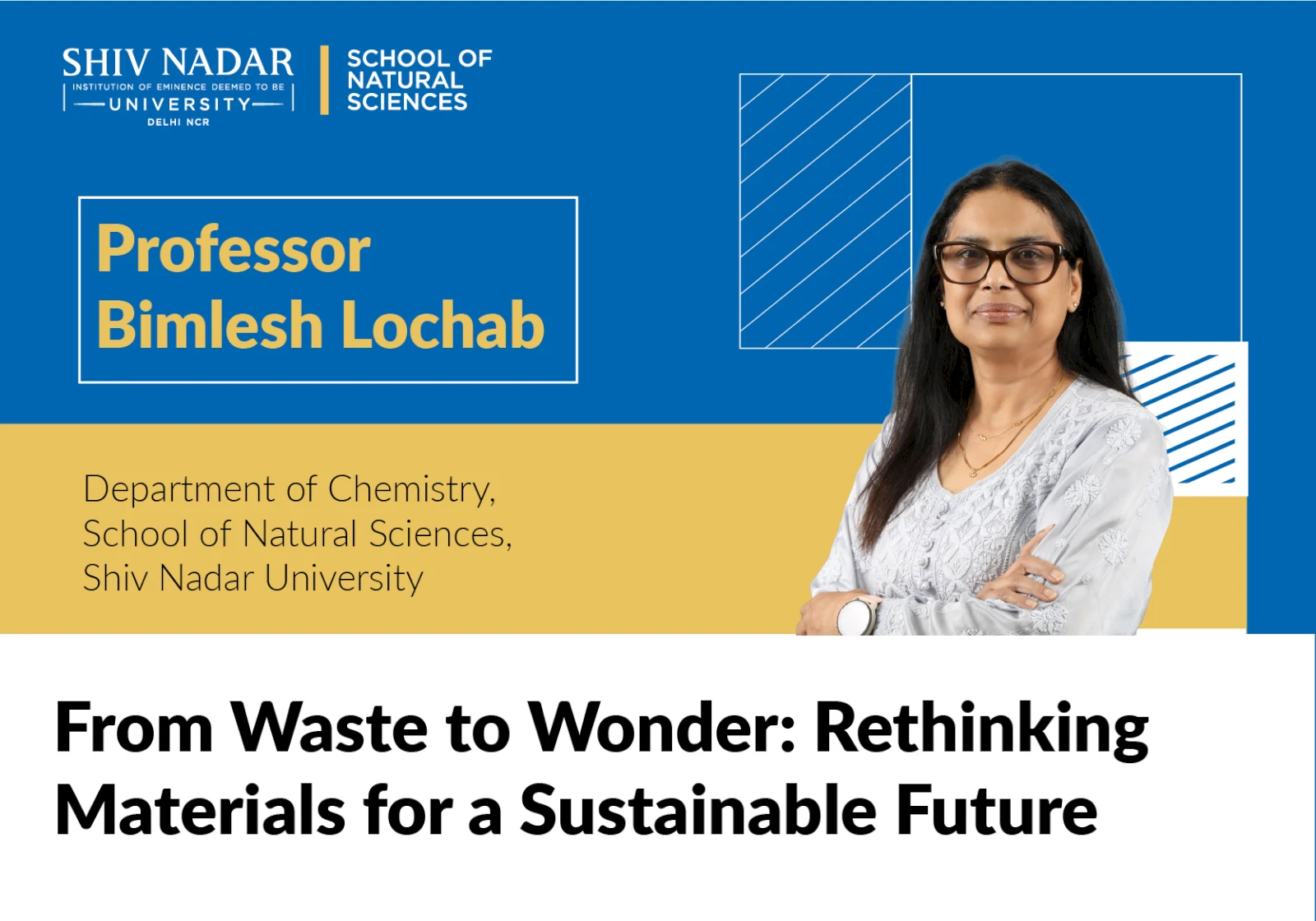
The next time you see something discarded—a nutshell, a piece of agricultural waste—it may be worth pausing for a moment. What looks like waste could, in the right hands, become a building block of the future. This simple but powerful idea guides the work led by Prof. Bimlesh Lochab, Professor in the Department of Chemistry at Shiv Nadar University, along with her team of researchers, who are quietly rethinking how materials are made, used, and reused.
Her work in sustainable materials has been recognised both nationally and internationally. Alongside her roles as Associate Editor of ACS Macromolecules, Vice President of the Society of Polymer Science India (SPSI), and Council Member of Chemical Research Society of India (CRSI), she remains actively engaged in the field. As a Fellow of the Royal Society of Chemistry, she values being part of a global community that fosters collaboration and supports women in chemistry.
“Our goal is not just to make better materials,” she says, “but to make materials that make sense—for industry, for people, and for the safer planet.”
At its core, her research focuses on turning agricultural and industrial byproducts into useful, high-performance materials.
Working at the intersection of chemistry and sustainability, her group focuses on bio- and waste-derived monomers and polymers sourced from agricultural residues. These materials are designed for a wide range of applications—from electro-optic systems and high-temperature adhesives to composites, energy storage, antibacterial coatings, and even improving the effectiveness of existing drugs and nucleic acids. This broad, application-driven vision has also led to three granted patents in the field of sustainability, marking an important step in taking laboratory ideas closer to real-world use: “Benzoxazine–Sulfur Copolymer, Method for Preparation Thereof”; “Biofeedstock-Derived Functional Groups Based Organic Semiconductors and Synthesis Thereof”; and “Process of Preparing Oxazine-Ring Substituted Benzoxazine.”
Modern industry relies heavily on polymers that are strong, stable, and reliable, but often at an environmental cost. Conventional materials, especially those derived from petroleum, can release harmful byproducts, require extreme conditions to degrade, and contribute to long-term ecological strain. The challenge is not just to replace them, but to do so without sacrificing performance.
One elegant solution comes from cardanol, a compound obtained from cashew nut shell liquid—an abundant agricultural waste. In this work, it serves as the foundation for polybenzoxazines, a class of advanced polymers known for their thermal stability and mechanical strength. When used in demanding applications such as brake pads, these materials show impressive resistance to heat, significantly reduced wear, and lower noise. They also avoid emitting harmful gases during processing and offer a longer shelf life, making them safer and more efficient from manufacturing to application.
“We often overlook what nature already gives us,” she notes. “The challenge is to use it wisely—and to design materials that do more with less.”
A key strength of this research lies in how carefully the materials are designed. Rather than relying on trial and error, the team looks closely at what is happening at the molecular level—how small changes in structure can lead to meaningful improvements. By modifying benzoxazine monomers, especially within the oxazine ring, they are able to control how these materials form, how stable they are at high temperatures, and how well they hold up over time. This kind of precision allows for more reliable and purpose-driven material design.
Just as important is what happens after these materials have been used. Traditional thermosets are difficult to recycle because of their rigid, cross-linked structures. Here, innovation comes in the form of dynamic chemical linkages. By introducing elements such as sulfur into the polymer network, the materials gain the ability to be reshaped, repaired, and reused. In some systems, external triggers such as light can enable controlled breakdown and reformation, allowing the materials to be recycled while largely retaining their strength.
“We are trying to move away from the idea of ‘end of life’ for materials,” she explains, “and toward materials that can adapt, recover, and continue to be useful.”
This approach also extends to other renewable sources. Furan-derived compounds, sourced from biomass, are used to create polymers with strong adhesive properties and excellent thermal performance. These materials often outperform conventional alternatives, benefiting from natural molecular interactions that quietly enhance their strength and stability.
Beyond polymers, the research also tackles pressing environmental challenges. One example is the development of a lightweight, porous aerogel that can remove toxic dyes from water while simultaneously killing harmful bacteria. Created using a combination of natural biopolymers and advanced nanomaterials, this sponge-like structure is both durable and reusable. Its low cost and scalability make it especially promising for decentralised water treatment, particularly in regions where access to clean water remains limited.
Taken together, this work points to a simple but important shift in thinking: materials do not have to be wasteful to be effective. Sustainability and performance can go hand in hand. With thoughtful design, waste can become a resource—and materials can be created not just to last, but to adapt and continue serving a purpose.
Srijita Banerjee,
Academic Associate,
School of Natural Sciences,
Shiv Nadar University.
More Blogs

The Hawthornden Literary Retreat bestowed on Dr Sambudha Sen to complete the manuscript of a novel
Professor Sambudha Sen, Head of the Department of English at Shiv Nadar Institution of Eminence, Delhi-NCR, was awarded a residency at the...
The Power of the Moving Body
Movement is an innate bodily action that humans have been exhibiting for the longest time. Long before language was invented, the body was the...

How Does A Multi-Disciplinary Approach To Education Enhance Learning And Prepare Students For A Multi-Faceted World?
In today’s world, where businesses are changing almost every day, it is the responsibility of educational institutes to provide holistic...