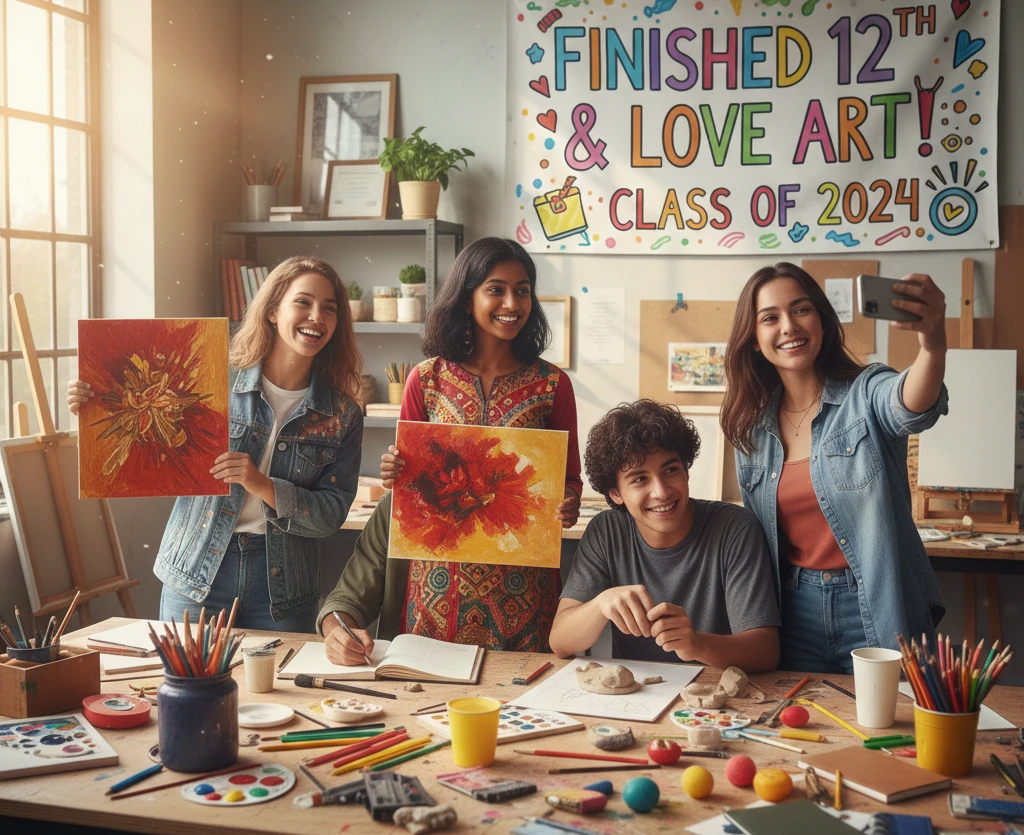
Finished 12th and Love Art? Here're Top Fine Arts Courses You Can Pursue
Blog / February 04, 2026
Ever wondered when you feel most alive? At the time when you are sketching, painting, or creating something from scratch? If you have just finished your 12th, it's normal to have a question in your mind- will a career in the arts make you successful or not?
No worry, you are not alone.
A lot of students reach this point after 12th and start asking the same question- what can I actually do with an arts background?
That’s where fine arts courses after 12th come in. They give you a clear direction as well as help you turn your creativity into a career in areas like painting, sculpture, or digital art.
This blog discovers the top fine arts courses that help you move forward with clarity and confidence.
Popular Fine Arts Courses After 12th
Here is a comprehensive fine arts courses list covering the most sought-after options at the UG level-
1. Undergraduate Degree Programs- 3-4 Years
These are comprehensive academic programs that provide a deep dive into both the history and practice of art.
|
Course Name |
Duration |
Primary Focus |
Ideal For |
|
Bachelor of Fine Arts |
3-4 Years |
Studio practice, Painting, Sculpture, Applied Arts |
Aspiring professional artists and visualizers. |
|
Bachelor of Visual Arts |
3-4 Years |
Modern visual media, Photography, Printmaking |
Students interested in contemporary art forms. |
|
BA in Art History |
3 Years |
Critical analysis, Research, Documentation |
Future curators, historians, and art critics. |
|
BFA in Digital Arts |
4 Years |
2D/3D Animation, Concept Art, Digital Painting |
Artists looking to enter the media & gaming industry. |
2. Diploma & Certificate Courses (6 Months - 2 Years)
If you are looking for a shorter, more skill-specific path to enter the workforce or refine a hobby, these are best alternatives.
- Diploma in Fine Arts
A 1 to 2 year program focusing on fundamental sketching, painting & composition techniques
- Diploma in Sculpture & Clay Modeling
Intensive training in 3D forms, anatomy & material studies
- Certificate in Photography
Short-term specialized training in lighting, framing, and digital processing
- Diploma in Applied Arts
Focuses on using artistic skills for commercial purposes, like illustration and visual branding
What Will You Study in Fine Arts Courses?
Most fine arts courses after 12th follow a "Foundation Year" structure where you explore all mediums before specializing.
Core Subjects in BFA Programs
- Drawing & Human Anatomy
Mastering proportion, light, and shadow
- Aesthetics & Art History
Understanding the evolution of art from prehistoric caves to modern-day NFTs
- Composition & Color Theory
Learning how to lead the viewer’s eye and evoke specific moods through color
- Printmaking & Etching
Traditional techniques of reproduction using woodblocks or metal plates
- Specialization (Years 2-4)-
- Painting- Mastering oils, tempera, and contemporary experimental media.
- Sculpture- Working with stone, metal casting, and environmental installations.
- Applied Arts- Creating visual identities, posters, and typography-led art.
Understanding Different Fine Arts Specializations
Once you've decided on pursuing fine arts courses after 12th, the next question is- which specialization? Here's what you need to know-
|
Specialization |
What You'll Learn |
Best For |
|
Painting |
Traditional and contemporary painting techniques, mediums, color theory |
Students passionate about creating original artwork and self-expression |
|
Sculpture |
3D form creation using clay, metal, wood, stone, mixed media |
Those interested in spatial art and working with physical materials |
|
Applied Arts |
Commercial art, advertising visuals, illustration, book design |
Students wanting to combine creativity with commercial applications |
|
Printmaking |
Etching, lithography, screen printing, relief printing techniques |
Those interested in reproducible art forms and experimental processes |
|
Visual Arts |
Photography, videography, digital media, installation art |
Students drawn to contemporary and technology-based art forms |
Career Scope and Salary- Can You Earn Well?
The "starving artist" is a dated stereotype. In 2026, fine arts graduates are integral to high-growth sectors including media, entertainment, and corporate branding.
Popular Job Profiles and Salaries
|
Job Profile |
Entry-Level Salary (Per Annum) |
Mid-Level Salary (Per Annum) |
|
Fine Artist / Painter |
₹2.5 - ₹5 Lakhs (Sales) |
₹8 - ₹15 Lakhs+ (Exhibitions) |
|
Illustrator / Storyboard Artist |
₹3.5 - ₹6 Lakhs |
₹8 - ₹12 Lakhs |
|
Art Director (Advertising) |
₹6 - ₹9 Lakhs |
₹15 - ₹25 Lakhs |
|
Museum Curator / Gallery Manager |
₹4 - ₹7 Lakhs |
₹10 - ₹18 Lakhs |
|
Sculptor / Installation Artist |
₹3 - ₹5.5 Lakhs |
₹7 - ₹12 Lakhs |
|
Concept Artist (Gaming/Film) |
₹5 - ₹8 Lakhs |
₹12 - ₹20 Lakhs |
Eligibility and Admission Process
The most important requirement is that you must have completed 10+2 from any recognized board. Here is what you need to know about getting into fine arts courses after 12th-
Basic Eligibility
- Completion of 10+2 from any stream (Science, Commerce, or Arts)
- Minimum aggregate usually between 45-50% (varies by institution)
- No age limit for most fine arts programs
- Portfolio of your artwork (10-20 pieces) for most BFA programs
Common Entrance Exams for Fine Arts
- BHU UET- Banaras Hindu University Undergraduate Entrance Test
- Jamia Millia Islamia entrance exam for fine arts
- DUET- Delhi University Entrance Test for arts courses
- State-specific entrance tests- it varies by university
- College-specific entrance exams and portfolio reviews
Most institutions conduct a 2 stage selection- a written/practical entrance test followed by a portfolio review and personal interview. Start preparing your portfolio in the 12th grade itself, document all your artwork with good photographs.
Study Fine Arts at Shiv Nadar University (Institution of Eminence) and Turn Creativity into a Career
Shiv Nadar University offers Master of Fine Arts program through the department of Art, Media, and Performance. The course is designed to prepare students for the evolving role of art and artistic practices in building modern society. The university emphasizes hands-on aesthetic exploration with rigorous academic study.
Why do students prefer Shiv Nadar University for Fine Arts?
- Opportunity to learn from committed artists and scholars
- Flexible Structure to explore your interests
- Collab with other departments to enrich your learning experience
- Facilities like sculpture studio, 3D fabrication, display space for degree shows, etc
- Visual Art Fellowship opportunity for artists to continue working on their work
If you are ready to build a long-term and successful career in the arts, Shiv Nadar University is the right choice for your career growth. Apply now!
Conclusion
Whether you are attracted towards classical appeal of painting and sculpture, or contemporary edge of visual arts, you have clear pathways after completing your 12th standard. Fine art courses are designed to offer structured ways into diverse industries for building a successful career. But it can only happen when you understand your strengths, discover different specializations, as well as find a program that aligns with your interests and goals. With the right course, you are able to turn your creativity into a financially stable and fulfilling profession.
FAQs
Which fine arts course is best after 12th?
The most popular choice after 12th standard is Bachelor of Fine Arts. It is designed to offer in-depth training in diverse areas like painting, sculpture, as well as applied arts. Apart from that, you can prefer BFA in Digital Arts or Bachelor of Visual Arts courses.
Do I need to be from the arts stream to pursue fine arts courses?
No you dont need to. Fine arts courses accept students from any stream. You just need to complete your 10+2 from a recognized board, or in many cases, submit your portfolio or pass an entrance test.
Can I earn well after completing a fine arts course?
Yes, fine arts graduates work in fields like advertising, gaming, film, illustration, as well as digital media. With experience and a strong portfolio, roles such as art director, illustrator, or concept artist can offer competitive salaries.