Beyond the Gene: Reading the Hidden Language of Plant DNA
Editorial / September 02, 2026
When plants encounter drought, excess salt, or other environmental stresses, they cannot move away from the problem. Their survival depends on changing how they use the genetic information already present in their cells.
One way of improving crops is to identify genes associated with desirable traits and alter them, often using gene-editing technologies such as CRISPR-Cas9. But genes rarely work in isolation. Changing one can affect several biological processes at once. A different approach is to understand how plants regulate their genes: which genes are switched on, which are silenced, and how those decisions change in response to the environment.
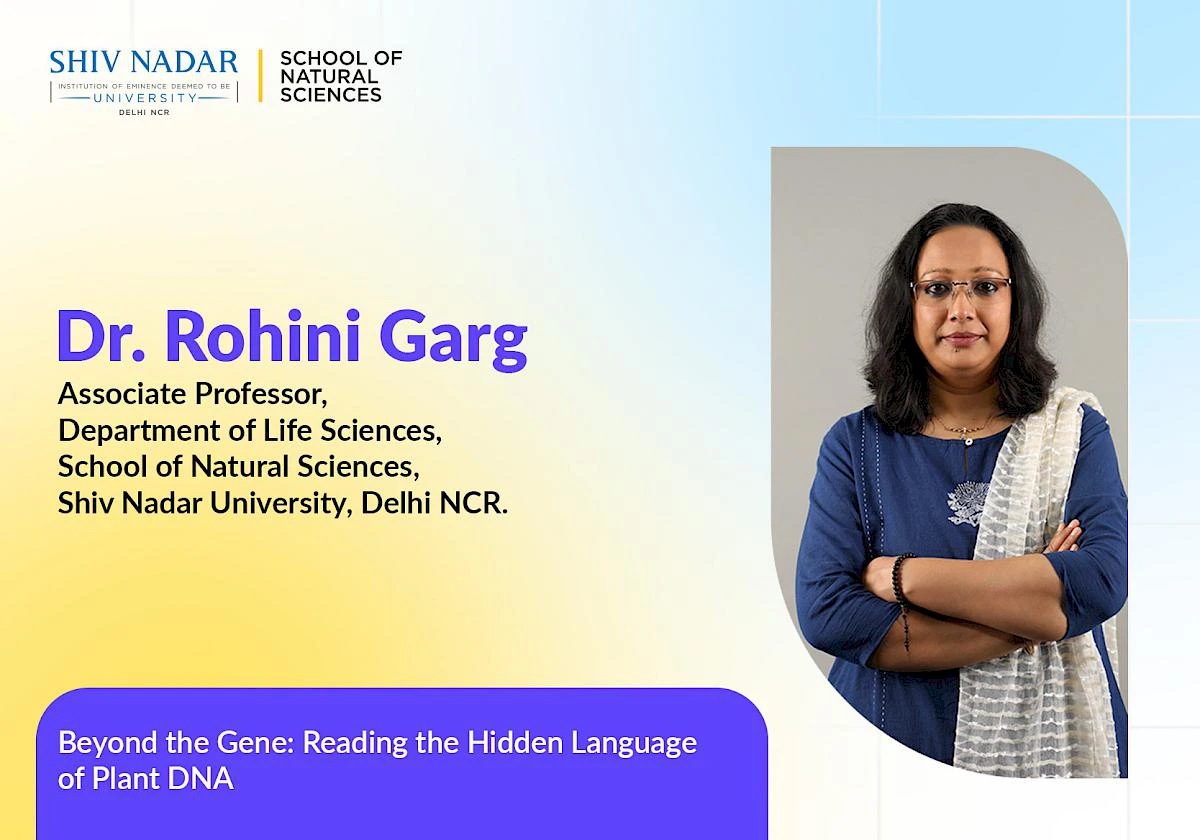
Understanding these regulatory processes is central to the research of Dr. Rohini Garg, Associate Professor in the Department of Life Sciences. Her work examines layers of regulation beyond the DNA sequence, including epigenetic changes and the physical structures formed by DNA.
Dr. Garg has worked extensively on the genomics and transcriptomics of chickpea, a crop of considerable importance in India and elsewhere. Her work in plant genomics and epigenomics has been recognized through several national awards and fellowships, including the INSA Young Associate Fellow, SERB Women Excellence Award, and the INSA Medal for Young Scientists. She has also been featured in Vigyan Vidushi: 75 Women Trailblazers of Science, among other recognitions. Her studies collectively explore a broader question: how do plants alter the way they use their genetic information when conditions become unfavorable?
When Dr. Garg began working on chickpea genomics, the genetic resources available for legumes were less developed than those for several major cereal crops. Using pyrosequencing, her team identified more than 34,000 genes expressed in chickpea, along with thousands of genetic markers. They later contributed to efforts to map the chickpea genome, providing a foundation for studying how the crop responds to its environment.
Dr. Garg's research subsequently moved into epigenomics—the study of molecular changes that influence gene activity without altering the underlying DNA sequence. One important mechanism is DNA methylation, in which methyl groups attach to DNA and can influence whether particular genes or genomic regions are active.
By comparing chickpea varieties with different levels of tolerance to drought and salinity, Dr. Garg and her colleagues found that plants can modify their epigenetic landscape in genotype-specific ways. Different stresses can therefore trigger distinct patterns of gene regulation. Under salt stress, these changes can affect genes involved in processes such as ion transport and root development, while drought influences another set of biological responses, including programmed cell death.
Dr. Garg's research goes a layer deeper by examining the physical structure of DNA itself. Certain sequences rich in the nucleotide guanine can fold into four-stranded structures known as G-quadruplexes, or G4s. Her team has investigated these structures across plant genomes and found them associated with genes involved in important biological processes, including growth and development. Their work has provided evidence that G-quadruplexes can influence gene regulation.
Before a gene can be expressed, cellular machinery must access and read its DNA sequence. A particular DNA structure can affect how easily that machinery moves along the molecule, providing plants with another level of control over gene activity—one based not only on the DNA sequence, but also on its physical structure.
This raises another question: how does the cell reverse such structures when a gene needs to be expressed? Dr. Garg's research has examined Pif1-like helicases, enzymes that can recognize and unwind unusual DNA structures such as G-quadruplexes. Studies in plants lacking particular helicases have shown altered growth and stress responses, suggesting that regulating these structures is important for normal development and adaptation.
This work reflects a broader shift in how scientists think about genetic engineering. The DNA sequence provides the instructions, but the sequence alone does not determine how those instructions are used. Gene activity is regulated through a network involving transcription factors, epigenetic modifications, chromatin structure, and the physical organization of DNA.
One possible application is epigenome editing. Modified CRISPR systems such as dCas9, often called “dead CRISPR,” can locate specific DNA sequences without cutting them. When linked to proteins that modify DNA or chromatin, they can potentially alter gene activity without changing the underlying genetic sequence.
For Dr. Garg, understanding these natural regulatory mechanisms is an important step toward developing more precise ways to modify plant responses to environmental stress. Her research has progressed from establishing genomic resources for chickpea, to studying how environmental stress changes gene regulation, and then to examining how DNA structure contributes to that regulation.
Understanding these layers of control could eventually help crop scientists move beyond asking which genes a plant possesses to asking when those genes are used, how strongly they are expressed, and what molecular mechanisms determine those decisions. This shift—from studying genes in isolation to understanding the regulatory systems around them—is central to Dr. Garg's work and to efforts to understand how plants adapt to an increasingly variable environment.
Srijita Banerjee,
Academic Associate,
School of Natural Sciences,
Shiv Nadar University.
More Blogs

The Hawthornden Literary Retreat bestowed on Dr Sambudha Sen to complete the manuscript of a novel
Professor Sambudha Sen, Head of the Department of English at Shiv Nadar Institution of Eminence, Delhi-NCR, was awarded a residency at the...
The Power of the Moving Body
Movement is an innate bodily action that humans have been exhibiting for the longest time. Long before language was invented, the body was the...

How Does A Multi-Disciplinary Approach To Education Enhance Learning And Prepare Students For A Multi-Faceted World?
In today’s world, where businesses are changing almost every day, it is the responsibility of educational institutes to provide holistic...