Barbers, Belief and the Battle for Dignity
Editorial / March 23, 2026
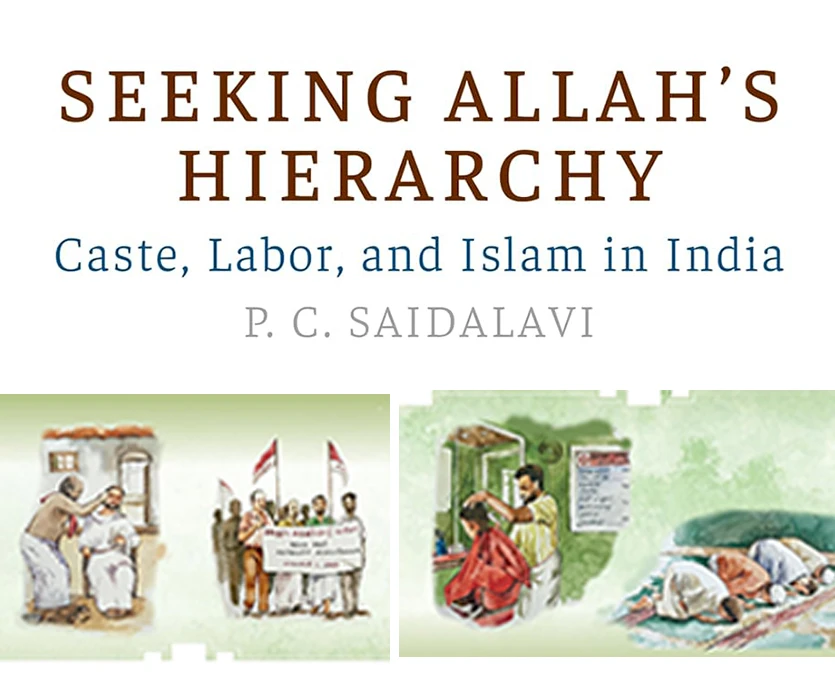
In an intellectual climate where discussions on Indian Muslims are often flattened into binaries, Dr. P. C. Saidalavi’s book, ‘Seeking Allah’s Hierarchy: Caste, Labor and Islam in India,’ published by University of Pennsylvania Press, offers an unsettling proposition: that inequality is not merely imposed from outside but is also negotiated, justified and resisted within Muslim social life itself. The book is a deeply political intervention that challenges both liberal romanticism about egalitarian ethos and the ideological insistence that caste is exclusively a Hindu phenomenon.
“At the heart of the book lies Abu, a 70-year-old Muslim barber from Malappuram in northern Kerala, whose life becomes a prism through which larger structures of power are refracted. What begins as an ethnographic encounter gradually unfolds into a layered critique of labour, dignity and hierarchy,” says Dr. Saidalavi, Assistant Professor, Department of Sociology, School of Humanities and Social Sciences.
In the book, the barber is not just a service provider; he is a political subject, caught in a chasm between religious obligation, economic dependency and a consciousness of rights.
The setting of the mahallu (a mosque-centred settlement) functions as more than just a backdrop. It is a governing institution, structuring not only ritual life but also access to resources, authority and belonging. Membership in the mahallu comes with rights: participation in religious activities, a say in mosque management and even burial in its graveyard. Yet, as Dr. Saidalavi carefully demonstrates, these rights are unevenly distributed. Beneath the appearance of communal cohesion lies a stratified order shaped by lineage, land ownership and proximity to authority.
The author identifies three broad social groupings within these settlements: the Mappilas, who constitute the majority, and the Sayyids, who claim descent from the Prophet and often occupy positions of symbolic and material privilege. The political insight here is sharp: hierarchy is not simply economic but also genealogical and moral. Authority is reproduced not just through land but through claims to sacred ancestry, creating a structure that is difficult to contest without appearing to challenge religion itself.
It is within this framework that the barber’s role becomes particularly revealing. Historically attached to the mahallu, barber families were expected to provide grooming for ritual functions like circumcision and midwifery. Payment was irregular, frequently in kind, and deeply tied to agrarian cycles. More importantly, the relationship was governed by obligation rather than contract. Barbers in this context were not seen as independent workers so much as dependents, tied into a moral economy that cast their labour as a form of religious duty rather than paid work. One of the book’s most striking insights is that exploitation does not always rely on force alone; it can also be sustained through stories and beliefs that make inequality seem natural, even just.
Barbers often continued to work despite uncertain or inadequate pay, drawing on Islamic ideas of service and community to make sense of their role. Refusing to serve was never just an economic choice—it risked social boycott and, in some cases, even violence. The mahallu, then, appears as a space that binds people together while also keeping a close watch on them, where expectations are upheld through a mix of shared faith and quiet coercion.
A shift begins to take shape in the late 1960s and 1970s, when barbers across Kerala started to organise collectively. The formation of the Kerala State Barbers Association marked a decisive break from the past. For the first time, barbers began to claim authority over their own labour—opening their own shops, setting prices, and pushing back against the long-standing expectation that their work could be taken for granted, unpaid, or underpaid.
Yet, as Dr. Saidalavi carefully notes, this was not a simple transition from tradition to modernity. Muslim barbers faced a unique challenge: reconciling their demand for wages with a religious framework that had long cast their work as service. Their response was both pragmatic and radical. They reframed labour itself as dignified, insisting that economic justice was not opposed to Islam but was, in fact, integral to it. In doing so, they drew upon the Quranic ideal of equality before God, using it as a counterpoint to the very hierarchies that structured their lives.
Importantly, the book challenges dominant academic frameworks that view caste among Muslims as merely derivative of Hindu practices. While acknowledging historical interactions, it insists that Muslim hierarchies must be understood on their own terms, as a concept rooted in Islamic jurisprudence, local histories and regional economies. This is a significant intervention, particularly in a field that has often been reluctant to confront internal inequalities within minority communities for fear of reinforcing majoritarian narratives.
And yet, this reluctance is precisely what the book pushes against. By foregrounding the lived experiences of marginalised Muslim workers, it expands the scope of political critique. It suggests that genuine solidarity cannot be built on denial or exceptionalism but must engage with uncomfortable truths about power within communities.
Dr. Saidalavi’s book ‘Seeking Allah’s Hierarchy: Caste, Labor and Islam in India’ is not just a study of barbers in Kerala. It is a meditation on the politics of equality itself, it on how ideals are translated into practice.
In an era where identity is mobilised as a shield against critique, this book insists on a more demanding form of engagement: one that takes both faith and justice seriously, and refuses to separate the two.
More Blogs

The Hawthornden Literary Retreat bestowed on Dr Sambudha Sen to complete the manuscript of a novel
Professor Sambudha Sen, Head of the Department of English at Shiv Nadar Institution of Eminence, Delhi-NCR, was awarded a residency at the...
The Power of the Moving Body
Movement is an innate bodily action that humans have been exhibiting for the longest time. Long before language was invented, the body was the...

How Does A Multi-Disciplinary Approach To Education Enhance Learning And Prepare Students For A Multi-Faceted World?
In today’s world, where businesses are changing almost every day, it is the responsibility of educational institutes to provide holistic...