B.Tech. CSE vs IT vs AI: Which Engineering Branch Has Better Scope?
Blog / January 19, 2026
At the core of modern engineering education lie three closely connected disciplines: Computer Science, Information Technology, and Artificial Intelligence. Although they share programming fundamentals, their academic focus, technical depth and specialization options set them apart.
This blog provides a structured comparison of B.Tech. CSE vs IT vs AI, highlighting curriculum differences, career outcomes, and industry relevance so that you can choose what’s best for your future.
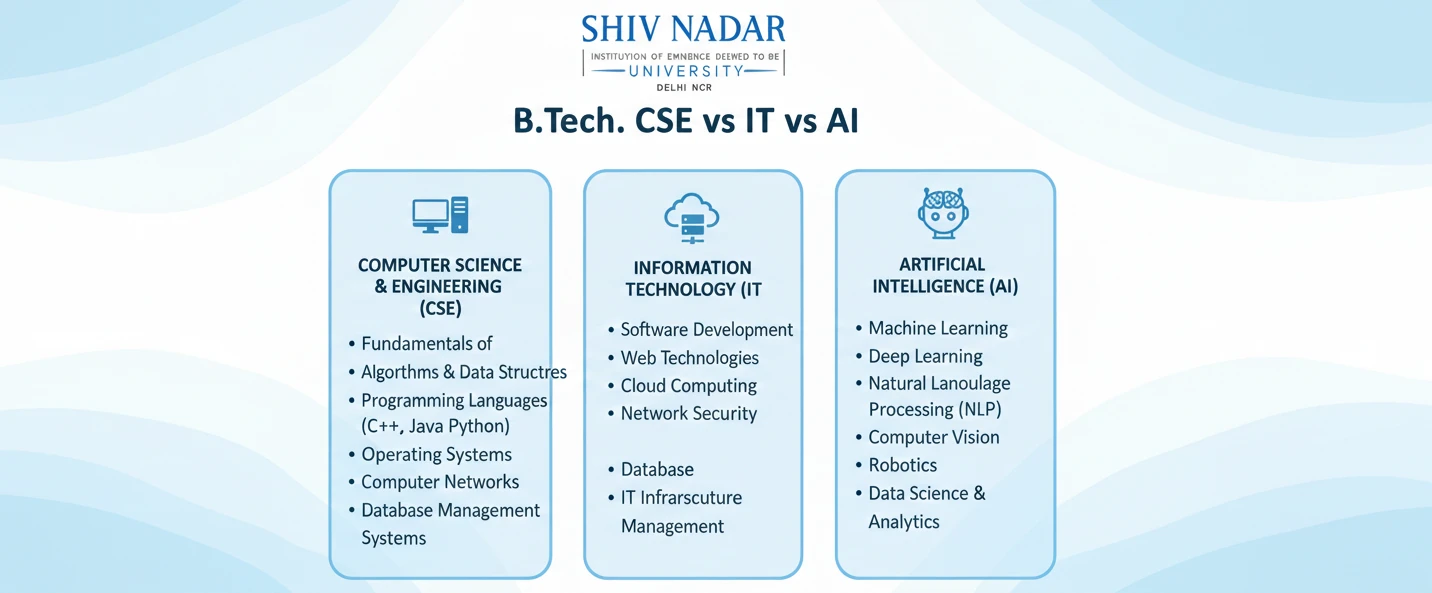
B.Tech. CSE vs IT vs AI: Quick Comparison
While these branches share foundational programming courses, their advanced curriculum and career trajectories differ significantly. Here’s a quick overview of what these programs offer-
|
Parameter |
B.Tech. CSE |
B.Tech. IT |
B.Tech. AI |
|
Full Form |
Computer Science & Engineering |
Information Technology |
Artificial Intelligence & Machine Learning |
|
Curriculum Focus |
Algorithms, data structures, OS, system architecture, software development |
Network systems, database management, web technologies, IT infrastructure |
Machine learning, deep learning, NLP, computer vision, robotics |
|
Skill Development |
Full-stack development, system design, multiple domains |
IT consulting, network administration, cloud technologies |
AI model building, data analytics, predictive modeling |
|
Specialization Options |
AI/ML, Cybersecurity, Data Science, Cloud Computing |
Cloud infrastructure, Network security, Business analytics |
Deep learning, Computer vision, NLP, Robotics |
|
Industry Applications |
Software companies, tech giants, startups, all sectors |
IT services, consulting firms, enterprise solutions |
AI research labs, data-driven companies, automation firms |
|
Job Market |
Broadest opportunities across industries |
Strong demand in corporate IT departments |
Highest growth potential but narrower initial scope |
Let’s understand by taking an example of B.Tech. CSE syllabus and subjects for what you will study.
B.Tech. CSE Subjects and Syllabus
Modern B.Tech. CSE syllabus programs balance theoretical foundations with emerging technologies, typically spanning across eight semesters. The curriculum builds progressively from fundamental concepts to advanced specializations, ensuring graduates possess both core competencies and cutting-edge skills.
Here’s a brief overview of the B.Tech. CSE subjects you will study in this program-
|
Year |
Core B.Tech. CSE Subjects |
Focus Area |
|
First Year |
Mathematics (Calculus, Linear Algebra, Discrete Math), Physics, Chemistry, Programming Fundamentals (C/C++/Python), Basic Electronics |
Foundation building in mathematics, sciences, and basic programming |
|
Second Year |
Data Structures & Algorithms, Database Management Systems, Computer Organization & Architecture, Digital Logic, Object-Oriented Programming |
Core computer science concepts and system-level understanding |
|
Third Year |
Operating Systems, Computer Networks, Software Engineering, Theory of Computation, Compiler Design, Web Technologies |
Advanced systems, networking, and software development methodologies |
|
Fourth Year |
Artificial Intelligence, Machine Learning, Cybersecurity, Cloud Computing, IoT, Blockchain + Major Electives + Capstone Project |
Specialization tracks, emerging technologies, and industry-ready projects |
Career Opportunities After Each Branch
Each branch opens distinct career pathways, though significant overlap exists in the current technology landscape. Let’s have a look at the job roles that each branch leads to-
|
Branch |
Primary Job Roles |
Role Description |
|
B.Tech. CSE |
Software Developer |
Build applications, systems, and platforms across web, mobile, and desktop environments |
|
AI/ML Engineer |
Develop machine learning models and AI-powered solutions for various applications |
|
|
Full Stack Developer |
Handle both frontend and backend development for complete application solutions |
|
|
System Architect |
Design scalable, efficient system architectures for enterprise-level applications |
|
|
Data Scientist |
Analyze complex datasets to derive business insights and build predictive models |
|
|
B.Tech. IT |
IT Consultant |
Advise organizations on technology adoption, digital transformation, and system integration |
|
Network Administrator |
Manage, maintain, and secure organizational network infrastructure and systems |
|
|
Database Administrator |
Design, implement, and maintain database systems, ensuring data integrity and security |
|
|
Cloud Engineer |
Deploy and manage cloud infrastructure on platforms like AWS, Azure, and Google Cloud |
|
|
Business Analyst |
Bridge technology and business requirements, translating needs into technical solutions |
|
|
B.Tech. AI |
Machine Learning Engineer |
Build and deploy ML models for real-world applications in various industries |
|
Data Scientist (AI Focus) |
Develop advanced analytics and AI solutions from complex, unstructured data |
|
|
Computer Vision Engineer |
Create systems for image recognition, object detection, and visual analysis |
|
|
NLP Specialist |
Develop language processing systems for chatbots, translation, and text analysis |
|
|
AI Researcher |
Conduct cutting-edge research in artificial intelligence and publish findings |
Salary Comparison: CSE vs IT vs AI
Compensation varies based on skills, company, location, and specialization. However, general trends show AI roles commanding premiums due to high demand and specialized expertise. The data below shows the rough estimate of what you can expect from each B.Tech. branch-
|
Branch |
Entry-Level (0-2 years) |
Mid-Career (5-8 years) |
|
B.Tech. CSE |
₹6-15 lakhs/year |
₹15-30 lakhs/year |
|
B.Tech. IT |
₹5-12 lakhs/year |
₹12-25 lakhs/year |
|
B.Tech. AI |
₹7-18 lakhs/year |
₹18-40 lakhs/year |
Which Branch Should You Choose?
Your choice should align with career aspirations, learning preferences, and long-term goals rather than following trends. Here’s what you need to know before choosing any of the branches-
Choose B.Tech. CSE if:
- You want flexible career options across tech fields.
- You enjoy both theory and practical application.
Choose B.Tech. IT if:
- You focus on the business side of technology.
- You’re interested in IT consulting and infrastructure management.
Choose B.Tech. AI if:
- You are passionate about AI and machine learning.
- You enjoy working with algorithms and cutting-edge technologies.
For versatility, B.Tech. CSE with AI/ML specialization is ideal.
Future Scope and Emerging Trends
The convergence of CSE, IT, and AI is accelerating as technology evolves. Future professionals will need foundational computer science knowledge, practical IT implementation skills, and AI/ML capabilities. Industry 5.0 emphasizes human-machine collaboration, making comprehensive CSE education increasingly valuable. Emerging areas like quantum computing, edge AI, blockchain, and cybersecurity require the broad skillset that CSE programs provide.
While AI specialization offers depth, the technology landscape rewards professionals who combine strong fundamentals with adaptability across evolving domains. The most successful graduates will be those who build versatile skill sets while developing expertise in high-demand specializations.
Advanced Learning in Computer Science & Engineering at Shiv Nadar University (Institution of Eminence)
Shiv Nadar University provides a well-respected B.Tech. in Computer Science and Engineering (CSE) through its School of Engineering. The university focuses on a research-oriented and multidisciplinary approach that integrates core engineering principles with liberal arts. This program stands out because of the following factors:
- Specialization Tracks: Artificial Intelligence and Machine Learning, Data Science and Big Data Analytics, Cyber Security and Privacy
- Research Emphasis: Undergraduate research strongly encouraged with faculty guidance across AI, machine learning, cybersecurity, and emerging technologies
- Expert Faculty: Highly selective faculty hiring ensures students learn from accomplished computer scientists actively conducting research
- Minor Options: Students from other disciplines can pursue CSE minor, particularly beneficial for engineering students from mechanical, civil, and chemical branches
- Industry Readiness: Strong focus on practical applications, industry projects, and placement preparation
Conclusion
The choice between B.Tech. CSE, IT, and AI ultimately depend on your career vision and learning preferences. B.Tech. CSE stands out as the most versatile option, offering comprehensive foundational knowledge that opens diverse pathways across software development, AI, cybersecurity, and system design.
For students seeking maximum flexibility and broad career options, B.Tech. CSE remains the optimal choice. Those certain about AI specialization might consider dedicated AI programs, while students interested in business-technology alignment may find IT more suitable. The B.Tech. CSE syllabus balances theoretical depth with practical application, preparing graduates for both immediate employment and long-term career growth.
Success ultimately depends on skills developed, projects completed, and continuous learning embraced throughout your engineering journey.
FAQs
Which is better, BE or B.Tech. CSE?
BE and B.Tech. CSE are essentially equivalent degrees with similar curriculum and career prospects. B.Tech. emphasizes practical application and laboratory work, while BE focuses slightly more on theoretical knowledge. Employers treat both degrees equally, and placement opportunities remain identical for both qualifications.
Is CSE good for AI jobs?
Yes, B.Tech. CSE is excellent for AI jobs. The curriculum includes AI and machine learning subjects, and CSE graduates possess the strong programming and mathematical foundation required for AI roles. Many AI professionals hold CSE degrees with AI/ML specializations, making CSE an ideal pathway.
Is B.Tech. CSE in demand?
Yes, both B.Tech. CSE programs are trending and in demand because advancements in IT companies have increased demand for tech professionals in information technology, artificial intelligence, and data-driven roles.
Which branch of CSE is best?
There’s no definitive "best CSE branch"; it depends on your interests. Currently, AI/ML, Data Science, and Cloud Computing are in high demand and offer high salaries, while Cybersecurity and Full Stack Development offer strong career paths. Core CSE remains a solid foundation for tech skills.