B.Sc. vs B.A. After Class 12th: Which Option Is Right for You?

Blog / September 15, 2026
Recently completed Class 12th and still confused about whether to opt for a B.Sc. or B.A. course? Let’s make the decision easier. According to the latest “All India Survey on Higher Education (AISHE)” report, B.A., including B.A. (Hons.), accounted for 38.6% of all undergraduate enrolments in India, with around 1.3 crore students enrolled. B.Sc. followed with 15.7%, representing around 53.4 lakh students.
But popularity isn't the same as the right fit for you.
The B.Sc. education helps you learn about numbers and facts, while a B.A. prepares you to think in terms of ideas and concepts. The blog will take you through everything you learn from each of the degrees, possible career opportunities, and skills that you acquire from both. Discover and identify which one suits your style of thinking, along with your aspirations for the next 5 years.
Choosing a B.A. (Bachelor of Arts) Degree?
A Bachelor of Arts (B.A.) is an undergraduate program that concentrates on arts & social sciences, where you learn how to think critically. Just reflect on the subjects that have been most interesting to you. Whether it is a discussion of history, analyzing poetry, or arguing about current events, the B.A. might be something very familiar to you.
Typical B.A. disciplines include-
- English and Literature
- History
- Political Science &International Relations
- Sociology
- Psychology
- Interdisciplinary Humanities & Social Sciences
How About a B.Sc. (Bachelor of Science) Course?
A Bachelor of Science (B.Sc.), on the other hand, involves studying scientific subjects that require numerical analysis. In simple terms, this degree will be more suitable for you if your passion does not lie in analyzing a text but rather in trying to find solutions to complicated equations or conducting an experiment to see what occurs.
Typical B.Sc. disciplines include-
- Biotechnology
- Chemistry
- Physics
- Mathematics
- Economics & Economics with Finance
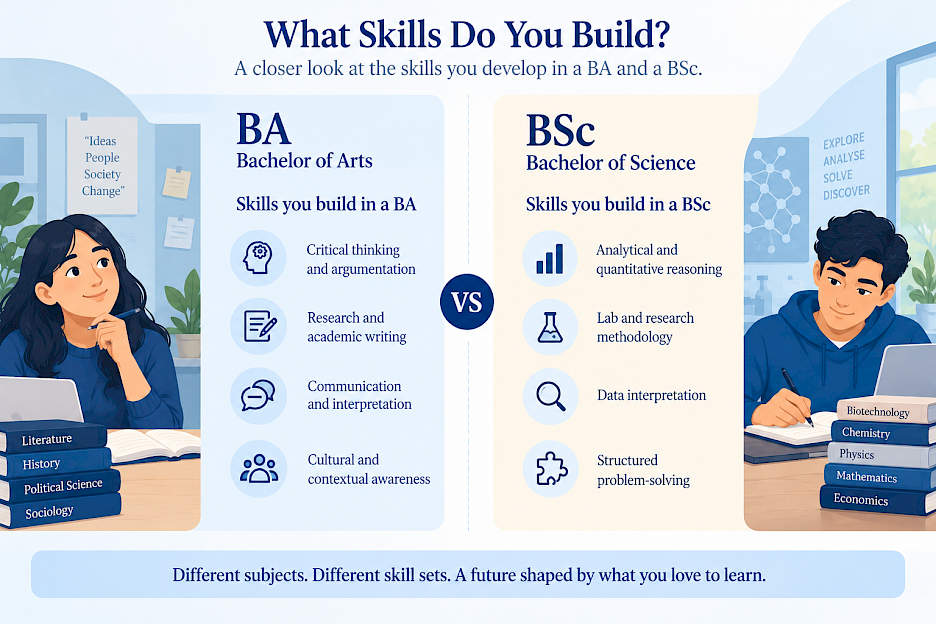
Beyond the subject matter, the degrees build distinct sets of skills too:
B.Sc. vs B.A.: Key Differences
After going through the content of the degrees, it becomes clear when they are compared one against the other. The following is a comparison of the two degrees according to the factors that will affect your studies and your future career.
Parameter | B.A. | B.Sc. |
Core Focus |
|
|
Learning Style | Reading, discussions, & essay-based analysis | Lab work, data, & structured problem-solving |
Typical Duration | 3 to 4 years | 3 to 4 years |
Flexibility | Broad electives across humanities subjects | Structured, subject-specific electives |
Career Direction | Writing, policy, media, management, civil services | Research, data, core science, technical roles |
Higher Study Options | MA, MB.A., law, civil services preparation | MSc, integrated PhD, specialized research programs |
The “Career Direction” and “Higher Study Options” rows above set up the next two sections, where we break down exactly what those paths look like in practice.
What Career Paths Open Up After a B.A.?
With a B.A., you get to have wide options that are designed into the program. Rather than confining you to a particular sector, the course prepares you for jobs that entail communication, planning, and dealing with people. It is because of this that it is the most popular undergraduate course in India.
- Content and communications roles: writing, journalism, publishing
- Public policy and civil services
- Human resources and management
- Education and academia
What Career Paths Open Up After a B.Sc.?
On the other hand, a B.Sc. degree will ensure you remain technical in your journey, and these skills are becoming more applicable in many fields. The World Economic Forum’s Future of Jobs Report reveals some job roles which have been ranked as the fastest growing worldwide until 2030; these include Big Data Specialists, AI and Machine Learning Specialists, and Software and Applications Developers. In India, the report highlights that the fast-growing jobs in the country will be in the field of technology.
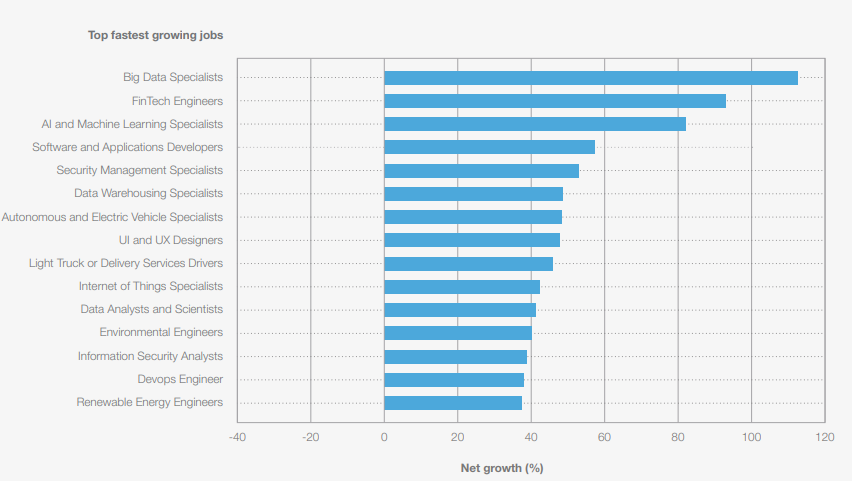
Image Source:World Economic Forum, Future of Jobs Survey
This makes skills in data analysis, quantitative reasoning, programming, and scientific problem-solving useful for graduates exploring technical and data-driven career paths.
- Research and lab-based roles
- Data analysis and data science
- Core science roles in chemistry, physics, and biotechnology
- Economics, finance, and analytics roles
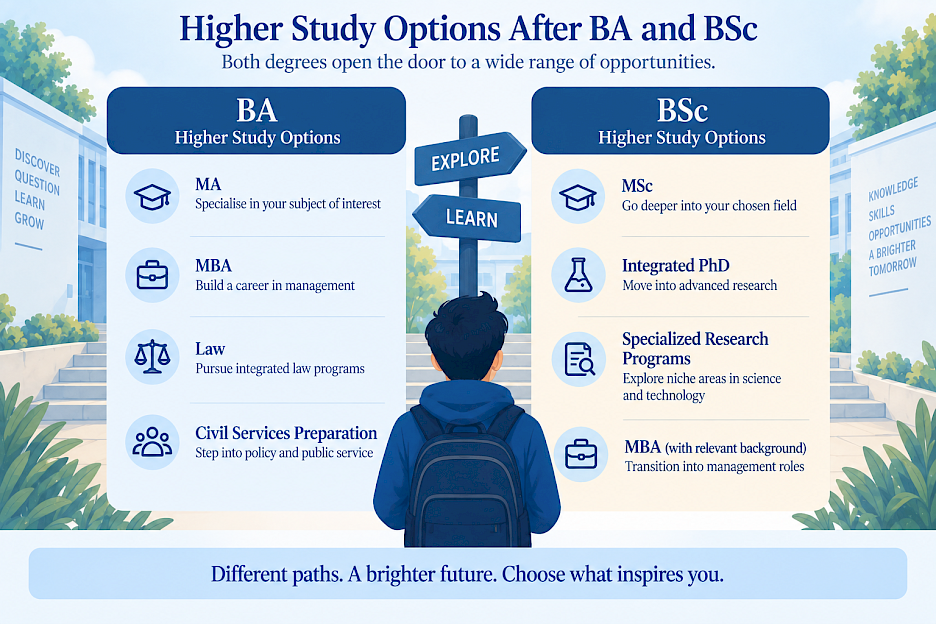
For further specialization, the table above outlines the higher study routes available to you.
B.Sc. or B.A., Which Is Better?
Choosing the better option between B.Sc. and B.A. depends on one's preferences and the way of thinking. The choice of the major should depend on the way people are used to think, learn new things, and solve problems.
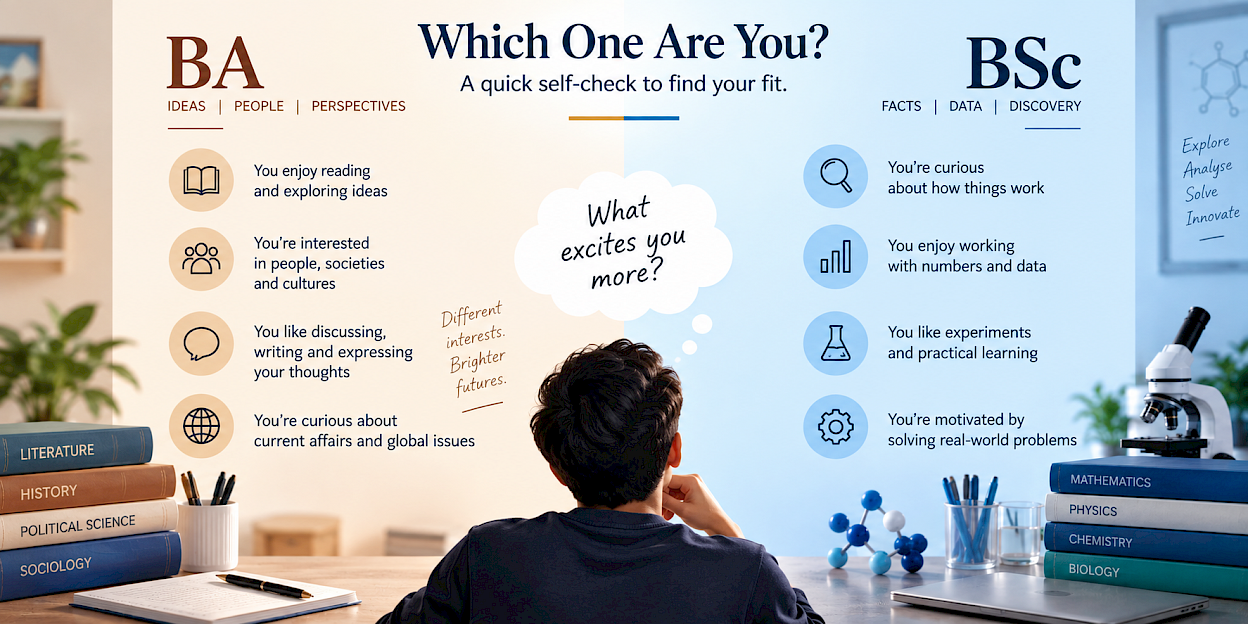
A few questions can help you decide faster-
- Do you enjoy solving numerical problems, or breaking down an argument in a text?
- Are you more comfortable in a lab, or in a discussion-based classroom?
- In which subjects did you consistently score well & also enjoy while studying?
Explore Different Types of B.A. & B.Sc. Programs at Shiv Nadar University (Institution of Eminence)
After choosing your direction, it is now time to choose the right university where you can do so in the right way. At Shiv Nadar University, you can enroll in a BA or BSc program in a variety of subjects like humanities, social sciences, and pure sciences through research-driven undergraduate studies.
- Research-Embedded Curriculum: Every major course carries a Research tag, with independent components like term papers, presentations, and a Supervised Research Paper in the final year.
- Interdisciplinary and Joint Programs: The B.Sc. (Research) in Economics and Finance is jointly offered across the “Department of Economics” and the “Department of Finance, Accounting and Control”, letting students combine two disciplines in one degree.
- Undergraduate Minors Across Schools: Students majoring in one discipline can pick up a minor from a different department, such as a minor in English, without switching their core degree.
- Faculty Trained at Leading Global Institutions: Departments are staffed by faculty with PhDs from universities including Oxford, Trinity College Dublin, and Jawaharlal Nehru University, with active, ongoing research output.
- Career Development Centre (CDC) Support: All undergraduates get access to the university's CDC for internship and job placement support throughout the degree.
- Multiple Admission Routes: Students can apply through SNUSAT, a valid SAT or ACT score, or CUET, followed by an interview, giving flexibility depending on the exams they've already taken.
B.A. Programs Offered
- B.A. (Research) in English
- B.A. (Research) in International Relations
- B.A. (Research) in Interdisciplinary Humanities and Social Sciences (IHS)
B.Sc. Programs Offered
- B.Sc. (Research) in Biotechnology
- B.Sc. (Research) in Chemistry
- B.Sc. (Research) in Economics
- B.Sc. (Research) in Economics and Finance
- B.Sc. (Research) in Mathematics
- B.Sc. (Research) in Physics
Whichever direction you lean toward, the research-first structure at Shiv Nadar University ensures that both B.A. and B.Sc. students graduate with practical & application-ready skills.
Conclusion
B.Sc vs B.A. is not about choosing between the two based on which has more popularity and a better pay scale; it is all about how you plan to spend the coming years and what your future plans are. Once you are sure of your interest and the field you would like to pursue your career in, the choice will be easier for you. Get to know about the B.A. and B.Sc. courses of Shiv Nadar University to choose the best one for yourself. Apply now!
FAQs
- Is B.Sc. tougher than B.A.?
B.Sc. generally includes more mathematical and practical classes that may seem tougher for students if they don’t have an inherent affinity towards them. In the case of B.A., the emphasis is generally more on reading and writing skills that also constitute a tough challenge for many students.
- Can I change my mind from B.A. to B.Sc. after Class 12th, or from B.Sc. to B.A.?
No, as both B.A. and B.Sc. degrees have different Class 12th subject requirements, and B.Sc. generally requires you to have Math in Class 12th.
- Does B.Sc. pay better than B.A.?
Salary generally depends on the nature of the job, specialization, and industry rather than the specific degree. However, B.Sc. generally gets a slightly higher starting salary than B.A., but it eventually evens out.
- Is B.A. a good choice in terms of future scope in comparison to B.Sc.?
B.A. offers a promising future scope in writing, public policy, human resource management, teaching, and management for those who would like to go for their MB.A. or civil service in the future.
- Is Math necessary in Class 12th for pursuing B.Sc.?
Yes, Math is necessary for B.Sc. programs in economics, physics, and mathematics, among other streams.
- Is B.Sc. limited only to those who have chosen to be researchers in the future?
No, B.Sc. graduates can take up careers in the areas of data analysis, finance, technical writing, and industry-specific technical jobs apart from research.
- What is the difference between B.Sc. vs B.A. in terms of course duration?
Both degrees typically run three to four years, depending on the university and whether you opt for an honors, research, or interdisciplinary track.
- Can B.A. and B.Sc. graduates pursue the same postgraduate degrees?
Some paths overlap, like an MB.A., but most postgraduate routes are subject-specific. A B.A. graduate would typically pursue an MA, while a B.Sc. graduate would move into an MSc or a related specialized degree.