From the First Question to the Final Research Project: The Integrated M.Sc. Ph.D. Journey

Blog / September 21, 2026
India’s research domain is expanding day by day which is creating more opportunities for students who want to go beyond usual postgraduate courses and build a future in research and academia. According to the recent AISHE data, India recorded 3,43,559 Ph.D. enrollments, as compared to 1,17,301 in the year 2014-15, which is an increase of approx 193% over the period.
For students who have completed their bachelor’s degree and already see research as a long-term career path, an Integrated M.Sc.-Ph.D. can provide a structured transition from postgraduate study to doctoral research. Instead of pursuing an M.Sc. and Ph.D. as two separate stages, the integrated route brings advanced coursework and research training together as part of one academic pathway.
However, what is involved in a combined M.Sc. Ph.D. program? What is the duration, who qualifies to apply, and how is it different from studying the M.Sc. program and then the Ph.D. program? It is important to know the above in order to be able to determine if the program suits one’s goals.
What Are Integrated M.Sc. Ph.D. Courses?
The integrated M.Sc. Ph.D. program is designed for students who want to achieve a research future soon after completing their UG degree.
The curriculum of the program begins with advanced coursework in a chosen discipline but as the student progresses, the focus shifts to research methodology, specialized course subjects, lab work, seminars, projects and lastly, a doctoral research project.
Why Choose One Research Journey Instead of Two Separate Degrees?
Selection of postgraduate courses represents an important milestone in the academic journey of students who wish to pursue a research-based career in future. An appropriate course design will assist in enhancing subject expertise through the development of research skills.
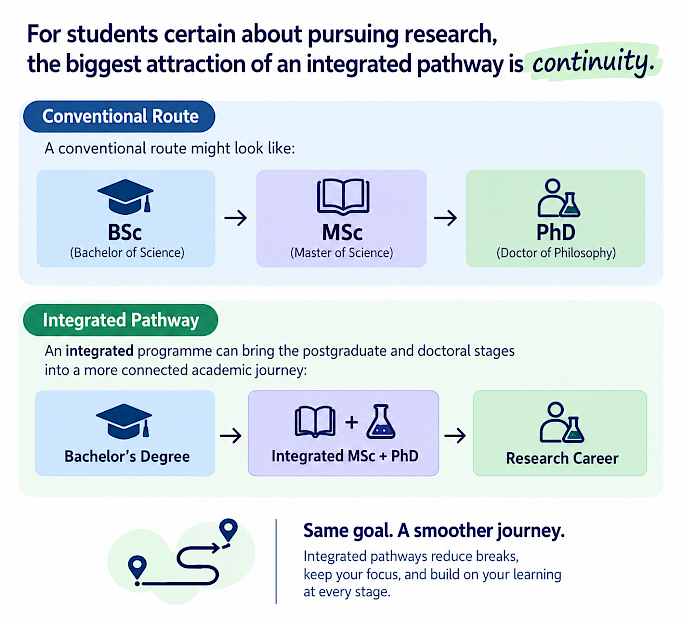
Note: Students should also keep in mind that choosing this course does not necessarily make the academic journey easier. A doctoral degree requires sustained commitment and students should be prepared to engage in independent research throughout the course duration.
How Long Do Integrated M.Sc. Ph.D. Courses Take?
The course duration of an Integrated M.Sc. Ph.D. is generally 6 years, although the exact duration varies by many factors such as research progress, academic requirements, and the discipline of students.
Some programs may also offer an M.Sc. (Research) exit option after students complete the required credits and research components. Therefore, students should check the university's program structure for the total duration, credit requirements, progression criteria, and exit options before applying.
Who Can Apply for Integrated M.Sc. Ph.D. Programs?
The eligibility criteria generally depend on the university, program, and subjects that have been taken by the student.
For the Integrated M.Sc. Ph.D. programs common eligibility requirements may include-
- A recognized UG degree in a relevant discipline with atleast 60% marks
- First division marks in class 10th and 12th
- Students with a 4 year of bechelor’s degree are also eligible for the program
- The selection process may also include a written examination followed by an interview
Note: Students should check the latest admission notification before applying rather than relying on a general eligibility rule.
Explore the Most Popular M.Sc. Ph.D. Programs
For students who are interested in choosing research as their career, the choice of discipline plays an important role in shaping the future of their academic journey. At Shiv Nadar University, the Integrated M.Sc. Ph.D. program is offered in the fields of Chemistry and Life Sciences.
1. Integrated M.Sc. Ph.D. in Chemistry
The Integrated M.Sc. Ph.D. in Chemistry program is designed to build a strong understanding of the core domains of chemistry. The curriculum covers organic, inorganic, physical, and analytical chemistry, providing a foundation that supports research in chemistry and related fields. It also follows a flexible, step-wise academic structure designed to develop subject knowledge as well as research and leadership skills.
2. Integrated M.Sc. Ph.D. in Life Sciences
The Integrated M.Sc. Ph.D. in Life Sciences follows an interdisciplinary approach to biological sciences, which combines foundational concepts with advanced learning. The program includes practical coursework, hands-on research, and faculty mentorship, helping students tackle complex biological challenges.
Both pathways provide a structured combination of advanced learning and research, but the scientific questions and skills developed differ according to the discipline.
Research and Career Scope After an Integrated M.Sc. Ph.D.
An Integrated M.Sc. Ph.D. course prepares students for professions where research and scientific thinking are involved along with knowledge about a particular field. The possibilities after this course mostly depend on the field opted by students along with their research interests. For fields like Life Sciences and Chemistry, possibilities can range from academia and industry to R&D.
Research Areas in Life Sciences
The field of Life Sciences gives students a broad area of choices through which they can specialize in many areas such as-
- Neuroscience
- Bioinformatics
- Cancer Biology and Immunology
- Virology and Cell Signaling
- Ecology and Evolutionary Biology
- Epigenetics and Gene Regulation
- Plant and Developmental Biology
- Protein Structure and Folding
- Regeneration Biology
- Vascular Development and Animal Behaviour
These areas can take students to research-based jobs in universities, research institutions, biotechnology firms, and other organizations related to life sciences. Research done in an interdisciplinary manner may also help students to study in areas like genomics, proteomics, bioinformatics, and drug discovery.
Research Areas in Chemistry
The field of chemistry provides scope for both applied and fundamental research. Students can explore many opportunities based on their interests and strengths such as-
- Organic & Synthetic Chemistry
- Materials & Environmental Chemistry
- Chemical & Biological Sciences
- Computational & Physical Chemistry
- Emerging Research
There are many more such specializations which offer pathways to R&D, the pharma sector, biotechnology, research, materials, which are based on industries and other science and technology driven domains.
From Advanced Learning to Research: The Shiv Nadar University (Institution of Eminence) Advantage
For students planning a future career in research, Shiv Nadar University offers a world-class environment with opportunities to explore Life Sciences and Chemistry through coursework, interdisciplinary collaboration, and practice-based learning. Given below are the key reasons to choose the university-
- Diverse Research Areas - Chemistry covers domains such as green chemistry, materials chemistry, chemical biology, catalysis, spectroscopy, medical chemistry, synthetic chemistry, and many more whereas Life Sciences includes virology, cancer biology, bioinformatics, immunology, protein biology, epigenetics, and neuroscience.
- Advanced Research Facilities - The research infrastructure of the institute offers specialized facilities for X-ray diffraction, EPR, FTIR, NMR, imaging, cell-based research, and genomics. These facilities support students’ interdisciplinary work and experiments.
- Interdisciplinary Exposure - Students approach scientific problems with new perspectives through research across disciplines such as data and computation, informatics, advanced materials, and translational research.
- Research & Teaching Assistantship - Admitted students to the Integrated M.Sc. Ph.D. are offered a research and teaching assistantship of ₹12,000 per month for 10 months during the first year of the program.
- A Research-Oriented Campus Environment - The University offers a campus environment that is designed to support academic and research work. Its 286-acre campus includes a Central Library with scientific and technical journals, research-oriented resources, dedicated health and wellness facilities, and spaces that support an active campus community.
The Integrated M.Sc. Ph.D. courses at Shiv Nadar University are supported by advanced academic learning, faculty-led research, and specialized facilities. The interdisciplinary approach will help students gain the necessary knowledge and research skills to further their academic/scientific careers.
Conclusion
Integrated M.Sc. Ph.D. courses offer a continuous pathway for students interested in research, advanced study, and academia. By combining PG learning with research and doctoral work, they help build specialized knowledge and independent research skills. Students should consider the curriculum, research areas, faculty, facilities, eligibility, and career opportunities before choosing a program that aligns with their long-term goals.
FAQs
1. Who is eligible for integrated M.Sc Ph.D. programs?
Eligibility varies by university and discipline. Generally, applicants need a relevant bachelor’s degree with the required marks, while some institutions may also specify subject requirements, entrance tests, or interviews.
2. How long does an integrated M.Sc. Ph.D. take to complete?
An Integrated M.Sc.-Ph.D. generally takes around six years, although the actual duration can vary depending on the discipline, academic progress, research requirements, and university regulations.
3. Do integrated M.Sc.-Ph.D. students receive a stipend or scholarship?
Some universities provide research or teaching assistantships, scholarships, or stipends to eligible students. The amount, duration, and eligibility conditions vary, so students should check the latest program or admission notification.
4. Can I switch to a regular M.Sc. or a separate Ph.D. if I join an integrated program?
This depends on the university's program rules. Some institutions may provide an M.Sc. (Research) exit option after completing specified academic and research requirements, while progression to the Ph.D. may depend on satisfactory academic performance and other criteria. Students should check the specific regulations before enrolling.
5. Can I pursue an integrated M.Sc. Ph.D. after a BSc?
Yes, some universities offer integrated M.Sc. Ph.D. programs for students with relevant bachelor's degrees. However, eligibility varies by institution, subject, marks, and admission requirements.