B.Sc. Mathematics Syllabus Decoded: What You Study Each Year and the Careers It Unlocks
Blog / May 18, 2026
If you think a B.Sc. Mathematics degree is just high school algebra with extra steps, you have already missed the point. The moment you step into a university mathematics program, the rules change. You stop asking “what is the answer” and start asking “how do we know this is true.” That cognitive shift (from computation to proof, from formula to framework) is precisely what makes mathematics graduates so extraordinarily valuable in 2026.
Understanding the B.Sc. Mathematics syllabus details is the first step to grasping why over 90% of modern mathematics now powers the engine rooms of the global AI and FinTech industries, which are collectively worth trillions of dollars. The algorithms behind your credit score, the models predicting market crashes, the encryption protecting your banking app—all of them trace their lineage directly back to a university mathematics syllabus. This blog lists the syllabus year by year, connects it to real career outcomes, and shows you the trajectories that go far beyond a blackboard.
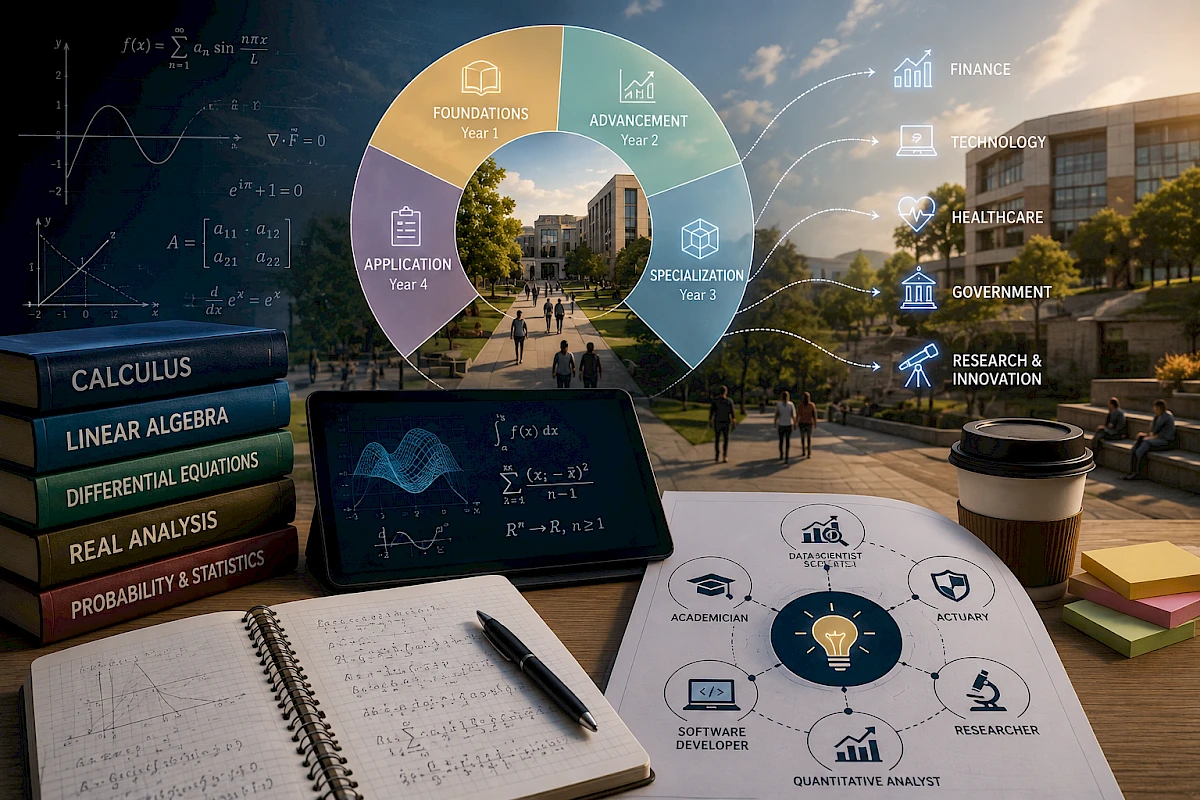
Year 1- B.Sc. Mathematics Syllabus Details: Moving From Calculation to Logic
The first year dismantles the assumption that university mathematics is a linear continuation of what you studied in Class 12th. It is not. High school mathematics trains you to solve problems by applying given formulas. University mathematics trains you to prove, which requires you to construct airtight logical arguments from first principles. This is not a harder version of what came before. It is an entirely different discipline.
In practical terms, Year 1 covers three foundational pillars-
- Calculus extended into multiple dimensions
- Linear Algebra as the language of data
- Analytical Geometry as the grammar of space
Each has a direct industrial analog that becomes clearer the deeper you go.
Core Subject | Key Concepts | Why It Matters for Careers |
Differential & Integral Calculus | Limits, continuity, multivariate functions, partial derivatives, gradient | Optimization in machine learning; backpropagation in neural networks |
Linear Algebra | Vector spaces, matrices, eigenvalues, linear transformations | Dimensionality reduction (PCA); recommendation systems; image processing |
Analytical Geometry | Conics, curves, coordinate geometry in 2D/3D, surfaces | Computer graphics; robotics path planning; geospatial analysis |
Differential Equations (Intro) | Ordinary differential equations, separable and linear types | Population modeling; circuit analysis; pharmacokinetic drug modeling |
Probability & Statistics (Intro) | Discrete distributions, Bayes' theorem, expectation | Risk quantification; A/B testing; financial forecasting |
By the end of Year 1, students have the mathematical vocabulary to engage with foundational roles in Data Analytics, Engineering Physics, and Quantitative Research. More importantly, they have trained their minds to think rigorously—a skill that no amount of vocational certification can replicate.
Year 2: The Shift Toward Mathematical Modeling
Year 2 is where mathematics becomes unmistakably alive. The introduction of Differential Equations at scale and Real Analysis as a formal framework transforms abstract theory into a toolkit for simulating reality. Where Year 1 taught you the language, Year 2 teaches you how to write with it.
Real Analysis, often cited as the most demanding course of the undergraduate journey, formalizes the intuitions that Calculus relied on. You prove why limits behave the way they do, why integrals converge, and why continuity is not the same as differentiability. For students heading into Quantitative Finance, this is non-negotiable groundwork—derivative pricing models rest on exactly these foundations.
Simultaneously, Year 2 introduces Numerical Methods and Computational Mathematics, bringing the following tools into the curriculum:
- MATLAB — used for numerical computation, matrix operations, and signal processing simulations
- Python (with NumPy/SciPy) — the dominant language for data science workflows, statistical modeling, and algorithm prototyping
- R — extensively used in actuarial science, biostatistics, and econometric research
- Mathematica / Wolfram Alpha — symbolic computation for pure mathematics problem solving and visualization
- LaTeX — the professional standard for mathematical typesetting, used in academic publications and research proposals worldwide
The career pathways that crystallize in Year 2 are Risk Management and Quantitative Finance. Actuarial professionals—who use probability theory and statistical modeling to price risk for insurance companies—command starting salaries of 7-10 LPA in India, making Actuarial Science one of the highest-entry salary tracks available directly from an undergraduate mathematics degree.
Year 3: Electives and the Specialization Frontier
Year 3 is where a B.Sc. Mathematics degree earns its true identity. The elective structure—typically spanning Pure Mathematics, Applied Mathematics, and Computational Mathematics tracks—asks students to make a defining choice: go deep into abstraction, or pivot toward application.
- The Pure Mathematics pathway typically covers Topology, Abstract Algebra (Groups, Rings, and Fields), and Number Theory. These are not ornamental subjects. Number Theory, for instance, is the backbone of modern cryptography. The RSA encryption algorithm, which secures virtually every HTTPS connection on the internet, is entirely derived from modular arithmetic and the properties of prime numbers—topics covered in a standard Number Theory elective.
- The Applied Mathematics pathway draws students into Fluid Dynamics, Numerical Analysis at an advanced level, and Mathematical Finance. Discrete Mathematics (Graph Theory, Combinatorics, and Logic) covering bridges both paths and has become indispensable in the era of network science, supply chain optimization, and blockchain technology.
The decision between Pure and Applied electives is not merely academic preference; it is a career-defining fork. Students who choose Topology and Abstract Algebra often go on to research fellowships, international PhDs, and roles in theoretical computer science. Those who choose Numerical Methods and Optimization find shorter runways into industry, landing in Operations Research, cybersecurity engineering, and quantitative trading within months of graduation.
Competitive Exams and the B.Sc. Mathematics Subjects That Power Them
The B.Sc. Mathematics syllabus is not just preparation for a job—it is also the foundation for India's most competitive postgraduate entrance pathways. Over 1.5 lakh students appear for the GATE exam in Mathematical Sciences each year, making it one of the most contested science streams in the country. The IIT JAM, CSIR-NET, and state-level entrance exams for research programs all draw directly from the Year 1-3 curriculum described above.
Students who understand their syllabus as more than a checklist of exam topics—who see Real Analysis as both a proof-based discipline and a quantitative finance prerequisite—consistently outperform peers who treat university mathematics as a subject to “pass.” The syllabus, approached strategically, is simultaneously a degree, a competitive exam preparation tool, and a career framework.
Career Options after B.Sc. Mathematics: Beyond Teaching and Banking
The stereotype that a mathematics graduate's only options are teaching or a desk job at a bank is not just outdated—it is demonstrably false. The following career tracks represent some of the fastest-growing and best-compensated opportunities available to B.Sc. Mathematics graduates in 2026.
- Data Scientist / Data Analyst- Data Science roles are growing at a 15% annual rate—one of the highest sector-growth rates in the Indian economy. A mathematics graduate with proficiency in Linear Algebra, Statistics, and Python is not only eligible for these roles but also architecturally prepared in a way that general engineering graduates often are not.
- Actuary- Actuarial professionals use probability models to calculate financial risk for insurance, pensions, and investment products. Starting salaries range from 7-10 LPA, with senior actuaries commanding well into the 30-40 LPA band. The Institute and Faculty of Actuaries (IFoA) examinations are directly aligned with university-level probability and statistics coursework.
- Cryptographer / Cybersecurity Analyst- With India's cybersecurity market projected to exceed $5 billion by 2027, cryptographers are in high demand across the defense, fintech, and enterprise software sectors. This role is built directly on Number Theory and Discrete Mathematics—Year 3 electives that most general science graduates never encounter.
- Operations Researcher- Operations Research applies mathematical optimization to logistics, supply chain management, healthcare resource allocation, and manufacturing. It is one of the most direct translations of Applied Mathematics into commercial value, with practitioners employed at firms like McKinsey, Amazon, and the Indian Railways.
Salary Benchmarks for B.Sc. Mathematics Graduates (India, 2026)
Career Track | Average Starting Salary (INR) | Top Employers |
Data Analyst | 6-9 LPA | Flipkart, TCS, Deloitte, Accenture, Mu Sigma |
Actuary | 7-10 LPA | LIC, HDFC Life, Bajaj Allianz, Mercer, Aon |
Cryptographer | 8-14 LPA | ISRO, DRDO, Infosys Security, Cisco, IBM |
Operations Researcher | 7-12 LPA | McKinsey, Amazon, HUL, Indian Railways, BCG |
B.Sc. (Research) in Mathematics at Shiv Nadar University (Institution of Eminence): Designed for Depth, Not Just Coverage
Not every B.Sc. Mathematics degree is built the same. The structural difference between a standard university program and a research-intensive curriculum determines not just what you learn, but what you become capable of doing at the frontier of the field. Shiv Nadar University's B.Sc. (Research) in Mathematics is designed precisely for students who intend to go beyond the syllabus, not just through it.
Four specific differentiators which set the program apart-
- Research and Thesis Component- Unlike a conventional B.Sc., this program embeds original research directly into the degree. You work with a faculty advisor to complete a thesis, building the kind of independent research capability that most undergraduates only encounter at the postgraduate level.
- Specialization in Mathematical Finance- If you are drawn to the intersection of mathematics and financial markets, this track prepares you for careers in banking, insurance, and institutional investment, where mathematical modeling directly drives risk and strategy decisions. The specialization also opens pathways into further research.
- Specialization in Applied Algebra- For students interested in the structural side of mathematics, this track covers topics with real-world applications in cryptography, coding theory, statistical design, and molecular modelling, areas where abstract algebra has quietly become essential.
- Flexibility to Add a Minor- While completing the Mathematics major, you can simultaneously pursue a Minor in another department. This lets you shape a degree that fits your career direction rather than staying confined to a single discipline.
Graduates from this program have gone on to higher studies and careers in mathematics, economics, and data analytics, with admissions to leading institutions in India and abroad.
In Summary
The B.Sc. Mathematics syllabus is not just a list of topics to memorize; it's a logical framework that top industries value and pay well for. Every year of the program builds a layer of that framework: Year 1 instills the rigor of proof, Year 2 connects theory to computation, and Year 3 opens the door to specialization in cryptography, research, or applied optimization. The syllabus is not a challenge to overcome; it's a tool for developing a problem-solving mindset that addresses issues others can’t even identify.
FAQs
1. Q. What is the syllabus of BSc Mathematics?
A. It spans 3 years — Year 1 covers Calculus, Linear Algebra, and Statistics; Year 2 adds Real Analysis and Computational Tools; Year 3 offers specializations in Cryptography, Topology, or Mathematical Finance.
2. Q. What are the subjects in BSc 1st year maths?
A. Differential & Integral Calculus, Linear Algebra, Analytical Geometry, introductory Differential Equations, and basic Probability & Statistics.
3. Q. Does BSc Maths have scope?
A. Yes. Data Science, Actuarial Science, Cryptography, and Operations Research are all directly open to BSc Mathematics graduates, and all are growing rapidly in India.
4. Q. What is the salary of BSc Maths?
A. 6-9 LPA for Data Analysts, 7-10 LPA for Actuaries, and 8-14 LPA for Cryptographers. Senior roles go well beyond 30 LPA.
5. Q. What are the top 5 math careers in India?
A.
- Data Scientist
- Actuary
- Cryptographer
- Operations Researcher
- Quantitative Finance Analyst