From Ph.D. in ECE to Patent Filing and Deep Tech Startups: A Realistic Roadmap
Blog / May 14, 2026
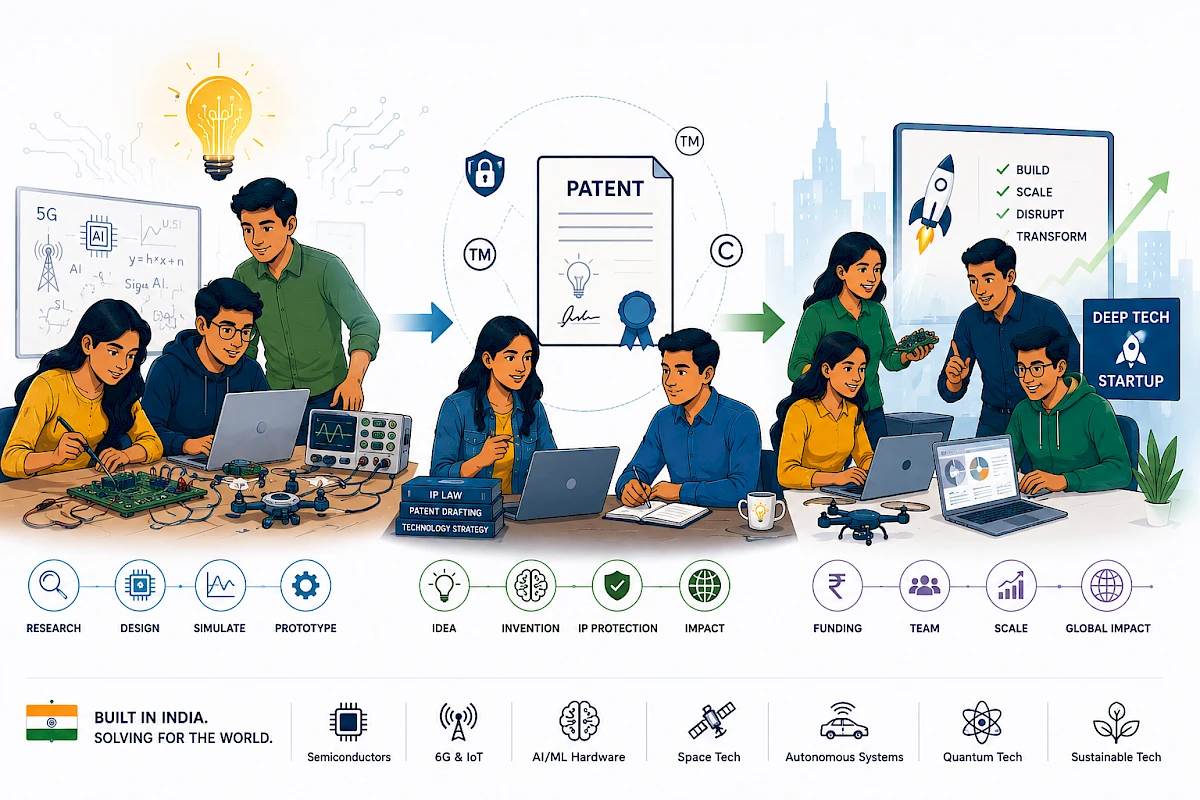
The domain of Electronics and Communication Engineering has evolved from circuit design to the cutting edge of Deep Tech. Pursuing a Ph.D. in ECE is no longer just a route to a professorship but the ultimate catapult for innovators, patent holders and entrepreneurs for disruptive startups.
The Global semiconductor market is poised to reach $1 trillion by 2030 and the rapid proliferation of 6G and AI-powered hardware ensures an all-time high demand for high-level researchers. This blog will act as a complete guide for all aspirants on pursuing a Ph.D. in Electronics and Communication Engineering, right from application to launch of a tech empire.
Understanding the Ph.D. in ECE: Eligibility and Admission Process
It takes more than just academic rigor to make a plunge into doctoral studies; it demands the will to solve unsolvable problems.
Ph.D. in ECE Eligibility
While specific requirements vary by institution, the standard Ph.D. in ECE eligibility usually includes:
- Educational Background- A Master’s degree (M.E./M.Tech) in ECE or allied fields (like Electrical Engineering, Telecommunications, or Instrumentation) with a minimum of 55% to 60% aggregate marks.
- Direct Ph.D.- Many premier institutes now allow exceptional candidates with a B.E./B.Tech. degree to apply directly for a Ph.D., provided they have a high CGPA (usually 8.0+) and a valid GATE score.
- Entrance Exams- Performance in national-level exams such as GATE, UGC-NET, or CSIR-NET is often a prerequisite for shortlisting.
Admission Process
The admission process is two-tiered. Post the initial screening based on academics and entrance score, one must clear the:
- Written Test- Covering the fundamental ECE domains like Signal Processing, VLSI, Embedded Systems, and Communication Theory.
- Technical Interview- The most critical round where the faculty assesses your fundamental clarity, research acumen, and intended research problem.
Duration and Scope of Ph.D. in Electronics and Communication Engineering
A Ph.D. is a marathon, not a sprint. The duration and scope of Ph.D. in Electronics and Communication Engineering reflect the depth of expertise one gains.
Duration
Typically, a Ph.D. in ECE takes 3 to 5 years to complete.
- Years 1-2: Coursework, literature review, and defining the research problem.
- Years 3-4: Core research, simulation, hardware prototyping, and publishing in peer-reviewed journals (IEEE, Elsevier, etc.).
- Year 5: Thesis writing and defense.
Scope and Career Trajectory
The scope of a Ph.D. in ECE is immense, particularly in the "Deep Tech" sector. Unlike general software startups, Deep Tech startups are built on tangible scientific discoveries or engineering innovations.
- R&D Labs- Giants like Intel, Qualcomm, Samsung, and NVIDIA hire Ph.D. graduates for their R&D divisions with starting packages often exceeding $100k-$150k (or ₹25–40 LPA in India).
- Intellectual Property (IP)-Patent filing becomes an important milestone in your Ph.D. research. In ECE-related domains like Telecommunications and Semiconductors, the IP has always played a pivotal role in the industry as seen by the international patent filing statistics.
- Entrepreneurship-Many Ph.D. graduates leverage their research to "spin off" startups solving specific hardware limitations (e.g. Development of novel GaN transistors, AI on chip architectures). This research often attracts Venture Capitalists.
Your Journey from Research to Patent Filing
A Ph.D. program equips you with time to work on research leading to the development of "Prior Art". In ECE, the filing of a patent for a novel algorithm or circuit design marks an important juncture. The IP can serve as a "moat" for your future startup and can prevent other entities from plaguing your idea. The data clearly shows that university research plays a crucial role in developing technology, especially hardware-related ones.
Explore the Deep Tech with Ph.D. in ECE at Shiv Nadar University (Institution of Eminence)
If you are seeking to find a balance between high-level research and practical implementation, then the Department of Electrical Engineering at Shiv Nadar University should be the apt choice for your research venture.
The Ph.D. program is designed for students who intend to lead the pack in technology innovation and given the specialization the Department offers, researchers have the opportunity to delve deep into domains such as:
- Advanced Communication Systems- Researching 5G/6G, Wireless Sensor Networks, and Optical Communications.
- VLSI and Nanotechnology- Focusing on semiconductor device modeling and chip design.
- Signal & Image Processing- Applying AI and Machine Learning to real-world biomedical and satellite data.
Key Highlights of the ECE Department:
- Interdisciplinary Approach- The curriculum encourages researchers to work across departments, integrating ECE with Computer Science or Material Science.
- World-Class Infrastructure- Access to high-end labs for simulation and hardware prototyping.
- Research Fellowships- The university offers competitive fellowships to full-time Ph.D. scholars, ensuring that financial constraints do not hinder the pursuit of innovation.
- Expert Faculty- Work alongside faculty members who are active contributors to international journals and have extensive industry-linked research projects.
The university’s focus on fostering an "Innovation Ecosystem" makes it an ideal choice for candidates who aim to see their research culminate in a patent or a commercial product.
Conclusion
A Ph.D in ECE is not only a higher education but a commitment to lead the future of technology. While the Ph.D. in ECE eligibility and admission process demands thorough preparation, the returns are unparalleled from a research and entrepreneurial perspective in the Deep Tech sector.
The right institute, like Shiv Nadar University, will not only ensure that you receive excellent education but will also allow you to innovate in fields that truly matter, helping you to mold your future into that of a visionary engineer building the future.
FAQs
- Is a Ph.D. in ECE worth it?
A. Yes, a Ph.D. in Electronics and Communication Engineering (ECE) is worth it for students aiming for careers in research, academia, semiconductor innovation, telecom, AI hardware, and deep-tech industries. - Q. What is the duration of a Ph.D. in ECE?
A. The duration of a Ph.D. in ECE is typically 3 to 6 years, depending on the research topic, institute guidelines, and mode of study. - Q. What is the scope after a Ph.D. in ECE?
A. Graduates can explore opportunities in R&D, teaching, semiconductor companies, telecom, embedded systems, robotics, AI, and startup innovation.