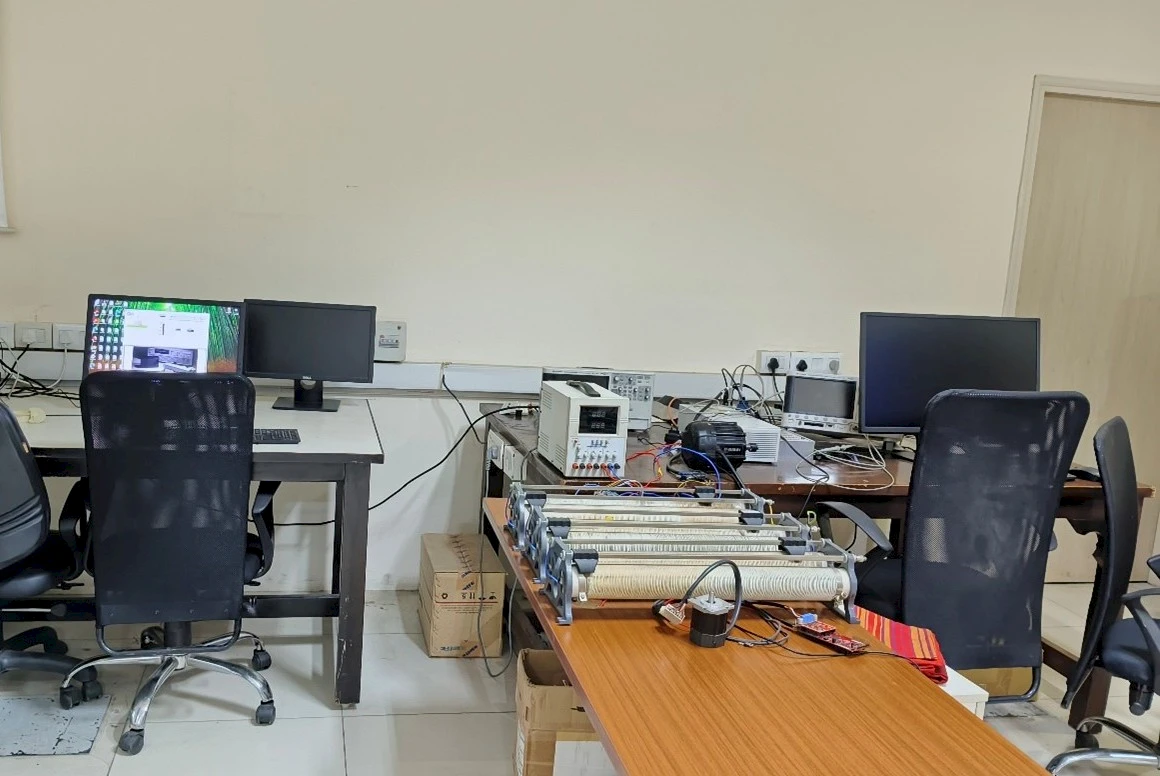
Energy Laboratory
Introduction
The Energy Laboratory is dedicated to research and training in renewable energy systems and electric mobility. It facilitates experimental work in solar power generation, electric vehicle (EV) charging, and wireless power transfer. Equipped with advanced hardware setups and real-time simulation tools, the lab enables students and researchers to test, control, and analyze energy systems under realistic operating conditions. It emphasizes hands-on learning and supports the practical application of theoretical concepts, bridging the gap between classroom instruction and real-world engineering challenges.
Mission
To provide a technical platform for the development, testing, and validation of systems related to solar energy, electric vehicles (EVs), and power conversion technologies, fostering innovation and practical skill development in sustainable energy solutions.
Vision
To bridge the gap between theoretical knowledge and practical skills, empowering students and researchers to address real-world challenges in modern energy systems, electric mobility, and power electronics through innovation and hands-on experience.
Focus
- Design and testing of solar power generation systems
- Development of EV charging infrastructure (AC/DC, fast charging)
- Wireless power transfer for EVs and portable devices
- Power electronics for efficient energy conversion and control
- Integration of solar energy with grid-connected and standalone systems
- Monitoring and analysis of energy flow using real-time tools
- Power enhancement of PV arrays under partial shading using advanced control and optimization techniques
Laboratory Facilities
The Energy Laboratory is equipped with modern tools to support testing, control, and analysis of energy systems. Major equipment includes:
- DC Power Supplies: Used to provide controlled power input for operating devices and circuits, including BLDC motor setups.
- Microcontroller – TI C2000 F28069: Used for real-time control of motor drivers, power converters, and EV systems.
- Solar Simulator – Chroma 62020H-150: Used to simulate solar panel output for PV system evaluation and MPPT testing.
- Battery – 48V/100Ah (48MLF100): Lithium-ion battery used for energy storage and EV charging/discharging studies.
- Resistive Load: Rheostats of various ratings for load testing.
- Electronic Load: Programmable load for performance testing under various operating conditions.
- Mixed Signal Oscilloscope – MSO64B 6-BW-1000: 1 GHz bandwidth oscilloscope for real-time signal analysis and debugging.
- Soldering Station: Precision equipment for assembling and repairing electronic circuits.
- Solar Panels: Used for photovoltaic system design, MPPT control, and renewable energy experiments.
- High-End Workstations: Advanced systems for real-time simulation, control algorithm development, and data analysis.
- Electronic Components: Diodes, MOSFETs, transistors, resistors, capacitors, inductors, ICs, and drivers.
Research and Innovation
The Energy Laboratory actively contributes to advanced research in solar energy systems, EV technologies, power electronics, and wireless power transfer. Faculty and students regularly publish their work in reputed international journals and conferences.
2025
- S. Tripathi et al., A novel cost effective reconfiguration scheme for consumers to mitigate power losses in TCT configured partially shaded PV array, Solar Energy, Vol. 295, 2025.
- K. K. Gautam et al., Size Optimized Load Independent CC–CV Wireless Charging System for EVs, IEEE JESTIE, 2025.
- A. Surjewala et al., Design and Performance Analysis of a Two-Switch Forward Converter, ICE 2025.
- A. Goswami et al., Design and Analysis of a Thyristor Based Three Point Automated Starter for DC Motor, ICE 2025.
- K. K. Gautam et al., Constant Frequency CC–CV Operation of LLC Resonant DC-DC Converter, IEEE TPEL, 2025.
2024
- D. C. Nautiyal et al., Maximum Power Estimation of a Partially Shaded PV String, IEEE PEDES 2024.
- H. S. Sahu et al., Maximizing Output Power of a PV Array, IEEE TENCON 2024.
- S. B. Santra et al., Reverse Conduction Loss Protection of GaN-HFET Converter, IEEE PEDES 2024.
- K. K. Gautam et al., Series-Series Compensation Topology for WPT, IEEE WPTCE 2024.
- K. K. Gautam et al., Variable Frequency CC–CV Charging for EVs, IFAC-PapersOnLine, 2024.
- D. C. Nautiyal et al., Parameter Estimation of Solar PV Module, IFAC-PapersOnLine, 2024.
2023
- S. Tripathi et al., Maximum Energy Harvest from TCT Connected PV Array, IEEE JESTPE, 2023.
- S. Tripathi et al., Novel MPP Estimation Technique for DDM PV Array, IEEE TSTE, 2023.
- K. K. Gautam et al., Inherent CCCV Charging of EVs Using LCL Converter, INOCON 2023.
2022
- S. Tripathi and H. S. Sahu, Z-Rearrangement Scheme for Partially Shaded PV Array, IEEE PEDES 2022.
2021
- H. S. Sahu et al., Direct MPP Estimation of PV Module, IEEE Transactions on Energy Conversion, 2021.
Academic Integration
The Energy Laboratory is closely integrated with the department’s academic curriculum and project-based learning. It supports both theoretical and practical aspects of courses while enabling students to gain real-world skills.
- Supports UG courses such as Photovoltaic Power Systems, Renewable Energy Systems, Power Electronics, and EV Technology
- Hands-on projects on MPPT techniques and converter control using TI C2000 microcontrollers
- Final year projects on EV charging systems, WPT, and isolated converter design
- Training in hardware prototyping and MATLAB/Simulink-based system simulation
Industry Collaboration
- Industry-Sponsored Labs: Partnerships under development for advanced equipment and joint research
- Internship Opportunities: Industry-linked internships and project-based learning for students
Lab Safety & Guidelines
Protocols
Comprehensive safety procedures ensure secure handling of electrical equipment and emergency preparedness.
Usage Policies
Users must follow equipment guidelines, report malfunctions, and maintain cleanliness in the laboratory.
Access Schedules
Lab access is limited to authorized personnel and managed through scheduled time slots.
Training
Mandatory safety induction sessions are conducted prior to lab access.
Contact
For any queries, please contact the Lab Coordinator. Details are available on the department notice board.
News & Events
Recent Updates
The laboratory has been upgraded with new equipment, including the Mixed Signal Oscilloscope MSO64B 6-BW-1000 with 1 GHz bandwidth.
Student Achievements
Krishan Kumar Gautam and Shivam Tripathi were awarded their Ph.D. degrees during the 2025 Convocation for their research in Wireless Power Transfer and Photovoltaic Systems respectively.
Upcoming Events
Guest lectures by industry experts are being planned to enhance practical insights and industry engagement.