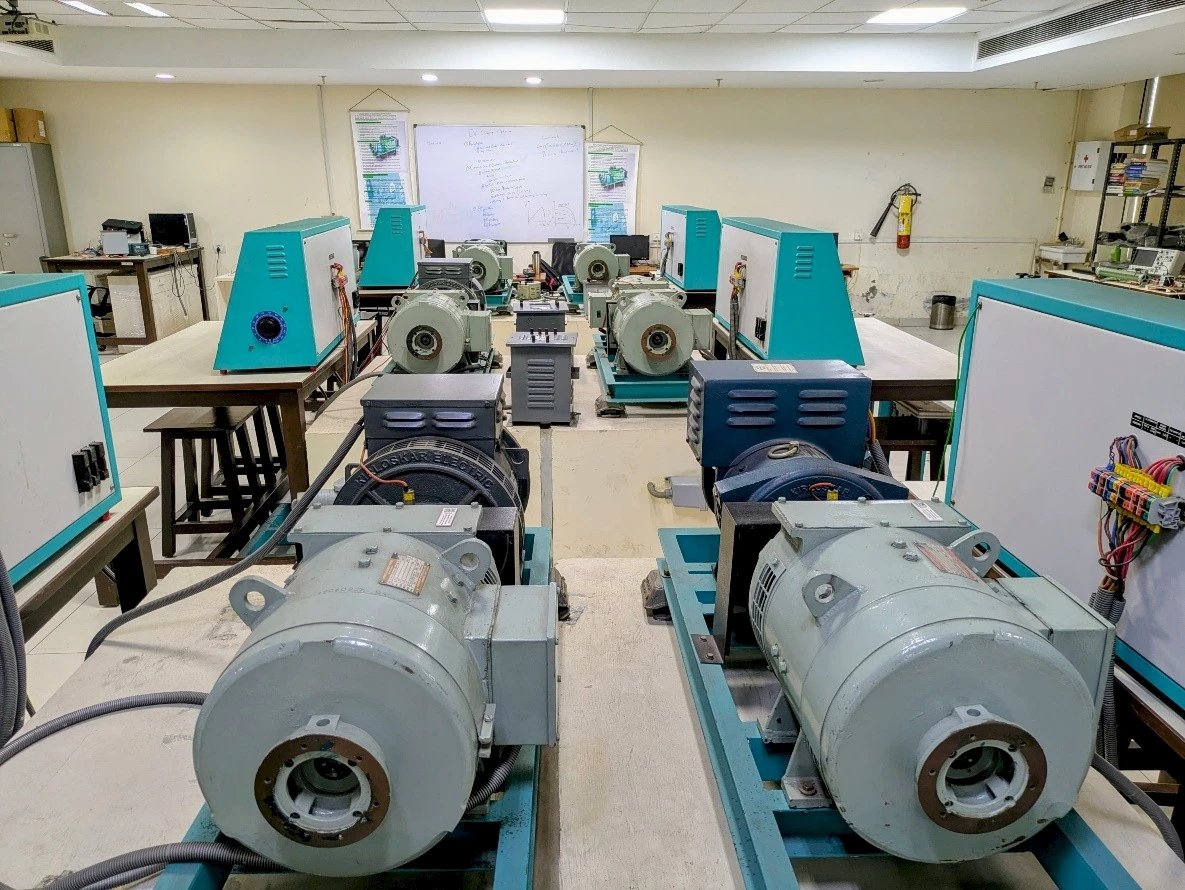
Electrical Machine Laboratory
Lab Overview
Introduction
The Electrical Machines laboratory is an essential component in the curriculum of the Electrical and Computer Engineering program. The laboratory provides students with a practical understanding of the operation, characteristics, and control of electrical machines used in industrial sectors, automobiles, and power stations.
Mission / Vision
The main purpose of the Electrical Machines laboratory is to equip students with the skills to analyze, operate, and control various electrical machines, thereby bridging the gap between theoretical concepts and real-world applications.
Focus
The laboratory primarily focuses on modern energy systems and electric vehicle (EV) technologies.
Laboratory Facilities
Key Equipments
The laboratory is equipped with the following electrical machines:
- AC Machines: Induction Motors, Synchronous Machines, Transformers
- DC Machines: Shunt Motor, Series Motor, Compound Motor
- Special Machines: Brushless DC Motor (BLDC), Switched Reluctance Motor (SRM)
Instrumentation
Students use various measuring instruments such as voltmeters, ammeters, wattmeters, oscilloscopes, and power analyzers to analyze the performance of electrical machines.
Software
MATLAB and ANSYS (Student Version) are used for modeling and simulation of electric machines.
Research and Innovation: Publications
- D. Barman, S. B. Santra and P. Pillay, "Analysis of Cogging Torque in a Series Hybrid Variable Flux Machine for EV Using Lumped Magnetic Circuit," IEEE Transactions on Power Electronics, vol. 40, no. 5, pp. 7423–7438, May 2025.
- K. K. Gautam, A. Chatterjee, S. B. Santra and D. Prasad, "Constant Frequency CC–CV Operation of Isolated LLC Resonant DC-DC Converter Using Switched Capacitor Network for WCS," IEEE Transactions on Power Electronics, vol. 40, no. 1, pp. 64–70, Jan. 2025.
- D. Barman, S. B. Santra, D. Chatterjee, R. Palisetty and P. Pillay, "Cogging Torque Computation in an Asymmetrical Interior Permanent Magnet Machine for Electric Vehicles," IEEE Journal of Emerging and Selected Topics in Industrial Electronics, 2024.
- M. Ramana, S. B. Santra, D. Chatterjee and Y. P. Siwakoti, "Sector Wise Modified Droop Control to Improve Voltage Regulation and Current Sharing in Parallel Boost Converter Interfaced DC Microgrid," IEEE Journal of Emerging and Selected Topics in Power Electronics, 2024.
- I. Kumar and A. Bakshi, "Effect of Empirical Constant of Ramberg-Osgood Relation on the Buckling Strength of Transformer Inner Winding," IEEE Transactions on Power Delivery, vol. 39, no. 2, pp. 1307–1309, April 2024.
- N. Marati et al., "IIR Filter-Based Compensator with Modified Feedback Repetitive Control Scheme of Voltage Source Inverter for Nonlinear Load Applications," Electrical Engineering, vol. 106, pp. 7181–7195, May 2024.
- I. Kumar and A. Bakshi, "Effects of Axial Sticks and Proof Stress of Conductor Material on the Buckling Strength of Transformer Inner Winding," IEEE Transactions on Power Delivery, vol. 37, no. 6, pp. 5465–5468, Dec. 2022.
- M. Kavitha, D. Prasad and P. B. Bobba, "Methods for Overcoming Misalignment Effects and Charging Control of a Dynamic Wireless Electric Vehicle Charging System," IET Electric Power Applications, vol. 13, pp. 1184–1192, June 2019.
- A. Bakshi, "Effect of Width of Axial Supporting Spacers on the Buckling Strength of Transformer Inner Winding," IEEE Transactions on Power Delivery, vol. 34, no. 6, pp. 2278–2280, Dec. 2019.
- N. Marati and D. Prasad, "A Modified Feedback Scheme Suitable for Repetitive Control of Inverter With Nonlinear Load," IEEE Transactions on Power Electronics, vol. 33, no. 3, pp. 2588–2600, March 2018.
- A. Bakshi, "An Investigation of Winding Curvature Effect on the Mechanical Strength of Transformer Windings," IEEE Transactions on Power Delivery, vol. 30, no. 4, pp. 1821–1826, Aug. 2015.
Academic Integration
Courses Supported
- Electric Machines and Power Systems (ECE201)
- Power Electronics & Machine Drives (ECE206)
Hands-On Learning
Being an undergraduate laboratory, students study the characteristics and operational aspects of transformers, induction machines, synchronous machines, DC machines, BLDC motors, switched reluctance motors, and PMSMs. Hands-on experiments on real machines help students gain practical experience and enhance technical skills.
Lab Safety & Guidelines
Protocols
Users must carefully read the equipment usage guidelines and follow standard operating procedures (SOPs) and emergency response protocols. Laboratory access is limited to authorized personnel.
Training
Mandatory safety induction sessions are conducted for all students and faculty members prior to lab usage.
Contact
For any queries, the lab coordinator should be contacted. Contact details are available on the laboratory notice board.
News & Events
Recent Updates
Irala Kumar has completed the Ph.D. degree. His thesis title is “Analysis of Buckling Strength of Inner Windings of Power Transformers under Short-Circuit Conditions.”
Upcoming Events
To be announced.
Photo Gallery
Coming soon.